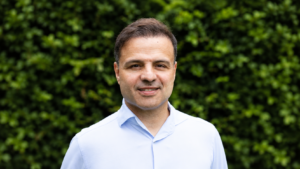

“Some startups pitch us, and it’s a terrible pitch, but I don’t just ignore those people,” observes Po Bronson, general partner at deep tech investor SOSV and managing director at IndieBio SF. “I can’t.
“I have to be patient, to listen, to wait, and ask, what did you say you do right there? You were kind of hiding it. Let’s ignore everything else and talk about your capability to do that and what we could do with it.
“A lot of our companies are not doing what they came to us to do [originally]. I have to hunt amongst the crumbs and find companies who no one’s going to invest in, but they are actually doing something amazing.”
And grim though the funding environment is, he says, companies that are performing are still getting funded, “despite everything. It’s not a broken system.”
Bronson (PB) joins AgFunderNews (AFN) to talk “non-rigorous thinking,” lower-capex biomanufacturing, AI in hen houses, next-gen fertilizer and why governments and corporates—not just venture funds—will shape the next wave of agrifood innovation.
AFN: Some people have become disillusioned about the venture funding model and agrifoodtech. How do you feel?
PB: Venture capital is a small portion of capital in the world, and only some companies are appropriate for venture funding. But there is an enormous amount of private capital out there. Largely, families and sovereign wealth funds are the long-term holders of all the real capital.
I tell every one of my startups, get out of VC world as fast as you can. It’s the most expensive capital in the world. It is extractive, but it’ll take the most risk. You put money in venture for alpha [above market returns], not for saving the world.
There’s nothing new about this [question about VC suitability for agrifoodtech]. What was new was a zero-interest-rate environment flooding venture with capital, which led to some non-rigorous thinking.
So what does it mean? I have found other sources of capital than just VC money for my startups. It was not easy. It’s hard because people are careful with their private capital. So finding other non-VC money is critical to continue to succeed in this market.
AFN: What other sources of money are you talking about?
PB: I’m just talking about private wealth. It’s not complicated. VC funds have LPs, so where do they get their money, and who are they? If you went straight after, essentially, the long-term holders of capital, you’re looking at people who, maybe they put money in VC funds, maybe they don’t.
What makes it hard is there’s no pattern to it. There’s no easy way to find them. It’s very ad hoc, and it’s a lot of hard work. But they are looking for what all capital is looking for: revenues, margins, and customer traction.
AFN: Define “traction” for a pre-revenue startup?
PB: One way or another, you’ve got to find customers showing strong interest. It may not be booked revenue, for sure, and it’s rarely realized revenue, but investors will want to talk to these [potential] customers to get any sort of a seed round together.
AFN: Is this the worst time to raise a VC fund?
PB: VCs are not deploying capital because they have a portfolio and they want to use their capital to support their existing portfolio. They may not be doing new investments. We need to look for people who actually deploy on capital.
AFN: You’ve talked about only investing in “low capex companies that can get to market in two years.” How does that relate to biomanufacturing?
PB: Precision fermentation is being done in half-a-billion-dollar factories. No startup can seemingly get the offtake agreements for long term demand to get really good contracts with CDMOs and they can’t fund the capex [to build capacity] themselves, so they’re stuck.
If instead you can grow an organism that lives around microbes all the time and has the ability to fend off other microbes or out-compete them so you don’t get contamination, you don’t have to spend all that capex [on biopharma-like fermentation facilities]. Can you do it [grow the microbes] in a raceway or an open-air greenhouse or plastic bags at a fraction of the cost?
AFN: Where does plant cell culture fit into this framework?
PB: You can grow [plant cells] in essentially plastic that’s multi-use or single use. Typical bioreactor size is only 1,000 liters. All of my plant cell companies will have fabulous [unit] economics, is the plan; but they’re only at a certain scale, and still have to demonstrate that they can de-risk lots of things.
In all cases they have their own bespoke bioreactor designs, but it’s not critical that you use those. They’re essentially selling factories, like you want to buy a factory, we will make bioreactors for you, we’ll make cell lines for you, we’ll teach you to do it. We’ll have a JV and a royalty structure.
AFN: In biomanufacturing, are you also looking at companies with enabling tech for biomanufacturing?
PB: We funded Fermeate, which is using optogenetics [using light to control microbial cell metabolisms] and we had funded Prolific Machines before [which uses light sensitive proteins in mammalian cells].
AFN: What are some exciting applications of AI in agrifoodtech in your portfolio?
PB: Avalo is using AI to create better crops, NotCo is working with all manner of CPGs to reformulate their products, FloVision is also in a very good position [using AI to help food processors measure yield, monitor quality, and improve labor performance in real time] and Calyx is using AI in hen houses to help you predict weight ahead of time to help planning.
AFN: How do you determine what’s defensible in the AI space vs something big firms could probably do in-house?
PB: People like Ernst & Young and McKinsey are going to every corporation and saying, hey, we’ll build an AI on all your data, so that’s not generally what we would invest in. I’m talking about systems that go get new data that is valuable to your overall system. FloVision measures things that its customers could not measure before and the ROI has been insane.
AFN: What areas in agrifood really interest you right now?
PB: Certainly in VC, there’s been a history of a sector gets hot [and everyone jumps in] but I do not see a sector where a bunch of companies are going to go public and succeed. So I invest in winning companies, not sectors. One example is Farm Minerals, which can vastly undercut existing fertilizer prices, and it’s emissions free. One pellet can cover an entire hectare. It’s radical.
Last September we also led the round for California Organic [which invented a bioprocess to convert biowaste from farms and processors into organic certified ammonia products]. The organic sector has only ever had nitrates as fertilizers. This is the first and only one certified by the state of California to be an organic ammonia fertilizer, and the company has an 80% margin.
AFN: What role do you see for corporates in the agrifoodtech investment ecosystem?
PB: They are playing a bigger role and I love it. I love to have multiple corporates in a round and for them to have partnerships with our companies. I’m a little different than other investors in this sense. In my mind, corporates are often more committed than strategic financial investors are because they’re betting on this as the future of their company.
Corporates are slow and when they write a check, they think their job is done. But the thing that’s great about them is that they know every test a potential product is going to go through, and they can run products through all the battery of tests. It’s a good time to be a co-investor with corporates, because rounds are not at FOMO valuation levels anymore.
AFN: What role do you see for governments in the agrifoodtech investment ecosystem?
PB: We established the Ireland Biomanufacturing Fund and the national treasury of Ireland is an LP in the fund.
Ireland has the fourth highest GDP [per capita] in the world. Today, they have 23 large biopharma plants, and they’re the world’s third largest exporter of drugs. It took 25, 30 years, but they did it because they didn’t quit. They also saw that big tech needed a presence in Europe and they recruited big tech, and they are the big European landing ground.
They’ve built biopharma really successfully, and now they want to go after biomanufacturing as they see that as another potential future anchor of their economy.
AFN: If agrifood companies won’t commit to long-term offtake agreements, can governments play a role?
PB: [You often hear that] what companies need are long term offtake agreements [from potential customers]. But who does long term offtakes in food? There’s no culture of that. You’ve just got to keep succeeding. They’re not guaranteeing shit.
So [in this environment] there is a significant opportunity for essentially the equivalent of reinsurance or the equivalent of when a government agency co-signs a lease for a nonprofit. You don’t really use all the capital, but it’s available because you’re playing the role of a guarantor.
That kind of model is very helpful because it could help food companies actually get into long term offtakes, because they don’t do them. I have [portfolio] companies that are doing really well and they don’t have any guaranteed offtake agreements. So I think it takes a different financial structure; it’s not just about more VC money being thrown out.
AFN: Name some of your pet peeves as an investor…
PB: It’s the title of the next book that Arvind [Gupta, venture advisor at SOSV who led the team that founded IndieBio in 2015] and I are writing. It’s called “Weapons of mass dilution.” So once a company is really doing great and it looks like a winner, people will offer them lots of big checks and drive the valuations up and dilute them and us early investors. we do keep investing in our companies through Series B, but at a certain point we just can’t.
I’m trying to make sure our companies earn their valuations and show that in revenues and not get ahead of their skis, because if they do, it’s very punishing.
AFN: Are good companies still able to raise money now?
PB: If companies are performing, they are getting funded in this market, despite everything. I had lot of deal activity last year. This year is not as great overall, but I still have a lot of activity and good companies are getting funded. It’s not a broken system.
AFN: I guess what I’m hearing is stop whining?
PB: A lot of companies have been recapped [recapitalized via down rounds, restructuring etc]. And it’s not about the valuation. It’s that they don’t have the revenue to make it super clear that they have product market fit. A bunch of customers want to try it, but are they going to durably order your product?
Further reading:
Rockstart’s Mark Durno on agrifoodtech’s next chapter: ‘Quality deals with defensible valuations’
🎥 Matt Crisp on agtech investing: ‘We need to get small in order to get big again’
Where Siddhi Capital is placing its bets: ‘GLP-1 is our AI. It’s a huge opportunity’
Rich Products Ventures MD: ‘We have to get results, but we don’t have to answer to Wall Street’

Sign up for our weekly newsletter.