When the music stopped and the spigot of money pouring into the agrifoodtech sector started to run dry in early 2022, the segment was left with “far fewer chairs than players,” observes Astanor cofounder and managing partner Eric Archambeau.
Fast forward to 2025, and the mood is more sober, he says. Some investors have drifted into adjacent areas, while others have retreated altogether. However, for Astanor, which closed its second venture fund at €360 million ($419 million) in late 2023, there is “no repositioning and no retreat,” he says.
“It annoys me when people say ‘That will never work.’ I remember John Doerr [at Kleiner Perkins] saying in the 1990s that the internet is ‘under hyped’ and people laughed at him because things cratered [during the dotcom collapse]. But then a few years later, you have the rise of Amazon and Google and Meta. He was totally right, but we had to go through that [interim] period [of disillusionment].”
AgFunderNews (AFN) caught up with Archambeau (EA) to ask where does agrifoodtech stand today? Has the ‘green premium’ evaporated? And when might we see some exits?
AFN: How has the agrifoodtech investment landscape evolved since Astanor started placing bets in this sector?
EA: Until 2021 there was quite a lot of euphoria. It was really venture capital looking at a white space that was one of the least tech-enabled sectors in the world and thinking it could apply the same type of formula as to software.
The reality is in agrifood you need to grow things, deal with regulatory barriers, and a lot of inertia in the system. And quite frankly, some of the early products were not as good as people thought they were, so there was some pushback. 2021 arrived and most of these companies were not profitable, they still needed a lot of CapEx, and there were not enough chairs when the music stopped. And in this case, it wasn’t just one chair missing, but many chairs missing.
And so everyone in our sector started to focus on a few [of the most promising] companies and said that if they could get to cost parity with the unsustainable solutions in the large sense of the word, they would eventually be worth something. And that’s what everyone has been doing between 2022 and 2025.
And this first cohort of companies are getting there, which is great, but it’s not enough to justify an entire industry of venture capital. So you have to think whether there’s still a venture thesis in our sector, and whether there’s something else than venture to be done. But the two are not incompatible.
AFN: How has this informed your approach?
EA: Today, we’re trying to be a bit more robust. There’s a difference between robustness and resilience. Resilience is where you basically come back from difficulties or repeat difficulties. Robustness means you place your bets in a way that you can have multiple different strategies, or your portfolio is such that you can have a few failures or companies that take forever to develop, and others that go faster. You need to have a mix.
But it’s not that we are being more ‘judicious’ than we were before. You’re always judicious when you are making investments. At any point, you are making decisions based on what you know at the time, and if the interest rate is zero, you may make a decision that is different to one you’d make if the interest rate is 20%.
Many investors have changed their investment thesis and decided to enlarge [their aperture beyond agrifood] into energy efficiency or things like that, while some of them totally abandoned [the sector].
There is no repositioning, no retreat from this [agrifoodtech] sector on our part, but we continue to invest in early-stage companies, with the resources to support them over the long term, while also expanding into later-stage growth opportunities.
AFN: Some people have become disillusioned about venture and agrifoodtech. How do you feel?
EA: It annoys me when people say ‘That will never work.’ I remember John Doerr saying in the 1990s that the internet is ‘under hyped’, and then people laughed at him because things cratered [during the dotcom collapse]. But then a few years later, you have the rise of Amazon and Google and Meta. So he was totally right, but we had to go through that [interim] period [of disillusionment].
It’s the same with renewable energy. People made a little bit of money for a while, then everything cratered, and now you have quite a lot of super successful companies in that space.
So is that going to be the same [for agrifoodtech]? We believe so. We went through the early hype with companies that probably didn’t deserve to have [a huge] valuation. And now we have a new cohort of companies that are either coming back from a very difficult time and becoming much stronger because of it, and then other companies that didn’t go through the hype that are coming through.
AFN: When might we emerge from the trough of disillusionment?
EA: Many sectors have been suffering from a lack of exits and liquidity, and we [as a sector] are definitely at the bottom of the pile in terms of liquidity events. But a large number of the companies that we have invested in or that have come back to see us are inching towards profitability; they found their product market fit.
So I think we’ll start seeing some exits, but the exits are not going to be back on the same type of crazy valuations of 2021.
AFN: Is the notion of a ‘green premium’ attached to products from agrifoodtech firms dead now?
Astanor partner Leslie Kapin: You cannot expect regulation or sustainability to drive demand for your product. You have to be at cost parity with the same or better characteristics in terms of product quality or taste. Sustainability is the cherry on the top of the cake. At some point, regulations could work in your favor, but we’re not making investments based on regulations.
That said, it [a potential investment for Astanor] has to be sustainably-driven, and we spend a lot of time assessing [startups’] environmental and social footprint and putting a monetary value next to it.
AFN: What agrifoodtech areas are you most excited about?
EA: We’ve started looking into areas such as metabolic health and prevention, aging, food is medicine and so on, because it goes into eventually reducing the healthcare cost that society is bearing today. So we’re doing quite a lot of deals of that type in the US at the really early stage, especially in the biotech space.
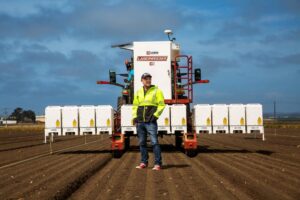
We’re also looking at data, AI, robotics and automation for the farm and for factories, so we just invested in [automated mushroom harvesting startup] 4AG Robotics for example. We have made investments in [AI-powered computer vision platform] Robovision and [autonomous tractor co] Monarch Tractor.
And then we have hired a team to do more growth equity investment. We are not going to compete with KKR and the big guys, but we are going after tech-enabled companies in the agrifood space which are already profitable.
AFN: Astanor invested in Ÿnsect, which has struggled… how do you view insect ag now?
EA: Ÿnsect did struggle a lot in part because it was first of a kind, and so [when you are a pioneer in a given space] you cannot really draw from anyone else’s experience. But it’s not dead yet and we may actually do something interesting because with all the learnings, the cost of production has gone down by 70% in the past year.
When these [pioneers in the insect ag space] started, they made assumptions about the cost of energy, about the biology of these animals and the temperatures needed to get optimal growth and so on, but it’s not a linear thing [scaling insect ag], as you discover when you put billions of insects into a single building…
It’s also different for mealworms versus black soldier flies, so you cannot even [apply learnings from one species to another]. It’s like raising horses on the one hand and raising cows on the other. They are completely different.
AFN: Astanor also invested in CEA cos such as InFarm and Smallhold… how do you view that sector now?
EA: People went way too far on the automation front. What we need are intelligent greenhouses, which are halfway between the old greenhouses that are not efficient, and the super high-tech vertical farms.
So yes, there are lots of lessons learned. We’re not going to invest in the same thing we saw before, but it could be the same sector or some sub-segment, because we would be able to identify better today [the pitfalls and opportunities].
AFN: You haven’t invested in cultivated meat. Do you feel like you dodged a bullet?
EA: We looked at it a lot, but we decided not to do it and I think we were right. But eventually this is going to work if you can get the right price point and the right application.
AFN: How do you see the precision fermentation space?
EA: It all comes down to the cost of production, the cost of feed, the cost of energy. In the case of [portfolio company] Standing Ovation [which makes casein proteins via precision fermentation] they are very lucky, because the microbe they are using can feed on a particular waste stream that, contrary to all the sugars people are using, has no value… it’s actually difficult to get rid of it. So that gives them an edge in terms of cost of production.
AFN: What applications of AI in the food space are exciting and how do you assess them?
EA: Quite a few of my former teammates, people that I hired in my companies, ended up being top guys in companies such as Meta and OpenAI and so on, so I have a pretty good network that we as a firm have been leveraging. Some of them are old generation, like Louis Monier, who was the founder of AltaVista and worked at Google [and is now AI fellow at BrightAI].
But AI is really all about data, and predictive models without the data don’t have much use.
I’d say [we’re entering the] golden age of robotics in industry in general and in agrifood in particular because of the cost of labor and the need to be more precise, and that relies on data.
AFN: The term ‘food is medicine’ is constantly bandied around these days. What does it mean to you?
EA: I used to think, naively, that if you provide education to people, they will change their diet. But if you tell someone that’s 20 that if you continue [your current eating habits] you’re going to die at 40, they will be pretty afraid for 10 seconds, and then they say, Maybe I’ll do something in 18 years.
So can we find a way to [provide foods that] are not more expensive, which still provide happiness and joy, and do not come at the expense of the earth?
For example, we have invested in a company called Zya that has developed an enzyme that transforms part of the sugar you are eating into fiber. It’s a double whammy, because you have less sugar and more fiber. We have also invested in a company called Holobiome that is mapping the microbiome.
At the growth stage, we are seeing a lot of appetite in the nutraceutical space, which is more mature.
AFN: How hard is it for startups to secure non-dilutive funding at the moment?
Astanor partner Leslie Kapin: That’s the beauty of Europe versus the US today. Europe has understood that it has a role to play, the edge it can bring by having a pool of money available for these technologies.
If you see all the programs we’ve seen from the EIB [European Investment Bank] and others, actually Europe is trying to find many ways to make private markets more efficient so it can become much more competitive versus the US, not only in terms of financing this tech, but just as an investment region.
Further reading:
Where Siddhi Capital is placing its bets: ‘GLP-1 is our AI. It’s a huge opportunity’
Rich Products Ventures MD: ‘We have to get results, but we don’t have to answer to Wall Street’