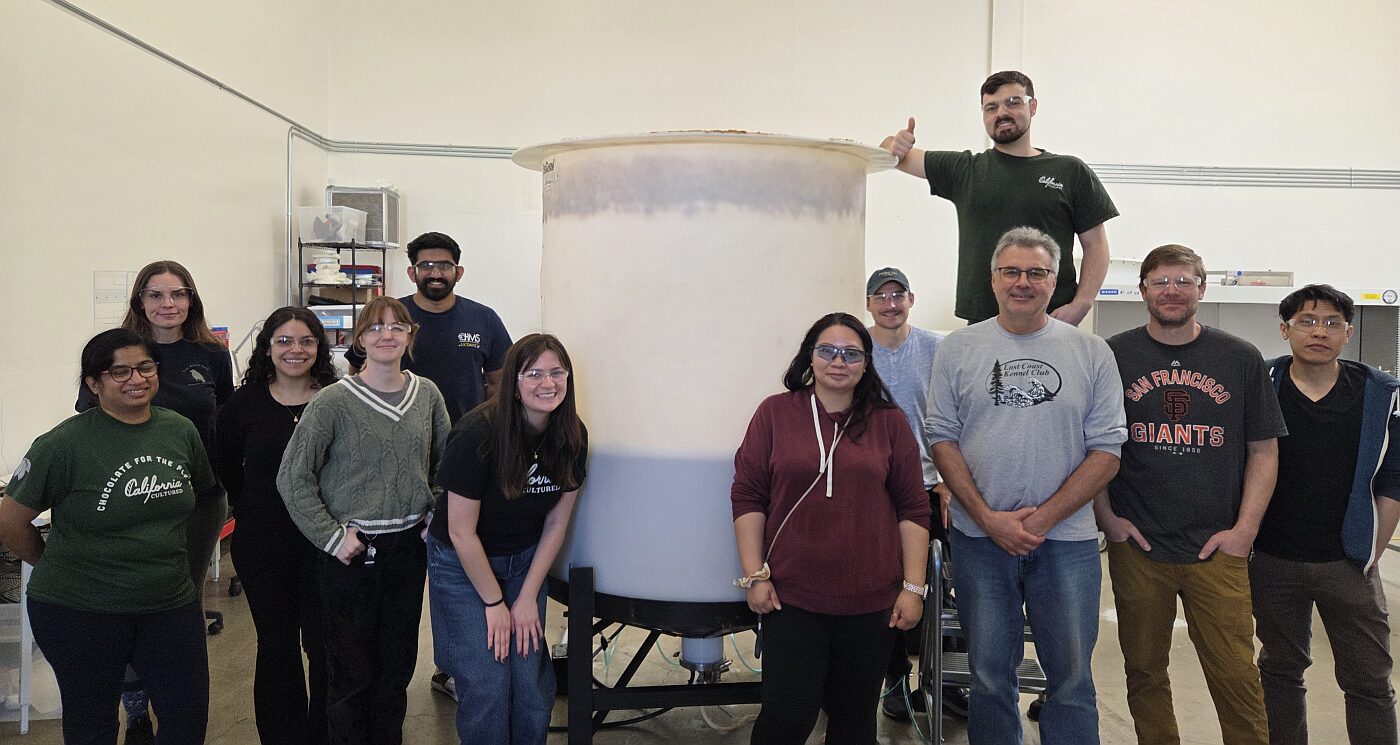
California Cultured—a startup growing flavanol-rich cocoa via plant cell culture—has completed its first successful production run in a re-usable 2,000-L custom-built plastic bioreactor that it claims could transform the economics of the approach by slashing capital and operating costs.
“When people see the production costs and the product quality later this year it will shift the conversation about what plant cell culture can realistically achieve,” Steve Stearns, head of strategy and business development, told AgFunderNews.
“Once products begin appearing on the market later this year people will start to see how efficient plant cell culture can be for ingredients like cocoa. The industry has spent years focused on proteins. Cocoa and similar high demand plant compounds may turn out to be an even better fit for this type of production.”
Scaling out, not up
Typically, firms growing plant cells in culture have used stainless steel fermentation tanks—which come with a hefty price tag and high operating costs—or single-use plastic bags, which are unsuitable for large-scale production, said Stearns.
California Cultured instead deploys proprietary rigid plastic bioreactors that can be re-used thousands of times before needing to be replaced.
“The systems are designed for continuous operation with a proprietary steam sterilization approach that keeps cleaning straightforward and significantly reduces labor inputs, which is one of the big cost advantages in our system.”
The successful run at 2,000-L is a key milestone “because it represents a true production scale system, not a lab demonstration,” said Stearns, who says bakery ingredients and chocolate giant Puratos will launch b2b products featuring its flavanol-rich cocoa later this year.
California Cultured has also struck an offtake deal with Japan’s largest chocolate company Meiji and says the two are “exploring a range of chocolate and chocolate-like products” incorporating California Cultured ingredients.
Notably, 2,000-liter vessels will be used for commercial production and are not an intermediate solution, explained Stearns. “One of the core ideas behind our manufacturing model is that instead of building extremely large centralized stainless steel plants, we scale out with many affordable reactors.
“These units cost us about $3k to build. For comparison, a new 2,000-liter stainless steel bioreactor can cost between $0.5-1 million for one reactor. Because our systems are inexpensive and modular, they can be deployed in relatively simple food-grade spaces. Even retrofitted office or light industrial space works well.
“That keeps capital requirements low and makes it possible to reach competitive commodity pricing with far less upfront investment.”
Lower CapEx and OpEx
While some commentators assume the firm’s economics “look like traditional biopharma stainless steel fermentation,” and conclude the math doesn’t add up, “Our approach changes the equation by lowering both capital cost and operating cost,” claimed Stearns.
“The reactors themselves are inexpensive, but the bigger advantage is the automated control systems we have built around them. The smart controller layer allows us to run large numbers of reactors with very little labor.”
California Cultured’s differentiation is three-pronged, he said.
- Cell lines “selected for traits that matter for chocolate such as fat production, flavor precursors, and flavanol content.”
- Reactor architecture that keeps capital cost extremely low.
- Automation and control software that lets the system run efficiently with minimal labor.
When those pieces come together you get a production platform that looks very different from traditional biomanufacturing, said Stearns. “There are others are working on similar technology following in our footstep. This is a good validation of our technology, which is why we are securing important patents along the way.”
Chocolate’s supply crunch
While cocoa prices have recently dropped from record highs in 2024 after poor harvests and disease outbreaks in West Africa squeezed global supplies, the long-term trajectory is clear, said Stearns.
“Chocolate is heading toward a supply crunch. Cocoa demand continues to rise while yields in major growing regions are increasingly unstable due to disease, climate pressure, and aging farms.
“What we are demonstrating is that cocoa does not have to be constrained by those agricultural limits. If cocoa cells can be grown efficiently in bioreactors at scale, you unlock a completely new supply chain for chocolate ingredients that is stable, local, and far less resource intensive.”
California Cultured’s products are self-affirmed GRAS in the US, says the firm, which has just submitted a GRAS notice to the FDA.
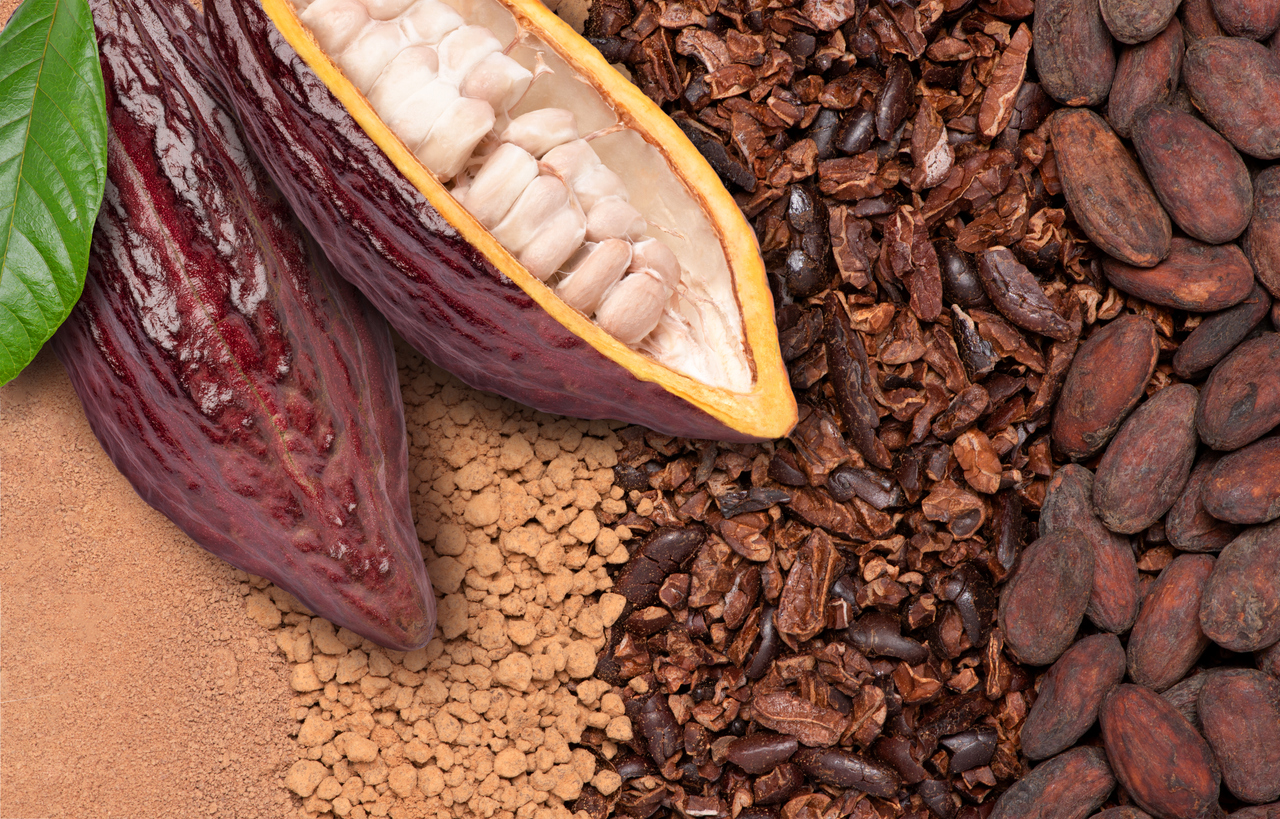
In traditional cocoa production, cocoa beans are fermented and roasted. For California Cultured’s first product, labeled “cultured cocoa powder,” there is minimal handling to preserve flavanol levels, said Stearns. “Just drying with zero lead and cadmium.”
This would be used at low inclusion rates as a health ingredient rather than a bulk replacement for cocoa, he said: “It is a hybrid product intended to boost flavanol levels of chocolate products and increase the health aspect of chocolate and cocoa products with lower heavy metals.”
What is plant cell culture?
Rather than using sunlight, water, and soil to nurture fully-grown plants, plant cell culture companies grow plant cells in bioreactors in conditions optimized for the rapid production of high-value compounds and secondary metabolites.
Plant cell culture technology is already used on a commercial scale to produce a handful of drugs, notably breast cancer drug Taxol, but has recently attracted interest in the nutraceuticals space as botanical supply chains become increasingly threatened.
In the cocoa space, players include California Cultured, Food Brewer (working with Lindt & Sprüngli), Kokomodo/Pluri (working with Cargill), and Celleste Bio (working with Mondelez International).
Advocates say it offers some key advantages over conventional agriculture:
👉 First, they say, plant cell culture can ensure a consistent supply of botanicals with supply chains increasingly threatened by climate change and unpredictable weather, political instability, adulteration, disease, and heavy metals and pesticides from soil.
👉 Second, they claim, it offers the promise of rapid, consistent, and controlled production of plant compounds regardless of season or location in a sterile environment, with no pesticides.
👉 Third, there’s a sustainability argument: Why use all that agricultural land, water and energy to nurture fully-grown plants when you’re only interested in one small part of the plant?
👉 Finally, they argue, it can also deliver higher yields. For example, by understanding the metabolic pathways in plants that produce certain polyphenols and the precise conditions that drive plants to generate more of them, skilled players in plant cell culture can achieve concentrations of bioactives that far exceed those produced by plants grown in the wild or via traditional agriculture.
Watch our interview with California Cultured CEO Alan Perlstein at the 2025 SynBioBeta conference in San Jose last year: