
Dan Blaustein-Rejto is director of food and agriculture at the Breakthrough Institute, an environmental research organization based in Oakland, US.
The views expressed in this guest article are the author’s own and do not necessarily represent those of AgFunderNews.
Since the International Agency for Research on Cancer classified glyphosate as “probably carcinogenic” in 2015, Bayer has faced more than 100,000 lawsuits claiming that Roundup should have carried a cancer warning. Most major pesticide regulators around the world, including the EPA, have concluded glyphosate is unlikely to cause cancer when used as directed. But some juries have sided with plaintiffs, and Bayer has already paid roughly $11 billion to settle Roundup claims.
Those lawsuits came to a head this week in the Supreme Court and Congress, which have considered whether EPA-approved pesticide labels should set one national standard, or whether states and juries can require additional warnings. Reasonable people can disagree about where that line should be drawn, but many of the implications for farmers are clear. Bayer says continued failure-to-warn liability could threaten its ability to keep supplying glyphosate-based products to US farmers. In fact, the company has already replaced glyphosate in residential Roundup products to reduce litigation risk.
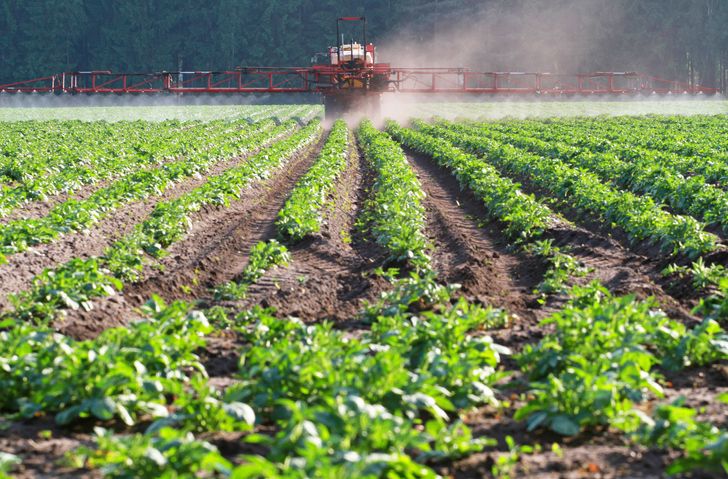
That possibility should worry anyone who cares about making agriculture more sustainable. Glyphosate may not be harmless, and farmers should not depend on it indefinitely. But it is one of the most effective, inexpensive, and low-impact herbicides available. Pushing farmers away from it before better tools are ready would not make farming safer or more environmentally friendly. It would likely mean more tillage and more use of other herbicides.
The path beyond glyphosate should run through better weed-control technology, not abrupt restriction or removal from the market. Precision sprayers, AI-powered weeders, alternative chemistries, biologicals, and other innovations can all reduce dependence on glyphosate. But they need to outperform it on cost-effectiveness, toxicity, and environmental sustainability.
Glyphosate is less toxic than currently available alternatives
Glyphosate became the most widely used herbicide because it is inexpensive and effective, especially when used in combination with genetically modified glyphosate-tolerant crops. Most corn, soybean, and cotton farmers use it to control weeds before planting, after harvest, and after crops emerge, which is only possible with the glyphosate-tolerant varieties as spraying would otherwise risk damaging the crop.
But it is also used in other crops like wheat to control weeds before planting and before harvest to control late-season weeds and help the crop dry more evenly.
Fortunately, given its popularity, glyphosate has a relatively low impact on wildlife compared to many herbicides farmers may turn to when glyphosate is unavailable or when weeds become resistant. Due to this, glyphosate poses a minimal risk to mammals, according to a recent Breakthrough Institute analysis, though it is the most widely sprayed herbicide on major crops. For example, it accounted for half of herbicide applications to winter wheat in 2024, but less than 1% of the overall chronic mammalian hazard posed by all herbicides used on the crop.
By most measures, including the widely used Cornell Environmental Impact Quotient, glyphosate is also less toxic to birds, fish, honey bees, and earthworms than most other herbicides widely used on the same crops. Paraquat, by contrast, is more toxic to birds, mammals, and honey bees and has been sprayed more on cotton and soy in recent years as glyphosate-resistant weeds have spread.
Glyphosate’s environmental impact though is not just about what herbicides it replaces, but also about the tillage it lets farmers avoid. By making it easier to control weeds without plowing and cultivating rows, glyphosate and glyphosate-tolerant crops helped scale no- and reduced-tillage farming.
Less tillage means less soil erosion, less sediment and fertilizer runoff, less diesel use, less dust, and fewer disruptions to soil organisms and ground-nesting birds. Since the 1980s, US cropland erosion rates have fallen by about one-third, in large part due to conservation tillage and glyphosate-based weed management. By one estimate, glyphosate-tolerant soybeans increased no-till adoption by 20 percent.
This is why any abrupt restriction or market pull-back would be risky. If farmers lose access to glyphosate now, they may spray other herbicides with greater health and ecological risks. They may till more often. They may also spend more on weed management or risk seeing yields fall. Those outcomes would raise costs and could reverse some of the environmental gains glyphosate helped enable.
Growing resistance
None of this is to say that glyphosate is innocuous. It is designed to kill a wide range of plants and so can impact vegetation that wildlife depend on. Glyphosate use and herbicide-tolerant cropping systems may have contributed to the decline of milkweed in farm landscapes, harming monarch butterfly habitat according to several studies.
Some glyphosate-based formulations raise concerns for aquatic species, in part because of surfactants mixed into the product. And overuse has contributed to resistant weeds, forcing farmers into more complicated, expensive, and sometimes more damaging weed-control systems. Those problems should push agriculture toward better tools.
How tech can reduce or replace glyphosate over time
The goal should be to make glyphosate and other herbicides less necessary while preserving the benefits they provide.
That is where agtech matters. The most sustainable path beyond glyphosate is not to ban or restrict it, whether through litigation or law. It is instead a portfolio of technologies that could help farmers spray more precisely, use more targeted chemistries, and replace herbicides where automated weeders can do the job.
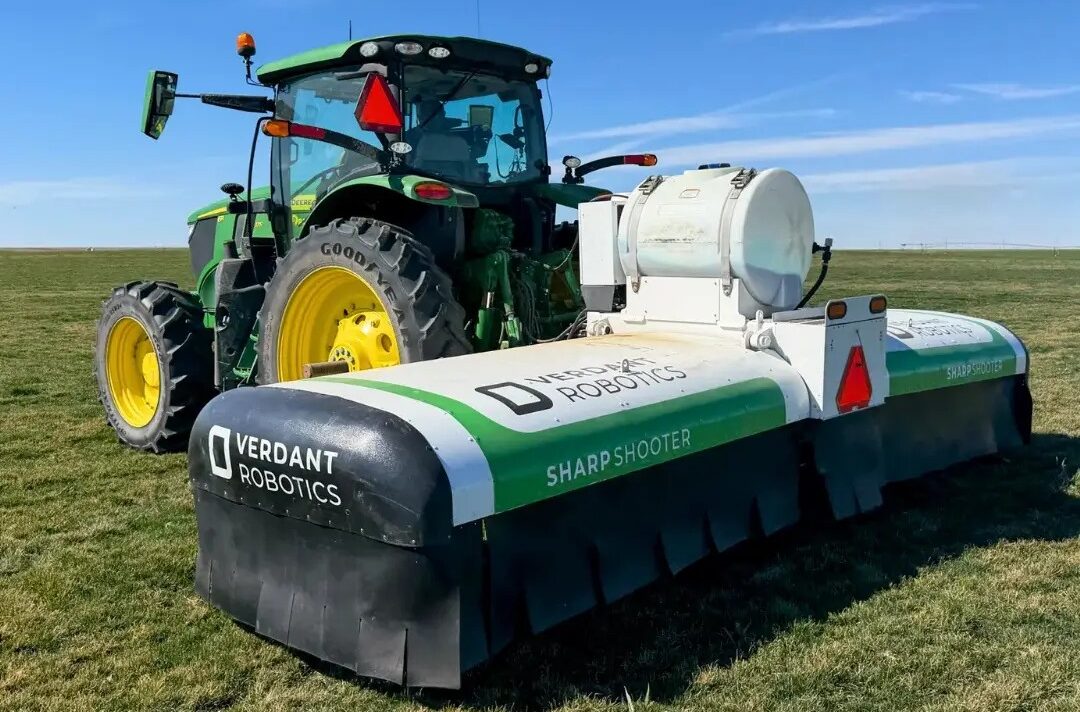
Precision application is already changing what herbicide use can look like. Instead of broadcasting across a whole field, new equipment uses computer vision, sensors, machine learning, and precision nozzles to identify weeds and treat individual plants. For example, Verdant Robotics [disclosure: AgFunderNews‘ parent AgFunder is an investor] developed a precision applicator that reportedly has millimeter-level accuracy and that “aims before it applies,” reducing application as much as 99%.
In some crops, mechanical and laser weed control can also substitute for herbicides. AI-powered mechanical weeders use cameras and robotic actuation to distinguish crops from weeds and remove weeds physically. AgriPass, for example, developed a vegetable weeding robot that uses computer vision to identify weeds and “robotic hand weeding” to remove them without herbicides. Other companies such as Carbon Robotics, have developed weeders that identify weeds and use lasers instead to kill them.
New chemistries matter too, especially for low-margin and large-scale operations where the economics of the more expensive robotic systems don’t currently pan out. Bindbridge, a UK startup is designing molecular glues for targeted protein degradation in weeds and other pests. Instead of inhibiting a protein the way most herbicides do, the approach is meant to trigger the destruction of proteins essential to the pest or weed.
Several other firms [such as Quercus Biosolutions and Invasive Species Corporation] are also working on broad-spectrum herbicides that could serve as a glyphosate replacement.

The way beyond glyphosate is not to wish it away. It is to outperform it
Rather than focusing on restricting relatively safe herbicides like glyphosate, policymakers should explore ways to advance these innovations that could improve weed management such that far less glyphosate and other herbicides are needed.
For example, Congress should provide EPA with the funding and staffing needed to evaluate new pesticide products quickly and rigorously. Likewise, USDA needs the capacity and regulatory processes to move faster on genetically modified crops. All of their reviews have gone over deadline, taking 600 days on average. Congress is also considering changes in the Farm Bill that would further support research and farmer adoption of precision agriculture equipment.
If better technologies make glyphosate obsolete, farmers and environmentalists should welcome that. Ultimately, the future of weed control should be judged by whether it improves on glyphosate’s performance: fewer toxic inputs, less soil disturbance, lower costs, stable yields, and less environmental damage.
The way beyond glyphosate is not to wish it away. It is to outperform it.
Further reading:
🎥 Beyond glyphosate: Quercus Bio targets weeds with designer proteins
Landmark glyphosate paper retracted in random reckoning for a scientific relic
Icafolin-methyl ‘a completion of glyphosate,’ not a replacement: in conversation with Bayer
A microbial cleanup for glyphosate just earned a patent. Here’s why that matters