
The crop protection industry urgently needs new solutions to combat herbicide and insecticide resistance and unlock new modes of action. Targeted protein degradation—which hijacks the internal “waste disposal” systems in pests and weeds to destroy proteins essential to their survival— is being pitched as a potential breakthrough, although it’s still early days.
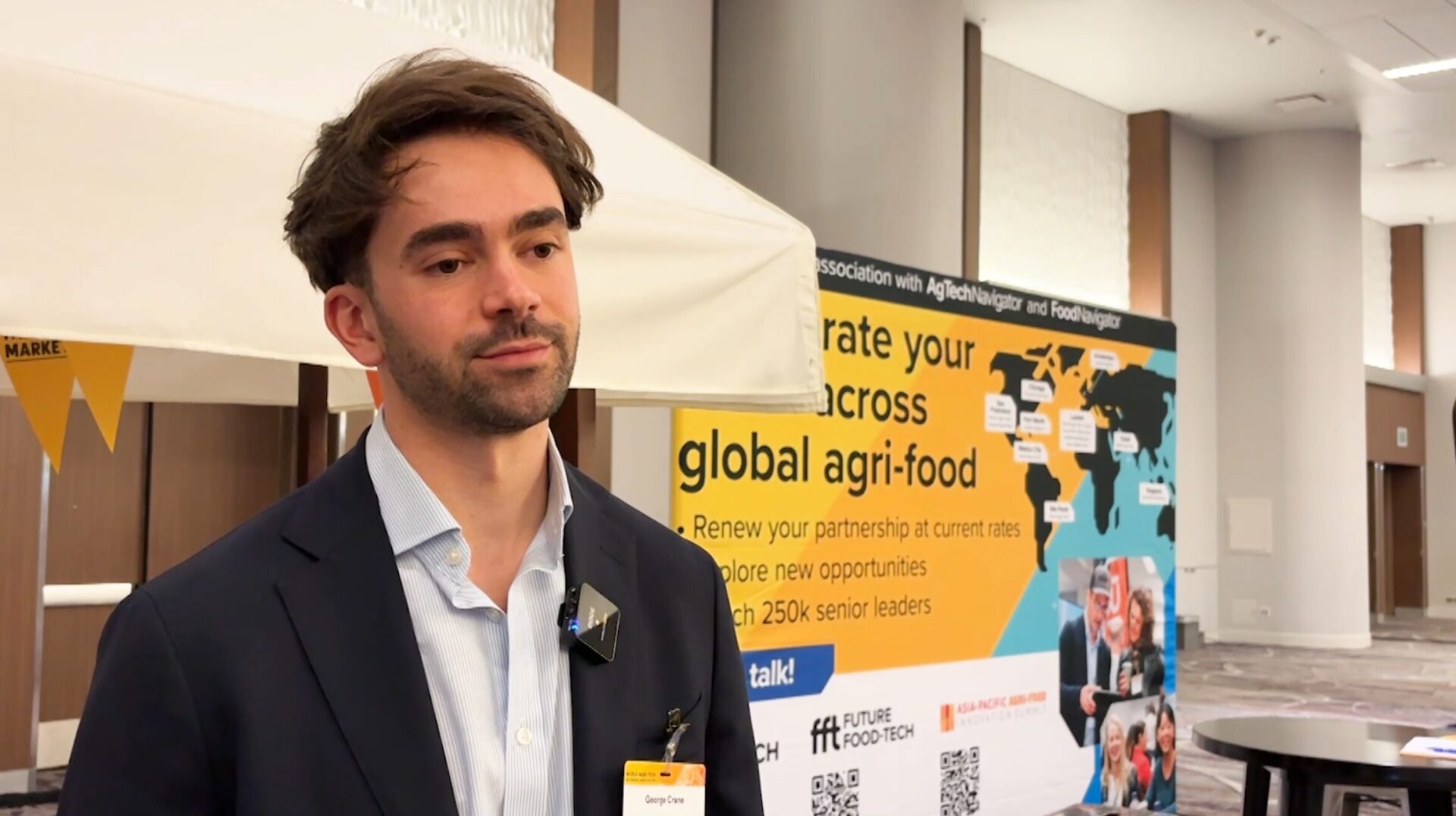
AgFunderNews (AFN) caught up with George Crane, PhD (GC), cofounder and CEO at UK-based startup Bindbridge at World Agri-Tech in San Francisco to discuss how molecular glues—a concept first developed in human medicine—could be the key to developing a viable alternative to glyphosate.
AFN: What is targeted protein degradation?
GC: We’re inspired by two main areas. First, advances in targeted protein degradation on the pharmaceutical side, where the industry is using this technology to degrade cancer proteins, and also [we’re inspired by] the plant’s own internal cellular homeostasis. So essentially, we’re identifying molecular glues, small molecule chemistries that are sprayed onto fields like any other [herbicide]. And once uptaken by the plant or pest, we induce proximity between a protein of interest and a protein degrader, typically an E3 ligase, and once proximity is induced, the protein of interest is tagged for degradation by the plant or pest cell.
AFN: And by degradation, you mean…
GC: Instead of inhibiting these target proteins, we’re removing them entirely from the cell.
AFN: So how does that differ from the mechanism of action in a traditional herbicide?
GC: So most ag chem products, and indeed, most drugs, function by inhibiting a catalytic site, an active site. So you can imagine that Pac Man model with something in his mouth. Our approach is different. We target non-catalytic sites to degrade rather than inhibiting the protein.
AFN: Why is this different mode of action potentially exciting?
GC: We are able to overcome resistance to existing targets. We’re able to drug the previously undruggable targets, such as transcription factors and scaffold proteins, unlocking a new toolbox for targets for the industry.
AFN: And could you have lower application rates potentially?
GC: So that’s one of the main benefits of targeted protein degradation. Molecular glues act catalytically, so one compound can degrade very many proteins, potentially reducing application rates by up to 100 times.
AFN: You said this isn’t an entirely new concept in crop protection, that some established herbicides do something kind of similar, but this was discovered serendipitously, whereas you are using rational design?
GC: Bindbridge is the first and only targeted protein degradation via molecular glue startup. We are taking inspiration from two approaches, first in the pharmaceutical industry and how they take well characterized degraders to target these neo-substrates. And second, around our fundamental understanding of plant biology and how we can modify these compounds like synthetic auxins to degrade novel targets.
AFN: Oerth Bio was doing a form of targeted protein degradation, but as I understand it, with larger, more complex molecules, and recently called it quits. How is the approach at Bindbridge different?
GC: Oerth Bio had licensed PROTAC technology from [biopharmaceutical company] Arvinas. Generally, those compounds are too large and expensive for field based application; they really struggle to get through the plants’ cell wall or waxy membranes. Our molecular glues are much smaller and cheaper to produce, and have more agronomically relevant qualities that make for good herbicides, fungicides and insecticides.
AFN: Can you explain how your computational platform uses AI to design these small molecules?
GC: At the center of our computational approach, we have our BRIDGE platform. It is a constrained generative process that takes real chemical fragments and chemical reactions and constrains the generation based on these desirable agronomic qualities. So what we have out the back of our model is up to 100 predictions that are both predicted to induce proximity between the target protein and the degrader, but also are predicted to have suitable agronomic qualities in the field.
AFN: So Bindbridge is able to factor in practical constraints from the outset?
GC: Exactly, and we’re able to then to tell our customer or chemical synthesis provider the exact chemical route to be able to create these molecules. We have an understanding of whether they are likely to work in the field, and an approximation of cost of goods as well.
AFN: Beyond crop protection, could this same mechanism be used for other things?
GC: In the first instance, we’re looking to develop a new broad spectrum non-specific herbicide. But our technology can also be applied to discovering new insecticides and fungicides as well as sprayable traits. In fact, many of those abiotic and biotic stress pathways are regulated by degraders in the plant, so overcoming or improving drought tolerance or nutrient use efficiency could be a whole new class of products for us.
AFN: Can you give me a specific example? How could you utilize targeted protein degradation for, say, drought tolerance?
GC: You could foresee a time where a farmer might see on his or her weather app a period of hot or dry weather coming up, and could preemptively spray a heat tolerant molecular glue onto the field to temporarily protect that crop from the drought. Very often [in stress-response pathways, helpful proteins are already present in plant cells but are kept “switched off” by negative regulatory proteins that act as a brake] they are negatively regulated. The proteins are always expressed, ready to go, ready to confer some drought tolerance. And what we can do is degrade that negative regulator, take our foot off the brake, and the plant can then have protection from this stress.
AFN: What is your business model at Bindbridge?
GC: We have two distinct business models. In the first instance, we are engaging in joint development programs with the ag chem industry. They come to us with either a target protein or application in mind. And second, we are developing our own lead compounds in-house, in the first instance, towards this target of developing a glyphosate replacement.
We’re working in key crops, so corn and soy in the US and South America, but our technology also potentially has an easier regulatory route, so may be applicable for European crops as well.
Further reading:
🎥 Beyond glyphosate: Quercus Bio targets weeds with designer proteins