
Carbon Robotics has hinted for some time that “another AI robot” would join its product lineup. Last week the Seattle-based company finally lifted the veil on its Large Plant Model (LPM), which it says is the most advanced AI model out there for plant detection and identification.
LPM will enable Carbon Robotics’ LaserWeeder fleets to instantly deal with weeds in the field, bypassing the need to constantly retrain the machines. As a result, farmers can address unwanted weeds faster and more accurately than was previously possible, even with the company’s LaserWeeder machines and accompanying automation kits.
For founder and CEO Paul Mikesell, LPM is a way to make AI tools not only valuable but actually practical for farmers.
“There’s a whole segment of agriculture and farming that was not really getting the benefit of all this AI research,” he tells AgFunderNews. “A lot of AI research is going to your ChatGPTs and your self-driving cars. I wanted to bring that kind of advanced technology into agriculture.”
“When our robots can understand any plant in any field immediately and adapt behavior in real-time, farmers immediately get maximum value from the machines,” he adds.
150 million plants and counting
LPM is possible because of the amount of data Carbon Robotics has amassed over the years about plants, says Mikesell.
“This is the kind of thing that happens once you get enough data and you can really start to iterate on the way the AI is working, and build something that’s brand new. That’s only comes when you have the volume of data that we have and the experience we have in the field.”
Weed populations vary from one field to the next, and, because they adapt to their given environments, may look slightly different in one type of soil and climate versus another.
Carbon Robotics has spent years capturing images, training and retraining its AI on these variations, says Mikesell.
“We’ve now got to the point where the AI model has enough data, and we changed and innovated in the way the neural net was operating.”
As a result, LPM can identify a new weed instantly.
“It can instantly figure out not only the type of plant it is but what it’s going to look like from all these different angles, what it’s going to look like as it grows and changes over time. We don’t have to send [the picture] up to the data center and retrain the model and all that stuff.”
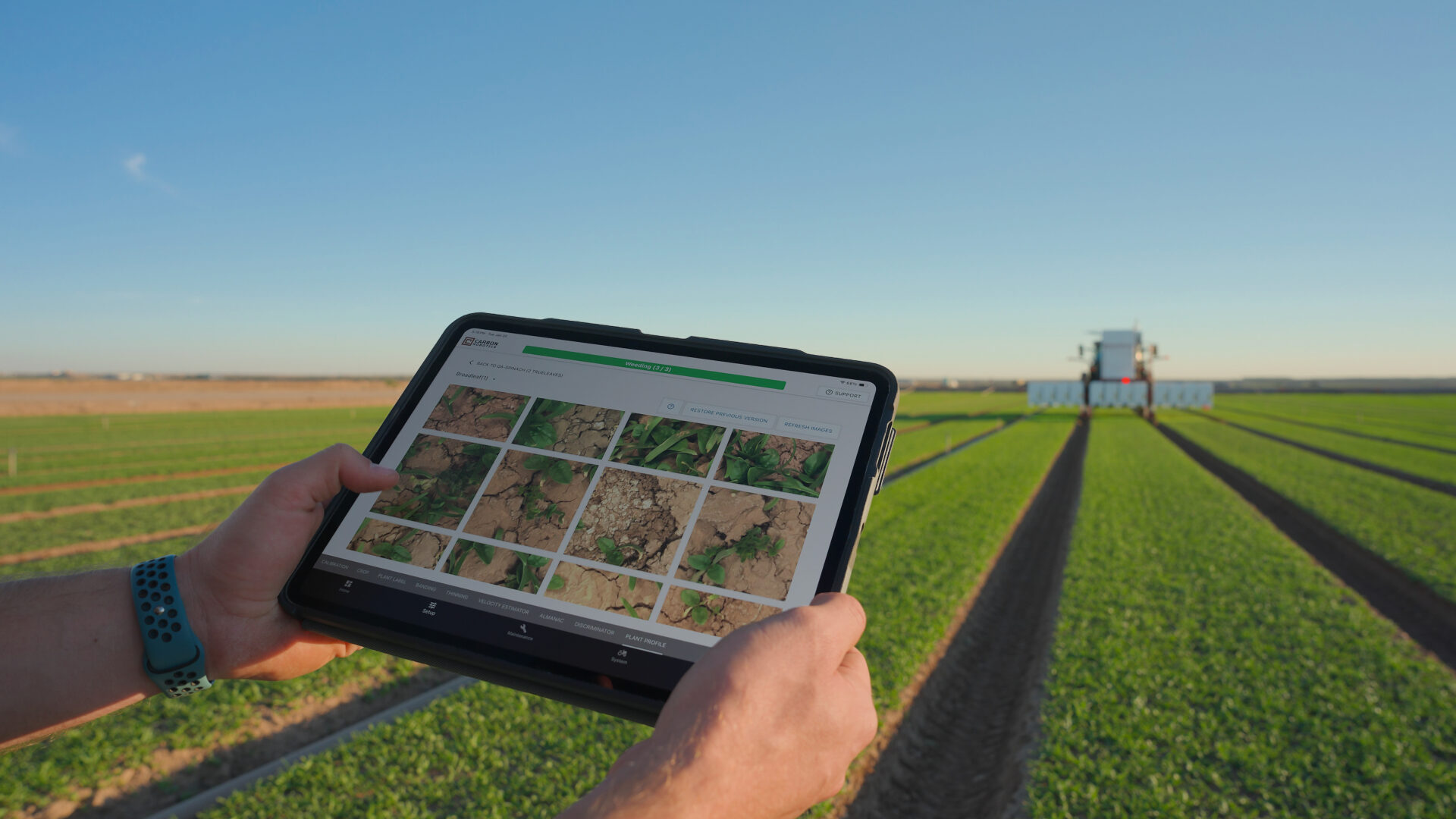
Farmers using the LaserWeeder can leverage the new PlantProfiles feature to select photos of crops and weeds in the Carbon Robotics iPad Operator App. The system automatically adjusts to the new parameters of that specific field.
That’s the real value of the workflow says Mikesell. “It sounds complex and advanced, but what it really means in the end is that you can just point at a picture.”
Those with existing LaserWeeder machines will be able to access LPM via a software update.

‘More advanced’ than self-driving cars
LPM itself has been in the works for years, says Mikesell, whose background includes working on deep learning systems for Uber.
“The initial version of LaserWeeder was built on an AI system similar to what people are doing with self-driving cars—a more traditional computer vision model.”
“Traditional neural net architecture was not really built to do this kind of thing,” he adds of LPM’s capabilities.
“There was no way in which it was understanding the things it’s looking at in a way where you can show it something new and it can decompose it and match it against everything else [in that environment].”
For Mikesell and team, the biggest challenges in developing and bringing LPM to market came down to model architecture and what was even capable to do on a GPU.
LPM is the result of taking “the best in computer science and the best in AI and applying it to agriculture.”
“These models are becoming so advanced that you can look at certain parts about our AI architecture and think that’s actually more advanced than what they’re doing on these self-driving cars. That’s real innovation.”