

Not all regenerative certification programs are equal in terms of standards they adhere to and the pesticides they prohibit, according to a recent report from environmental organization Friends of the Earth.
While regenerative agriculture is typically associated with eco-friendly farming practices that boost soil and human health, the report makes it clear that these things vary from one standard to the next, causing confusion for both consumers buying products and the food companies sourcing crops for ingredients.
“We are trying to ensure that agrochemical reduction is a part of every conversation about regenerative ag, because very often it’s left out,” says Friends of the Earth deputy director of science Kendra Klein when asked about the motivation for the report.
“The science is really clear that reducing use of pesticides is critical to building healthy soils, which is, of course, the heart of regenerative agriculture,” she adds.
US crop production—the main focus of the report—leans heavily on chemical pesticides and herbicides, particularly in row crops like corn and soy. But as Friends of the Earth points out, continued reliance on “toxic pesticides and synthetic fertilizers” undermines the foundational principles of regeneration in food systems, which include soil health, biodiversity, and community wellbeing.
The 60-page report analyzes 10 prominent regenerative agriculture certifications in order to understand their claims about both finished products that hit store shelves and the practices that happen at the farms, communities, and supply chains producing crops for those products.
The report found that regenerative certification programs “vary widely” in terms of which agrochemicals they restrict as well as in their soil health requirements and verification processes.
In short: “Some programs are able to provide strong assurance to consumers and purchasers about the finished product, others provide strong assurance about practices on the ground, while others don’t have transparent or robust enough verification models to guarantee either.”
‘Regenerative’ doesn’t mean ‘organic’—but it should
“In our view, organic should serve as the baseline for formal regenerative definitions because it provides both strong environmental outcomes and a clear, enforceable standard,” says Klein.
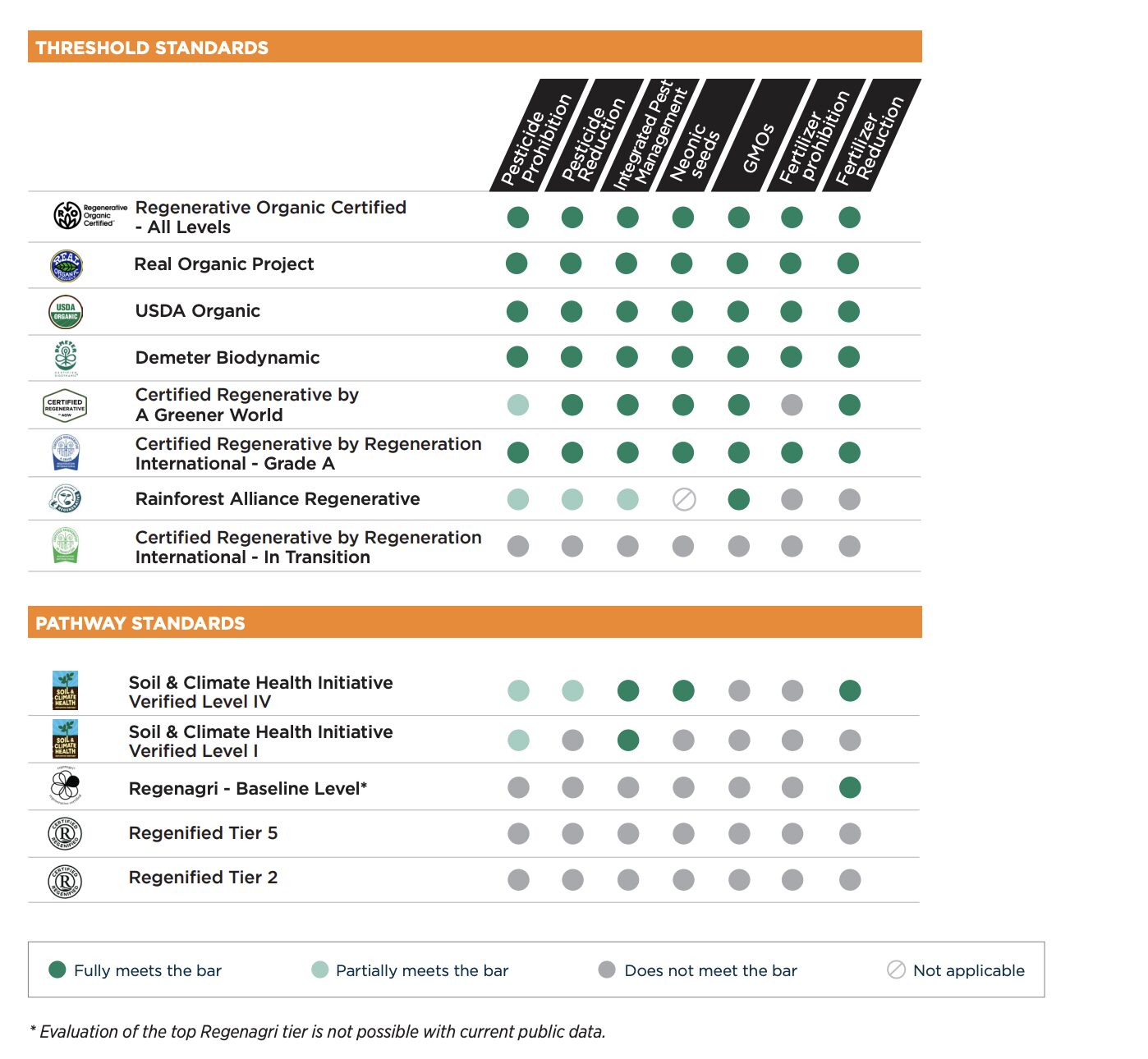
However, the 10 certifications analyzed in the Friends of the Earth report have different restrictions around pesticides, with some more lenient than others when it comes to toxic substances.
The most robust certifications are USDA Organic and those that use it as a baseline: the Real Organic Project (ROP) and Regenerative Organic Certified (ROC).
Since these programs follow USDA Organic’s federally regulated National List of Allowed and Prohibited Substances, they inherently meet the report’s standards for “pesticide prohibition.”
All regenerative certifications should strive to be organic, according to Klein, who points to the decades of evidence showing that organic is one of the most comprehensive and well-established systems for advancing the goals of regenerative agriculture.
“Research consistently shows that organic farming can improve soil health, strengthen climate resilience, support soil carbon sequestration, reduce synthetic pesticide and fertilizer use, lower pollution impacts, and protect biodiversity, human health, and community wellbeing,” she says.
Organic is also backed by clear standards, verification, and enforcement, with a rigorous legal framework supporting those things.
In contrast, regenerative agriculture, which doesn’t even have a standard definition, is still a patchwork of standards and enforcements.
For example, Regenari, Regenified, and Certified Regenerative by Regeneration International – In Transition, have few if any restrictions on agrochemicals, according to Friends of the Earth’s report. Regenagri only prohibits pesticides for coffee production, while Regenified’s only restriction states that chemical pesticides can’t be applied to grains within 21 days of harvest.
But strict accountability matters for both consumer trust and environmental integrity, says Klein.
“While regenerative pathway programs can play a valuable role in helping farmers make incremental improvements, they should ideally function as stepping stones toward more comprehensive systems like organic rather than substitutes for them.”
Pathways vs thresholds
Programs also differ in structure and stated goals, which is why Friends of the Earth divided them into two categories, “threshold” and “pathway.”
Pathway programs are designed to “meet farmers where they are,” and require continual improvement when it comes to farm practices, says Klein.
“Their focus is on engaging producers at the beginning of the regenerative transition and supporting incremental improvement over time.”
These programs—which include Regenified, Soil & Climate Health Initiative Verified, and Regenagri—play an important roll in making regenerative practices more accessible to more participants.
However, Klein also highlights some ambiguities in these programs: “The on-package labels for the pathway programs do not distinguish between different achievement levels within the program. In practice, that means consumers can’t distinguish whether a product merely meets a baseline entry requirement or represents more advanced regenerative practices. Companies should carefully consider how this ambiguity could affect consumer understanding and long-term trust.”
The remaining seven certifications in the report fall into the “threshold” category. As the name suggests, this is a single, standard baseline all producers must meet from the outset.
The bar for entry is much higher for threshold programs around agrochemicals, soil health, and ecological management.
“For consumers specifically seeking to avoid exposure to toxic pesticides, threshold certifications that prohibit such pesticides—including organic—remain the clearest and most reliable assurance,” says Klein.
What food companies can do
Understanding the nuances of regenerative certification is just as important for food companies as it is to consumers.
Klein encourages companies wanting to invest in regenerative supply chains to focus on organic farmers and those transitioning to organic production.
“Organic standards already deliver many of the environmental and soil health outcomes companies are seeking with regenerative agriculture, while also offering a high level of accountability and transparency,” she says.
At the same time, there’s value to be had in pathway certifications that can help engage farmers earlier in the regenerative transition as a gateway to organic.
“Our analysis identified Soil & Climate Health Initiative as a standout example because it includes meaningful requirements, continuous improvement measures, and stronger structural integrity than other emerging regenerative claims,” says Klein.
According to Friends of the Earth, the ultimate goal is to make certifications like these become “not exceptional achievements, but a baseline expectation for what our agricultural policies deliver in terms of environmental health, community wellbeing, sustainable farmer livelihoods, and public health protection.”