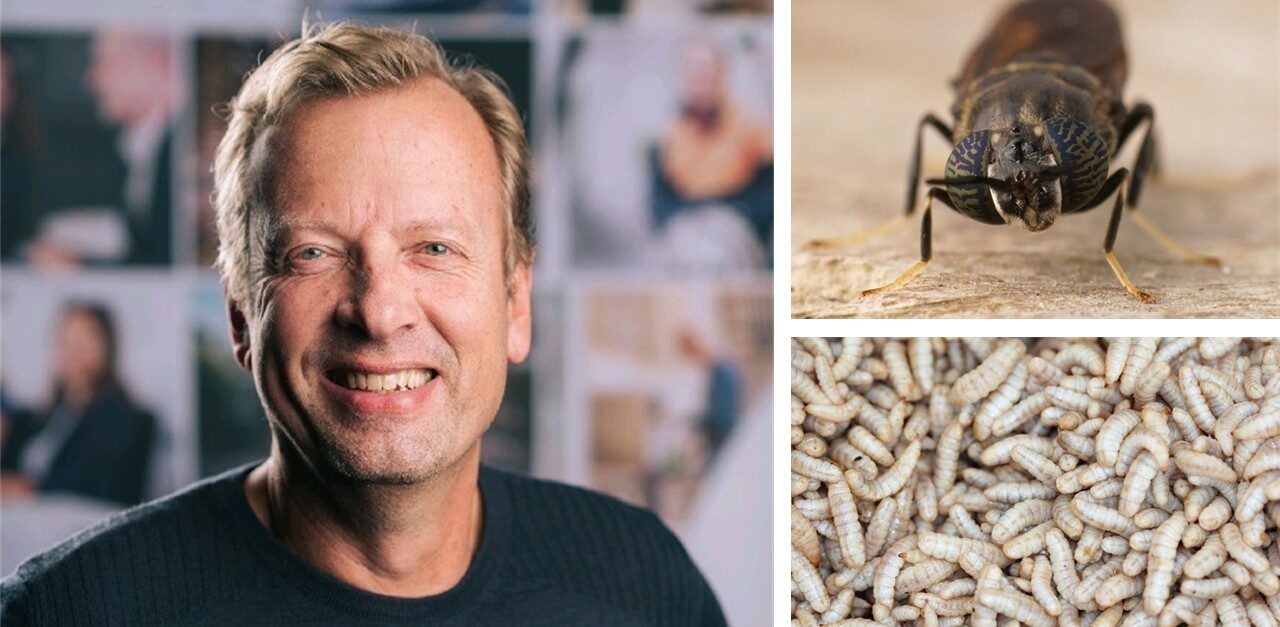
Dutch insect ag pioneer Protix is shifting its focus from Europe and North America to Asia, where it says the cost and regulatory structures are more favorable for the nascent industry, which is reeling from a wave of bankruptcies.
Until Europe relaxes rules that block insect farms from using post-consumer food waste and most animal by-products as feed, it’s hard to make the unit economics add up, especially in markets such as The Netherlands and France, says Protix CEO Maiko van der Meer [although French insect ag firm Innovafeed tells us it is targeting profitability at its site in Nesle by the end of 2027].
Those restrictions do not apply in North America, where Protix had been planning a large-scale facility in Nebraska with partner and investor Tyson Foods. However, that project is now on hold, and van der Meer says the company sees more immediate opportunities in Southeast Asia.
“We want to go east. Our new strategy is buy and build in Asia for aquafeed, livestock and pet food,” he told AgFunderNews. ”
“It’s just much more cost effective to produce in Southeast Asia. Energy, land, building and labor costs are cheaper, and there are not the same restrictions on the feedstock, which is the biggest driving force behind the cost,” added van der Meer, an agrifood industry veteran who took the helm at Protix in November 2025.
“In Southeast Asia we also have a model with much less automation because labor costs are lower. The other thing is air conditioning [climate control]. If you have a country where it’s always 30 degrees it’s a lot cheaper [to operate an insect farming facility].”
Protix recently signed an MOU with a post-consumer waste collection company in South Korea called Reco, said van der Meer. “Our model is a joint venture model where we bring in our expertise, IP, operational expertise, and genetics, and the local business partner, who is preferably a company who is sitting on the feedstock, provides some supplemental cash.
“The JV will then seek additional external funding to build the factory. It is the model we’ve used in the US and what we’re planning to use in Southeast Asia for a second facility in Thailand, Malaysia, Vietnam, or Indonesia. So in the next two or three months, together with my CTO, I’m going to visit prospective partners and see who is willing to jump in with us.
“At the same time, we are talking to Asian investors—both strategics and impact investors—who are a lot more upbeat about these markets. I think that also has to do with food security. A lot of Asian governments are also pushing on making sure food waste doesn’t get thrown away, and the government is actively pushing and subsidizing it.”
Europe: The global development hub
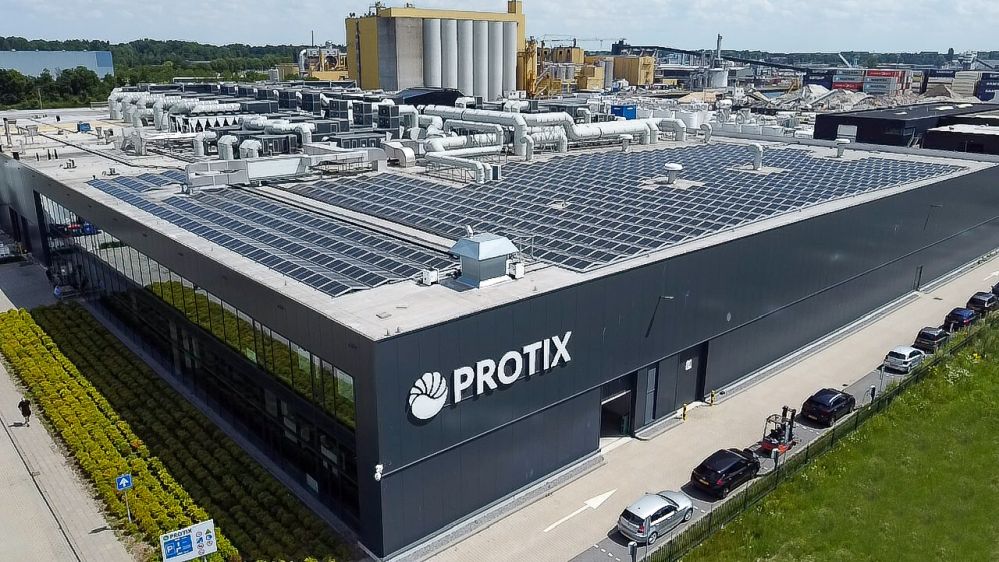
In Europe, Protix’s flagship facility in Bergen op Zoom will serve more as a development hub over the longer term, while plans to build a facility in Poland have been shelved, said van der Meer.
Asked if the Bergen site has a path to profitability, he said: “It was built to become the global development hub of the business, so you shouldn’t see it as a straightforward commercial plant; it’s more ultimate proof of testing all the possible scenarios [for larger-scale plants elsewhere].”
He added: “We have loyal customers in the European pet food market. And having a commercial scale facility is a powerful tool to demonstrate our capabilities to investors, business partners and people around the world who want to leverage our technology and expertise, but we’re not going to put any more capex into the plant.”
“I don’t necessarily see it running in another 10 years from now [as a major production hub],” added van der Meer, who said Protix will harness its years of experience in genetics, feedstocks, and equipment to generate revenue as a consultant and tech licensor in the industry. “I also see a lot of opportunity for selling neonates [young larvae for others to farm] as well.”
North America: A work in progress
Asked about the plan for North America, he said: “We’ve done our job, we’ve provided all the designs, the recipes, the technology, the expertise, and now it’s in the hands of Tyson.”
But if there are no restrictions on feedstocks in North America, and Protix could have a plant adjacent to a key source of feedstocks with Tyson, why not go full steam ahead in the US?
In part, because the end markets for insect protein are more developed in Asia, he claimed. “I always prefer to have customers begging me for product rather than imposing product on the customer.”
“I can’t speak for Tyson,” added van der Meer, “But with new technologies, scaling is always difficult. Sometimes you jump and you go too fast, sometimes you don’t jump, but you should have. There are many reasons, financial timing, economics risks, stability in the world. But we have done our part, designed the factory, done all the feedstock testing, so [it’s up to Tyson] to push the button.”
‘Realism kicked in’
While the industry has had its fair share of failures in recent years (Ÿnsect, Agriprotein, Aspire, Inseco, Enorm, Beta Hatch et al), many of the issues were company-specific, he noted, while the economics of black soldier fly larvae vs mealworms vs crickets are all quite different.
“The black soldier fly is the most effective in yield and efficiency and most versatile. And so when people talk about Ÿnsect’s failures as systemic failures, it always frustrates me. Mealworms are not the same as black soldier flies. It’s like talking about chicken and pigs. If a chicken company goes bankrupt, you don’t say all the pig companies are going to go [bust].”
Clearly, some of the timelines shared by insect ag companies were “overly optimistic, and at that time [2018-22], investors were wildly excited about this field,” he said. “But realism kicked in, and people realized that you have to have economic benefits, not just sustainability benefits.
“We’re now seeing trials showing real health benefits in shrimp, salmon, bream, bass etc around lower mortality, better immunity, better flesh texture, but you have to be cost competitive on a protein level. I can tell you, we are not cost competitive from the Netherlands with fishmeal in aquafeed at the moment, but we will be on day one in Thailand or Malaysia or Indonesia or Vietnam.
“We could make BSF protein for $1 a kilo and we don’t even have to be at the huge scale for that.”
👉 Stay tuned for a round up on insect ag with updates from the key players later this month on AgFunderNews.
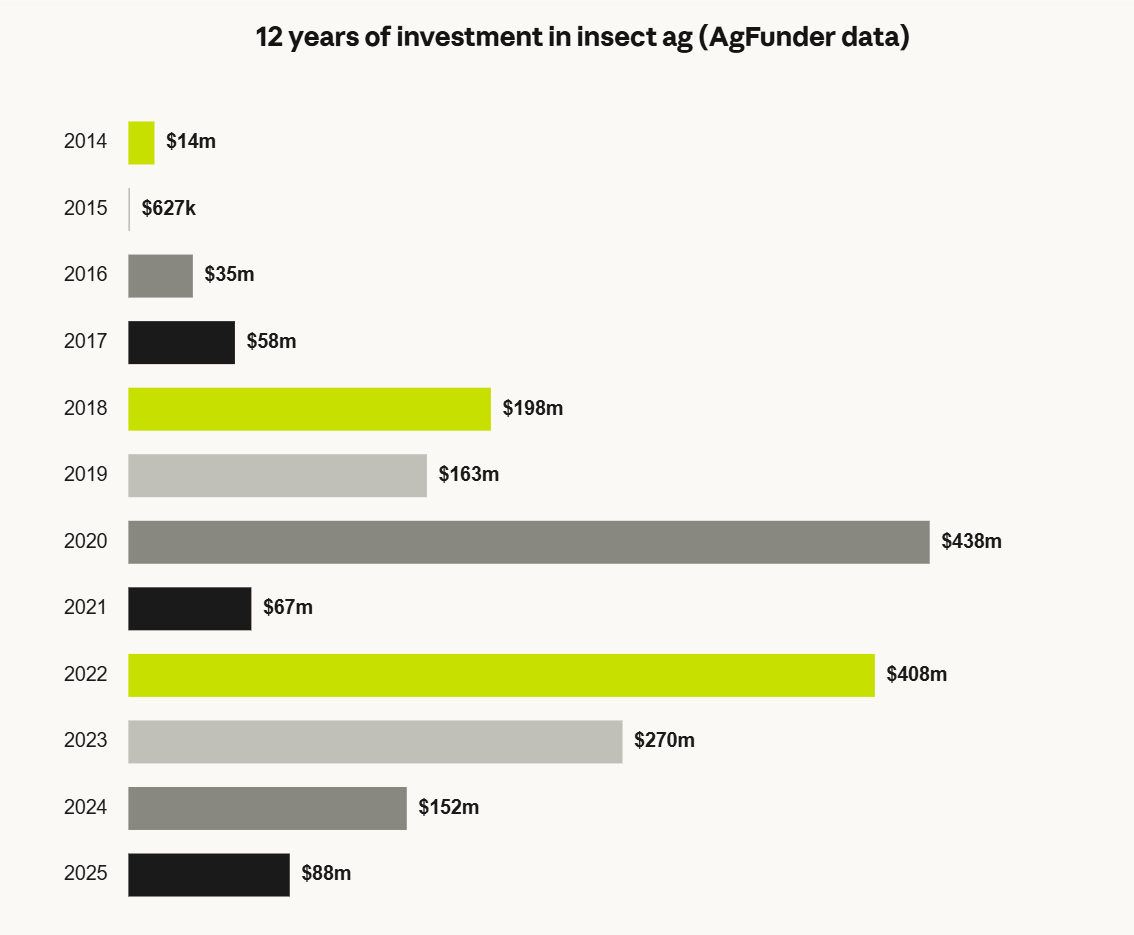
Recent funding rounds in insect agriculture (US dollars):
2025: $88.45 million
- Volare (black soldier fly larvae, Finland): $30 million
- nextProtein (black soldier fly larvae, France/Tunisia): $21 million
- Protix (black soldier fly larvae, Netherlands): $11 million/debt
- Proteine Resources (lesser mealworms, Poland): $11.1 million
- GreenGrahi (black soldier fly larvae, India): $3.7 million
- Loopworm (silkworms, India): $3.25 million
- Insectius (black soldier fly larvae, Spain): $2.9 million
- BetaBugs (black soldier fly genetics, Scotland): $2.7 million
- InsectBiotech (black soldier fly larvae, Spain): $1.7 million
- Viridian Renewable Technology (black soldier fly larvae, Australia) $700k
- Enthos Circular Feed Technologies (black soldier fly larvae, Colombia): Undisclosed
- FlyBox (black soldier fly larvae, UK): $400k
2024: $151.9 million
- Entosystem (black soldier fly larvae, Canada): $42 million
- Protix (black soldier fly larvae, Netherlands): $40 million
- Tebrio (mealworms, Spain): $32.6 million
- FreezeM (black soldier fly neonates for breeding, Israel): $14.2 million
- Chapul Farms (black soldier fly larvae, US): $9 million
- Nasekomo (insect ag franchisor, black soldier fly neonate supplier, Bulgaria): $8.7 million
- Entocycle (enabling tech for insect ag, UK): $2.6 million
-
Viridian Renewable Technology (black soldier fly larvae, Australia) $1.7 million
- Insectius (black soldier fly larvae, Spain): $1.1 million
Source: AgFunder data [disclosure: AgFunder is the parent company of AgFunderNews]
Further reading:
Exclusive: Aspire Food Group’s Ontario cricket farm sold to new owner as firm collapses under debt
Judicial liquidation for Ÿnsect as insect farming sector ‘struggles to become competitive’
Breaking: Danish insect ag firm ENORM declared bankrupt after failed reconstruction process
South African insect ag co Inseco calls it quits amid power cuts, pivots: ‘We ran out of time’