The Ontario Superior Court of Justice has approved a deal to sell the assets of struggling insect ag firm Aspire Food Group to Halali Group Holdings, a purchaser with “interests in commercial real estate and food and beverage manufacturing.”
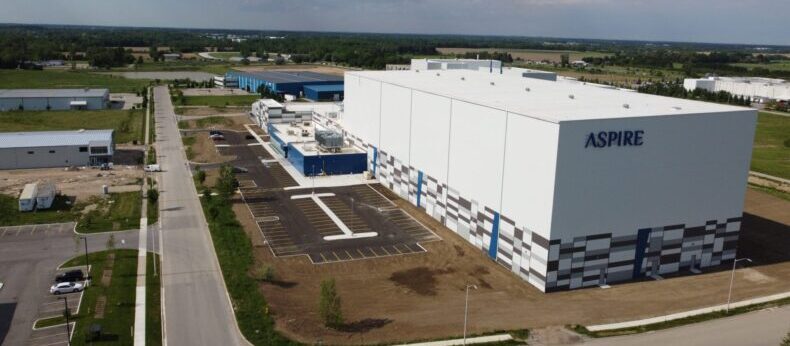
Court documents filed by receiver FTI Consulting do not provide further details but say Halali “intends to explore opportunities to source a commercial tenant for the London facility [a large-scale cricket farming facility in Ontario, Canada] so that it will continue to be used for industrial purposes, including, potentially, the insect agriculture business.”
The two directors at Halali listed in the court filings are Hassan Al-Ali and Hussain Al-Ali.
David Rosenberg—who cofounded vertical farming startup AeroFarms and took on the CEO role at Aspire in late 2023—told AgFunderNews: “This is effectively a negotiated solution with the bank with a funding structure that will allow us to operate under [COO] Gabe Mott. I’m moving on but will still be involved in an advisory role.”
The plan is to build back production in one part of the facility in early 2026, he added. “We’ve solved how to grow with higher yields in 10-15 different trials, so we feel like we’ve found an elegant solution.”
While the firm is still operating at low volumes it will focus on undisclosed “high-value niches,” he said.
London facility ‘did not perform as expected’
Billed as the world’s largest cricket processing facility, Aspire’s 150,000 sq ft facility in London, Ontario, supplied frozen whole crickets that customers could further process for animal feed and pet food markets. In early 2023, cofounder and then-CEO Mohammed Ashour predicted it would get to 100% of production capacity (12,000 tons of crickets) in the first half of 2024.
However, the highly automated facility “did not perform as expected, operating at significantly less than full capacity,” according to a recent report by receiver FTI Consulting, which was called in by lender Farm Credit Canada (FCC) in May when it became clear that Aspire could not meet its financial obligations.
According to FTI, the underperformance at the London site was “caused by, amongst other things:
(a) geographical and environmental differences between the growing process in Texas, where the process was developed, and Ontario, where the Aspire Group sought to scale up the process;
(b) changes in the growth and harvest methods (such as a new tote design and a new stacking system); and
(c) equipment issues, including problems with the hopper and conveyor systems.”
Asked whether the company had erred in building a large automated facility around a design that had worked at a small scale in Texas but had not been properly validated in Ontario, Rosenberg said: “You can always be the Monday morning quarterback. If you go from small to medium to big, there’s, let’s say, another 10 to 20 million of expense in that medium term. If you go straight from small to big, there might be 10 to 20 million of expense in all the mistakes you need to fix.”
Firm ‘continued to struggle to pay operating expenses’
Despite internal restructuring efforts and financial monitoring, Aspire “continued to struggle to pay operating expenses,” added FTI, which said Farm Credit Canada is owed about CAD$44.1 million ($32 million).
Following its appointment as receiver in May 2025, FTI contacted commercial real estate brokerages, commercial liquidators and prospective operators to explore a sale, explained FTI in court documents.
According to FTI, three real estate brokerages and six liquidators submitted proposals for the property, while it also received a non-binding bid from the Aspire Group’s former management and shareholders.
Additional unsolicited interest was received from third party prospective purchasers, it explained. “One party submitted a non-binding letter of intent proposing a rollover and partial forgiveness of certain indebtedness, but no cash consideration.”
‘The best available option’
In June, FTI received an unsolicited expression of interest from Halali Group Holdings, which submitted a non-binding letter of intent on July 3. FTI, in consultation with Farm Credit Canada, determined that this was the “best available option.”
With Farm Credit Canada’s support, FTI and Halali entered into the asset purchase agreement on August 28, said FTI. “The agreement contemplates the purchase of substantially all assets of the Aspire vendors, including the London facility, equipment, certain specified intellectual property, books and records and the assignment of certain contracts.”
About 25% of the funding for the London plant came from government grants, 30% came from a loan, and the balance from equity, said Mohammed Ashour in an interview with AgFunderNews in March 2023 in which he claimed to have “significant contractual commitments for the majority of our production.”
Further reading:
Can InsectBiotech crack the code on insect ag economics by tapping into Spain’s olive waste?

Sign up for our weekly newsletter.