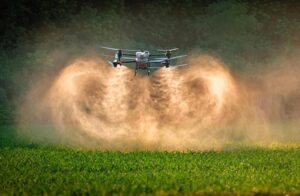

South Korea this month became the latest country to unveil new plans around integrating AI into agriculture, joining recent national initiatives from India, the UAE, Saudi Arabia to help farmers navigate climate change, the impacts of war, trade tensions, and unpredictable supply chains.
South Korea’s ambitions come in the form of the Agriculture and Rural Artificial Intelligence Transformation (AX) strategy, announced jointly by the Ministry of Agriculture, Food and Rural Affairs and the Ministry of Science and ICT.
The plan aims to make AI more accessible to growers of all sizes by expanding smart farm models to small- and mid-sized operations, in addition to large enterprises. Shared machinery centers, “smart” processing centers, and AI-based livestock grading tools are also in the works.
“AI is no longer a choice but a core foundation that will determine the survival and future competitiveness of agriculture and rural communities,” Agriculture Minister Song Mi-ryung said. “We will make 2026 a starting point for agricultural AX to overcome challenges such as climate change and a rapidly aging population.”
South Korea’s ambitions extend beyond the field, too. It also aims to become one of the world’s top biotech economies by 2030, and has a framework in place to support the industry’s growth. Earlier this year, the country said it would merge its National Bio Committee and Biohealth Innovation Committee, and launch new plans to boost biotechnology innovation.
This month, Samsung Biologics unveiled a collaboration with pharmaceutical giant Eli Lilly to establish a hub supporting early-stage biotech companies in the country.
Necessity drives much of this. Just 22% of South Korea’s land is farmable, which underscores the need for efficiency in farming systems through everything from microbiome technology to improve crop protection products to AI tools that ensure some predictability into turbulent supply chains.
South Korean agrifoodtech funding swims upstream
Given all of this, it’s unsurprising that agrifoodtech funding in South Korea has gone upstream. According to AgFunder’s latest Global AgriFoodTech Investment report, roughly $120 million went to startups working near the farm or lab, or on the supply chain side; $96 million went to downstream areas like restaurant and delivery.
Even more telling, AI and robotics are weaving their way into all investment categories across the country, whether on the farm or in the restaurant.
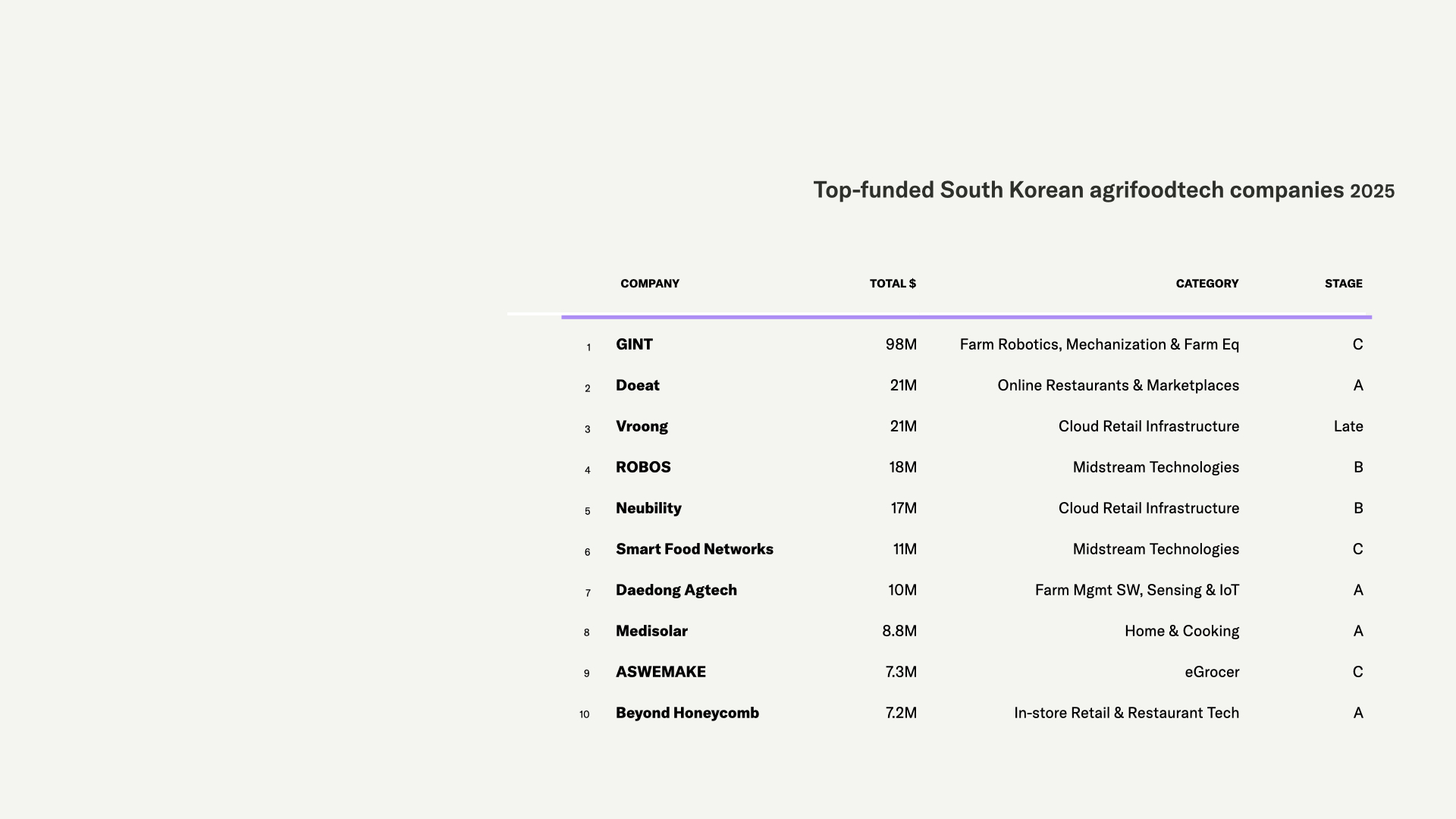
About 40% of last year’s funding came from a Series C raise from GINT, which specializes in autonomous driving systems for agriculture, led by PT.Indo Agritech Investment with participation from LIG Nex1 and IBK Capital. At the time of the fundraise announcement in December, the company said it had broadened its product features to include AI-based crop management software and robotic pest control systems.
Outside of robotics, AI and deep tech show up in logistics operations (Vroong), slaughterhouse management (ROBOS), flavor creation (Joomidang), kitchen automation (Beyond Honeycomb, ControlM), and fish monitoring (Tidepool), among other areas.
Investment still an early-stage affair
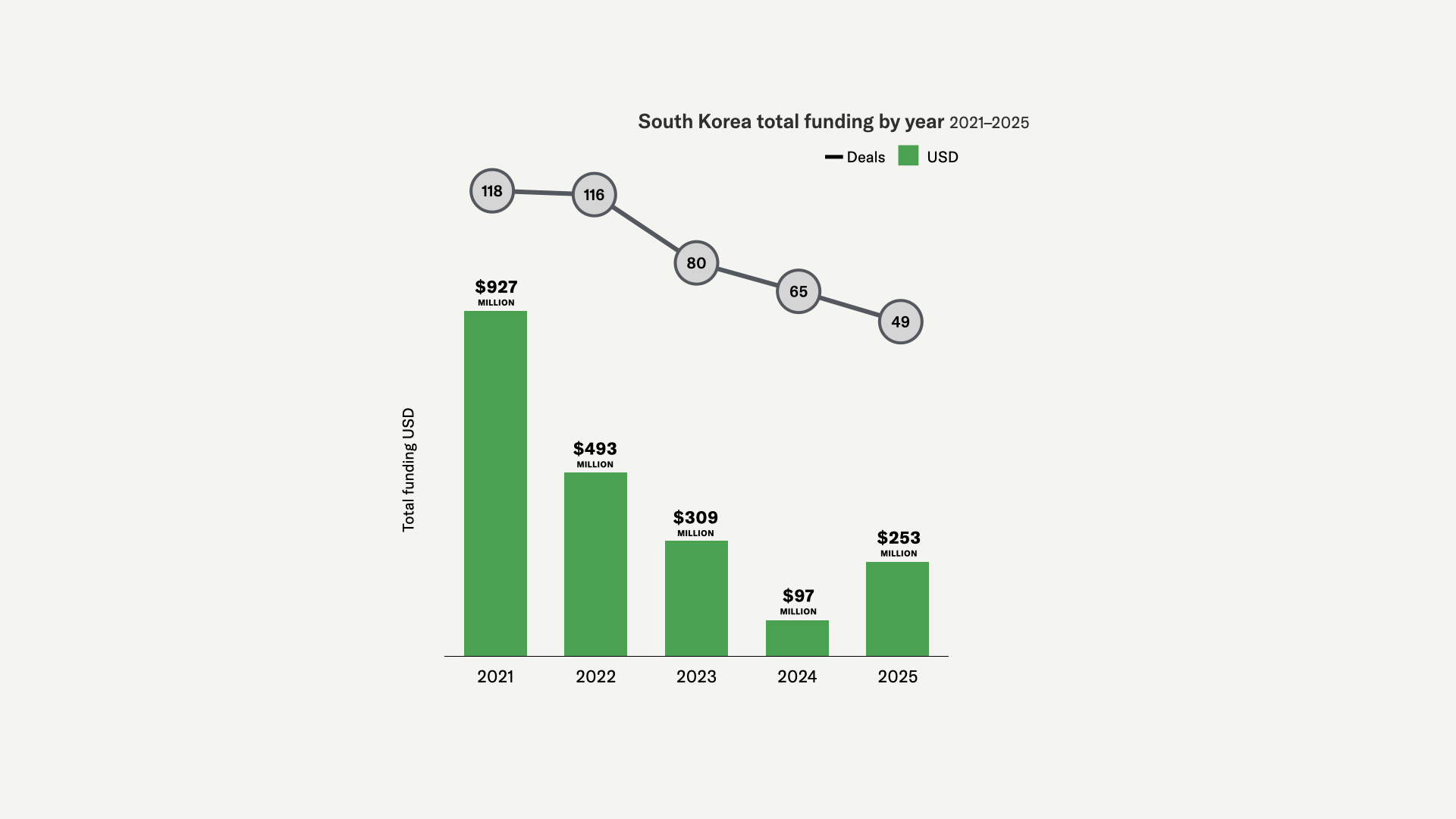
Overall agrifoodtech funding to South Korean startups grew from $97 million to $253 million in 2025, though deal count declined from 65 to 49, reflecting the conservative state of the broader agrifoodtech funding environment.
The country’s agrifoodtech investment is overwhelmingly early-stage, with 82% of the 49 deals for Seed or early-stage companies, and a median deal size of just $4.1 million.
This is in keeping with global trends, where the share of deals going to first-time funded companies reached 46% after years of decline.
For South Korea, the next question is whether these startups can raise the necessary follow-on rounds, and whether the country’s efforts to integrate AI and deeptech will help the agrifoodtech ecosystem.