
The global AI landscape has a new “big three” in 2026, with India trailing only the US and China in Stanford’s latest Global AI Vibrancy Index and surpassing nations like the UK and South Korea. Indian AI is full steam ahead with a range of announcements already in 2026, apparently shoring up its position.
The latest was earlier this month when Finance Minister Nirmala Sitharaman unveiled a landmark policy: a 20-year tax holiday offering zero taxes through 2047 for global AI workloads.
The move is designed to turn India into the world’s “AI back office,” and the giants have already arrived. Amazon has committed $35 billion toward its Indian cloud operations, while Microsoft has pledged $17.5 billion to build out its largest hyperscale region in Asia, centered in Hyderabad. Google, meanwhile, has anchored its presence with a $15 billion investment in an AI hub in Vizag.
But while Silicon Valley is leading this infrastructure push, applications are increasingly home-grown.
Nowhere is this more critical than in agriculture, where the government has also made recent, significant moves to bridge the gap between AI and farming.
In late January, it announced the launch of Bharat-VISTAAR, a multilingual AI tool that will provide advisory support to farmers. The tool integrates records from AgriStack, a government initiative to digitize agriculture, with validated practices from the Indian Council of Agriculture Research (ICAR). The goal is to enhance farm productivity, assist farmers in decision-making, and reduce overall risk.
It’s just one example of the numerous ways in which India is working to overcome the barriers to wider deployment of AI across agriculture.
‘Numerous obstacles’ to AI adoption
Improving farm productivity and livelihoods is no small feat in a country of almost 1.5 billion people, where 86% of farming is done on 2 hectares or less, and where annual farmer incomes average around $1,500.
Despite the “vibrancy” of the tech sector, a 2025 World Economic Forum (WEF) report on AI in Indian agriculture highlights “numerous obstacles, including fragmented infrastructure, limited access to high-quality data and affordability concerns for smallholder farmers.”
The WEF findings suggest that inherent limitations associated with small landholdings constrain production scalability, mechanization, and technology adoption. “As a consequence, marginal farmers often remain confined to subsistence-oriented production systems characterized by low productivity, minimal surplus, and limited profitability,” reads the report.
This is compounded by limited access to institutional credit, quality inputs, adequate post-harvest storage, and market intelligence.
But it’s also hampered by what the researchers call “erratic infrastructure”: the very AI workloads India’s government is courting require five times more power and 10 times more water than conventional data centers. These resources are already under stress in rural India.
These constraints make selling a digital ag service (AI or otherwise) directly to smallholder farmers a monumental task.
As Seamus Tardif, cofounder and CRO of agentic AI startup Myca, says, “Monetizing farmers in the global south is next to impossible to do.”
Scaling agribusiness without scaling headcount
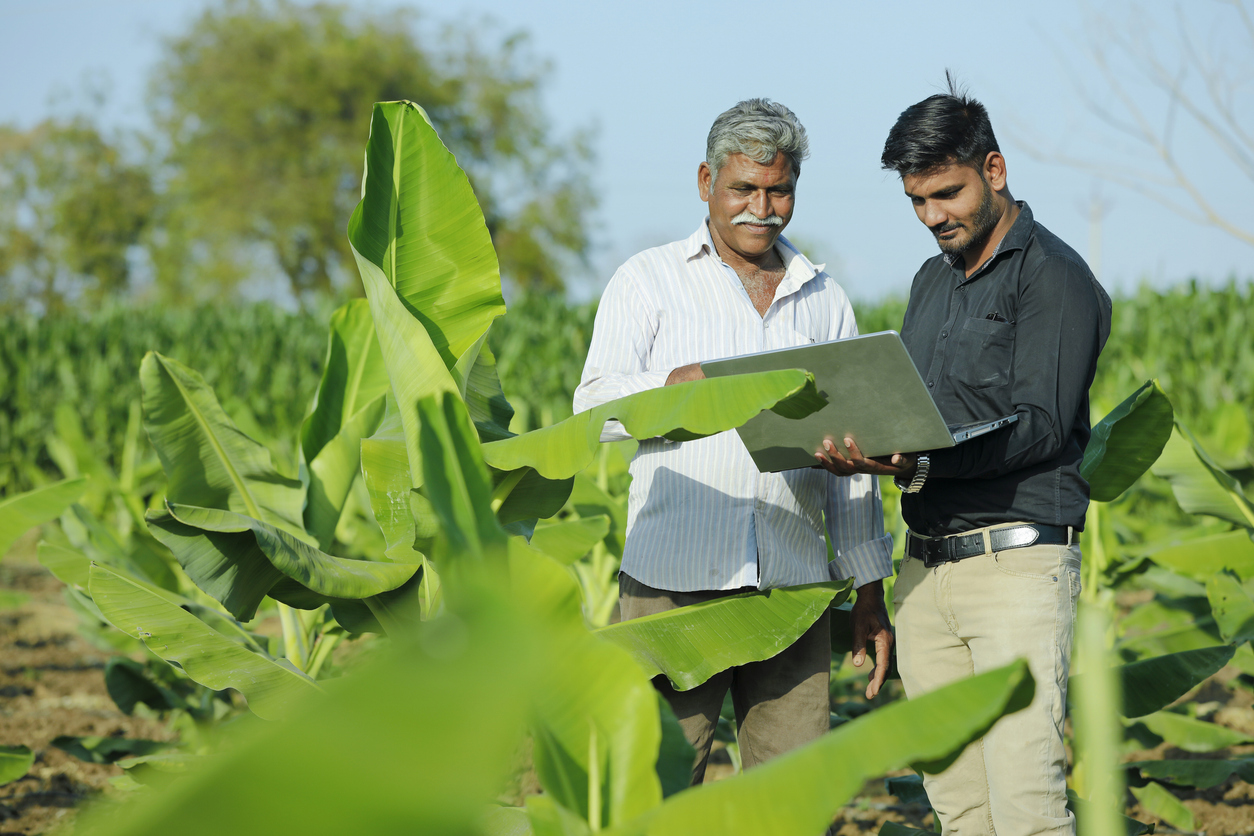
This is why some startups have stopped selling directly to farmers. Tardif argues that the most effective way to reach the smallholder is through the agribusinesses that already supply them.
These companies manage field officers who are currently stretched thin, with ratios often reaching one advisor for every 1,000 farmers.
Myca’s system uses AI reasoning power to optimize these field teams, distributing the workforce based on historical sales data, crop calendars, local climate variables and overall corporate goals. It means the field team’s activities are much more intentional versus their current ad hoc nature, with the goal to help these companies scale their impact without a linear increase in headcount. By moving toward “agentic big planning,” Tardif and his team have demonstrated that they can shift the advisor-to-farmer ratio from 1:10 to 1:60, making the field team’s activities intentional rather than ad hoc.
Meanwhile, Myca’s credit offering, Watchman, uses machine learning to enable tighter control over credit distribution and management, deviating from the typical seasonal or annual credit scores to a per-transaction scoring based system.
Ground truth—i.e., data collected from the field and field agents—plays a critical role in determining credit worthiness, he adds.
“If you don’t have these field insights coming in, you’re only building half the credit story, which still leaves you with a lot of exposure.”

Bridging the knowledge gap for farmers
Dr. Pratik Desai has spent years focusing on the interface. Long before the general public discovered ChatGPT, Desai realized that the biggest barrier was the “vernacular gap.” Even if the AI is brilliant, it is useless if it doesn’t speak the farmer’s language—literally and contextually.
In early 2023, his team launched KissanAI, a voice-based copilot that bypasses literacy barriers by allowing farmers to talk to the app in their native tongue. The efficacy of this simple interface was immediate: “Suddenly, the farmers were coming to us organically,” he says. “Within a few months, we got 100,000 farmers using the app, and that was unprecedented. The interface was simple. Click a button, start talking in your language, and it will reply back,” said Desai.
The system is also grounded in regional nuances: for example, it understands that a “bigha” of land in Uttar Pradesh is nearly half an acre, whereas in Assam it is only 0.33 acres.
By capturing these regional workflows, KissanAI has also become a vertical solution for giants like Bayer, helping the company scale agronomist services to provide specific product recommendations and dosages directly to growers. Deep research models within Bayer’s AI advisory app E.L.Y enables agronomists to delve into detailed compliance, economic, and sales data to provide more comprehensive and informed answers to growers.
“When the query comes in, the model not only converts it into the appropriate language, it will also identify what [the farmer] is talking about,” says Desai. “If your knowledge base is grounded in agriculture or dairy or a like industry, [the system] will understand the nuance of how the business works, how they deal with the farmer. All those workflows are important because a general-purpose company would probably not understand what they’re trying to do.”
Finding, organizing, and structuring the disparate and often not even digital datasets associated with such distinct regional differences in language, measurement, climate and so on is no small feat, according to Rhishi Pethe, managing partner at Metal Dog Labs.
In fact, data is a major bottleneck to the development of AI capabilities in India more broadly, and especially in agriculture, making the work groups like KissanAI and also DigitalGreen especially impressive, he adds
“Having the data available to train any AI or Gen AI model is always a challenge in India. It’s all over the place, a lot of it is not documented well, or it’s in PDFs and so on,” he tells AgFunderNews.
“If you want to get value from this, you actually have to make an effort. For example, Digital Green or Kisan [have] actually spent a couple of years to go and basically scour the internet for all this data, which is in all kinds of formats, and a lot of it is not even available digitally, so they have to do a bunch of work.”
Reaching more farmers through Small Language Models
At the same time, a push for efficiency has also led to a move away from massive, expensive models.
Digital Green’s FarmerChat app utilizes what are known as Small Language Models (SLMs) like Gemma and GPT-4o mini. Founder Rikin Gandhi explains that smallholder farmers tend to ask a finite set of seasonally recurring questions—”Why are my leaves yellowing?” or “Where is the nearest quality seed?”—which makes the problem more tractable for smaller, fine-tuned models.
This modular AI stack has delivered an 8x reduction in cost and lower latency compared to general-purpose models. And because Digital Green operates as a nonprofit, it can invest in longer-horizon R&D, such as multimodal image understanding, and share its datasets openly on platforms like Hugging Face. This reduces duplication across the ecosystem, creating a “public good” model that Gandhi believes is essential for lasting adoption.
Engineering sophistication and talent
While the macro data paints a picture of a burgeoning AI superpower, those watching the ecosystem on the ground see a more nuanced reality. Pethe notes that the sophistication of Indian AI is highly concentrated. He points to KissanAI’s use of synthetic data—generating artificial datasets to train models where real-world agricultural data is scarce—as an example of high-end capability.
“That level of work is pretty sophisticated and well-suited to a data-scarce environment like India,” Pethe says, though he cautions that “this level of sophistication is not yet widespread.”
According to Pethe, the defining characteristic of the Indian AI engineer is a ruthless focus on utility over theory. Unlike the “frontier” research happening in San Francisco, Indian developers are less obsessed with the “how” of a model and more focused on the “what.”
“Indian engineers I talk to are practical and application-focused: less obsessed with building foundation models, and more focused on ‘How can I make this work for my application?’” Pethe observes.
He suggests that while cutting-edge Generative AI work is still gravitating toward Silicon Valley, India is leading the curve in experimenting with “applied use cases like chatbots and WhatsApp-based advisory services” that solve immediate problems.
There is, of course, a growing interest in building indigenous foundation models—often called “BharatGPTs”—to ensure India isn’t entirely dependent on foreign tech. However, the sheer cost of training these models remains a barrier.
“Building foundation models is a massive, capital-intensive effort,” Pethe notes. “Most people are choosing to build on top of existing global models like ChatGPT or Llama rather than create Indian ag-specific base models.”

‘It’s still early days’
Despite the billions in investment and the rise in global rankings, digital adoption in Indian agriculture remains stubbornly low, at an estimated 20%. As Omnivore’s Mark Kahn points out, AI adoption is currently “spiky,” with some agribusinesses building sophisticated internal solutions while others are barely beginning to experiment.
“It’s still very early days,” says Kahn. “AI adoption is not even. Some agribusiness companies are trying to build their own solutions, and others are working with the largest players in the world. And there are some trying to work with these smaller players.”
Ultimately, India’s AI story is moving from the lab to the soil. In a country where data is often trapped in paper records and regional dialects, the real victory won’t be in the size of the model, but in the ability to finally make it work for the person in the field.
This complexity is echoed in MIT-led research from 2021, which identified 18 explicit barriers to adoption, identifying a “Trust Paradox” where technology is often viewed with suspicion by rural communities. The research suggested that until AI is seen as a local, grounded tool rather than a foreign “black box,” mass adoption will remain elusive.