
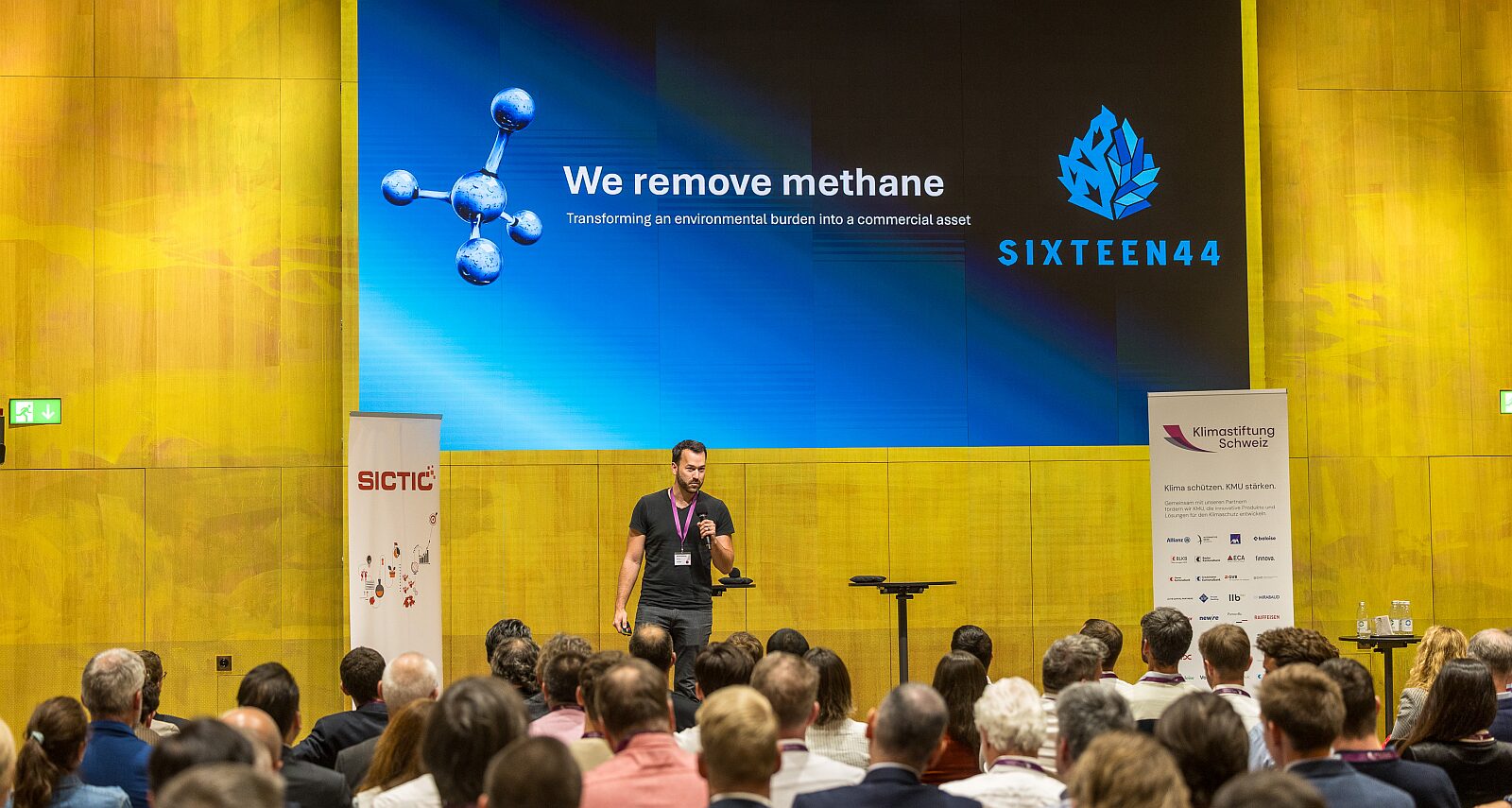
Swiss methane abatement startup Sixteen44 is preparing to deploy its first operational field demo unit at a farm in Switzerland for a multi-day demonstration to validate its process in real-world conditions.
Whereas feed additives such as 3-NOP or seaweed work by reducing methane emissions at source, Sixteen44 treats methane after it has been emitted, acting as a low-energy air-cleaning system for dilute methane sources where it is not feasible to capture or flare it.
While its tech can work in a variety of settings from coal mines to landfill sites and covered manure lagoons, Sixteen44 is first testing its tech in dairy barns.
Low-temperature oxidation
Founded in late 2024 by impact investor Nelson Dumas, chemist William Ramsay, PhD (LinkedIn tagline: “destroyer of methane”), and physicist Mario Michan, PhD, Sixteen44 deploys non-thermal plasma technology to oxidize methane. Ramsay and Michan previously worked together at methane abatement firm Daphne Technology.
While on the face of it, a process that generates carbon dioxide might not sound like a winning climate solution, methane is a far more potent greenhouse gas than CO2, says Ramsay, who says the climate math is clear.
“If you remove one ton of methane per year, it has the impact of 80 tons of CO2 [on a 20-year basis]. You could also potentially capture the carbon dioxide,” he tells AgFunderNews.
Methane is hard to capture because it is relatively inert, although it can be converted into carbon dioxide and water through a catalytic process. The problem, says Ramsay, is that this kind of tech typically needs to operate at very high temperatures (400 degrees Celsius).
“One of the advantages of what we do is that you can operate at temperatures as low as 50-60degrees Celsius, which is unheard of. If you have to operate much higher than that, then the logistics and energy costs become unrealistic.”
The catalyst was developed in house, he adds. “It’s proprietary mix that we covered in a patent application filed last year.”
On a farm, the setup can connect to a barn’s existing ventilation system or be installed where cows congregate, such as feeding areas. The tech does not involve any disruption to farm operations.
Who pays?
While methane-reduction tools that do not improve productivity can be a tough sell, Ramsay is not relying on farmers to pay for the tech. Instead, it is exploring models in which dairy coops or other stakeholders looking to reduce Scope 3 emissions fund the equipment and operating costs and recoup money via carbon credits.
While any model relying to heavily on ESG targets and the voluntary carbon market may lack appeal in the US and some other markets, Switzerland and parts of Europe are more receptive, he claims.
Given that most dairy cows around the world spend a fair bit of time outdoors, where enteric methane disappears into the atmosphere, this isn’t a silver bullet for livestock methane, meanwhile, but part of a toolbox of approaches, says Ramsay.
Beyond the barn
Beyond agriculture, coal mines also present a fertile opportunity, says Ramsay. In some markets, operators are facing emerging rules that require them not only to monitor and report methane emissions, but in some cases to reduce venting and flaring over time.
And existing solutions such as regenerative thermal oxidizers (RTOs) only work when methane concentrations hit a certain threshold, he says.
“RTOs require a minimum concentration of methane because it’s a self-sustaining mechanism [the heat from oxidizing methane sustains the reaction without much added fuel]. You need a minimum level of methane at which point the heat that’s generated keeps everything going.”
The problem is that many methane sources fall below that threshold, he says. “There’s quite a few installations where they install these RTOs and discover that the concentrations are lower than what they thought and the technology is not even usable.”
Verified methane cuts
One notable advantage of Sixteen44’s system is that methane abatement can be directly measured, providing a clearer basis for carbon credits than projects where reductions are modeled or estimated, says Ramsay.
“We have an MRV [monitoring, reporting, and verification] system and we measure the methane that comes into our system and the methane that comes out. The difference between the two gives you a 100% verified unequivocal reduction in methane.”
According to Ramsay, direct air capture for CO₂ typically uses around 1.5–3.5 kWh of total energy per kilo of CO₂, while Sixteen44’s system today uses about 1.3 kWh per kilo of CO₂-equivalent abated.
He estimates the firm’s cost of methane abatement to be around $125 per ton of CO₂-equivalent, including equipment, operating and maintenance costs. That is above prevailing voluntary carbon credit prices, but closer to the lower end of prices paid for some premium engineered carbon removal credits, he says.
“Buyers in the voluntary market are paying >$250/ton for many carbon removal solutions such as enhanced rock weathering, bioenergy with carbon capture and storage, direct air capture, and ocean alkalinity enhancement.”
He adds: “We have different business models depending on the market. For compliance, this takes the form of hardware sales or leasing or service level agreements; willingness to pay is driven by fines/taxes. For the voluntary market, the methane credits that are generated—which are bought by large organizations or even individuals—pay for the capex and opex; willingness to pay is driven usually to offset Scope 3 emissions.
“The dairy co-op is a new one, but we understood the co-op would be paying for the Sixteen44 equipment for the farms, and the milk/ dairy products could be sold at higher prices since they are made with a lower carbon footprint; we also understood that the co-op is willing to pay to offset its Scope 3 emissions.”
Climate tech reset
Sixteen44 has been funded through a mix of non-dilutive grants and equity from impact VCs, says Ramsay, who acknowledges that the appetite for climate tech solutions today is “radically different” from what it was a few years ago. Some investors are also wary of firms relying too heavily on the voluntary carbon market, he says.
“They can be skittish about 100% reliance on the voluntary carbon market, which is fair if they’ve been burned by that in the past.”
That said, methane removal is gaining more interest because of its near-term climate impact, says Ramsay, who has just launched a public crowdfunding campaign on Republic Europe. “We started it because every time we talked about our projects, people would ask is there a way that I could help?”
Over the next year, the company aims to use its Swiss farm demonstration as a launchpad for wider deployments in Europe, before expanding into other markets and methane-emitting sectors. Its longer-term target is ambitious: removing 1 million tons of methane per year by 2035.
Further reading:
Exclusive: Waste methane to fertilizer startup Windfall Bio auctions off assets
ArkeaBio raises $7m, hires Vence cofounder to accelerate vaccine for livestock methane reduction