A visual inspection of crops may suggest all is well. A tissue sample analyzed with spectroscopy may reveal otherwise. But both are lagging indicators of crop health, says California-based startup Crop Diagnostix, which is pioneering an approach it claims can identify problems weeks before visual symptoms appear.
A technique used to determine which genes are active in the plant, RNA sequencing measures which genes are turning on or off in response to environmental conditions. Because gene expression changes immediately when plants encounter stress—from pathogens to drought or nutrient imbalance—it provides a much earlier signal of trouble.
By the time nutrient deficiencies show up in leaf chemistry, by contrast, the plant may already have suffered weeks of stress and lost yield potential, says the firm.
Borrowing a tool from human medicine
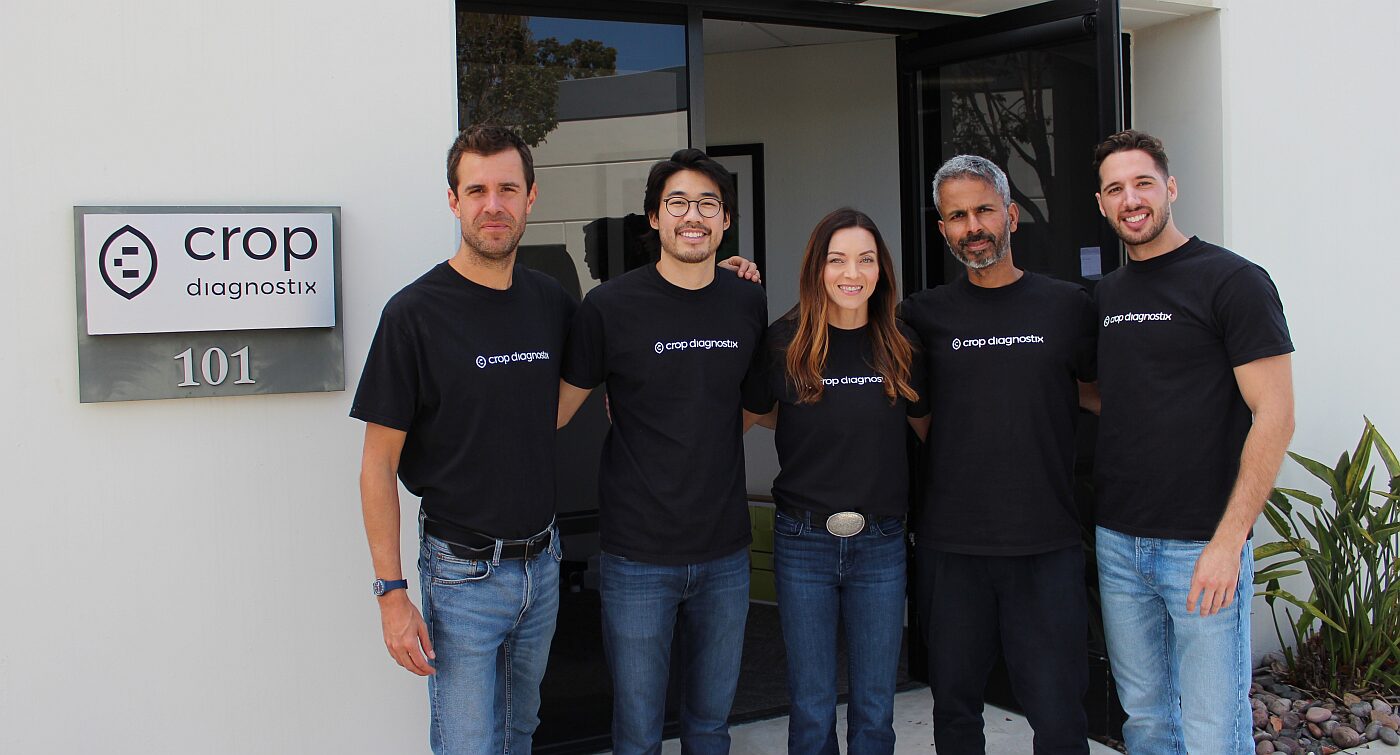
Founded in 2023 by Brandon Chi (engineer and Harvard MBA), Joseph Swift PhD (plant molecular biologist) and Amitesh Pratap PhD (AI/ML scientist), who was using RNA for early detection of health problems in humans, Crop Diagnostix is applying a similar approach to crop health, Chi tells AgFunderNews.
“The example we like to give is that if you’re sitting on an airplane and the person next to you is coughing, that doesn’t mean you’re already sick, but there’s a pathogen load in your environment and your genes are going to turn on to try to defend yourself, and that’s what we’re monitoring.
“With the cost of genomic sequencing declining exponentially, we’ve been able to deploy the technology for plant health, not just human health.”
Decoding crop stress from gene expression
The firm’s core competitive advantage lies in its proprietary biomarkers and datasets linking gene-expression patterns to stresses such as nutrient deficiencies, disease pressure, or drought. These datasets, built from thousands of real-world samples, are used to train the machine-learning models that generate four crop health indexes, spanning:
- yield response (are plants biologically on track to meet yield targets?)
- nutrient response (eg. nitrogen levels)
- pathogen stress
- water stress
In field trials, Chi says the approach has detected disease four weeks before visible symptoms, giving farmers time to apply inputs more precisely rather than relying on routine preventive spraying.
From pilots to commercial launch
The company began with corn and potatoes, where it has collected thousands of RNA samples to train its models, says Chi. The system relies on weekly sampling.
Growers punch small holes in leaves, place the samples in vials containing a stabilizing solution, and send them for sequencing. Results are delivered within 48 hours, allowing them to adjust irrigation, fertilizer, or crop protection strategies during the growing season.
“We started in corn and potato and we’ve done two seasons in both of those crops,” says Chi. “We launched a pilot with 15 growers last year in potato, and then this year we’re launching both crops commercially, and looking at expanding into others.”
Crop Diagnostix sells its service through agronomy partners and agricultural retailers such as CHS Inc. and Wilbur‑Ellis and is also working with high-yield corn grower network Total Acre, which helped it refine its platform last year ahead of a 2026 commercial launch.
In pilots, Crop Diagnostix claims RNA-guided decisions delivered a $720 per acre net profit advantage versus the grower’s standard practice driven by an 8% increase in yields and 23% reduction in crop inputs, including a 38% reduction in nitrogen fertilizer.
Given pricing of roughly $500–$700 per field per season, the exact ROI depends on field size, says Chi. “For a 120-acre field size, this would cost the grower $4-$6 per acre to return $720 per acre.”
He adds: “It’s all by letting the plant RNA tell us what the plant needs and then applying it, or in some cases not applying it, right?
“When the RNA of the plant says there’s no nitrogen deficiency, you don’t need to apply nitrogen. When it tells us there is a sulfur deficiency, you can apply a timely sulfur application. When it says there is no disease pressure, you can skip or delay a pre-planned fungicide application.”
The challenge of interpreting plant RNA
Chi—who raised $3.5 million in seed funding from backers including Trailhead Capital and Shark Tank’s Kevin O’Leary in late 2024—is unaware of any other companies offering the same service.
“We have no direct competitors and we’ve built an incredible moat because we have the largest corn and potato RNA data set that exists, and we already have models trained on that data and algorithms that are predicting all of these different indices very accurately.
“We’ve developed IP around the biomarkers [knowing the connection between the sets of genes that respond to specific stressors], our workflows, our assays and our sequencing process to be able to do this at scale, high throughput at low cost.”
The complexity arises because “within a corn plant, for example, there are 35,000 genes turning on and off in response to stress,” he notes. “Imagine each of these is a dimmer switch. We’re using AI and machine learning to decode what this pattern of dimmer switches is trying to tell us.”
A 360-degree view of crop health
That said, the information Crop Diagnostix presents to customers is “very easy to understand,” says Chi. “The RNA will show you when you have nitrogen stress, sulfur stress, water stress, or specific pathogen stress, for example.”
“We’re also working on a feature that identifies your specific limiting factor, because if your main limiting factor is water stress, for example, you can apply all the nutrients and micronutrients that you want, but it’s not going to move the needle.
“And as RNA provides a 360-degree view of crop health, we’re able to identify the limiting factor, whereas if you just look at a tissue test, you’re only assessing nutrients.”