Precise details of what went wrong at cultivated meat startup Believer Meats will no doubt emerge over time, but stepping back, says one source close to the company, “I don’t think there is any great mystery here.”
Speaking to AgFunderNews after Believer Meats ceased operations, the source said: “This executive team is known for being really aggressive about the technology and willing to take big, big risks without having certainty. And this [abrupt end to operations], I think, was always a potential outcome.
“But it’s been a sad disappointment to see what happened. The difficulty with raising so much money so quickly [$390 million] is that you then have to build business plans that deliver a return for that investor dollar, which is one of the reasons you end up with a great big factory being constructed before the technology is set.”
‘The consumer doesn’t understand cultivated meat’
Another challenge for businesses in the space, added the source, is that startups have understandably tried to simplify the tech for consumers with graphics of bioreactors with a steak coming out the other side. But the reality—in the short term at least—is that such structured products are not yet commercially viable at scale.
The best-funded players, meanwhile (UPSIDE Foods, Believer Meats, GOOD Meat) have focused on low-value meats such as chicken with a minimum viable product (cell biomass) that is designed to be combined with plant-based meats in processed products such as burgers and nuggets.
Such products are unlikely to appeal to vegans or vegetarians as they contain animal cells, while the message to meat-eaters and flexitarians is difficult to articulate. The sustainability message is not yet clear on a product such as chicken, the ethical message is a hard sell to many US consumers, the health message is confusing (the emphasis has been on matching the real thing rather than offering a healthier alternative), and the economics are extremely challenging.
This doesn’t mean that consumers will not ultimately embrace cultivated meat, said the source. But right now, the case isn’t very compelling. “The consumer doesn’t understand cultivated meat. There are always early adopters who like certain things, and if you can make a delicious product, maybe people just think it’s cool. But that’s not a basis for a business that’s raised almost $400 million and needs to deliver a return to investors.
“Believer Meats always said you would not be able to grow sufficient quantities of cultivated meat on scaffolding to build a business and that it needs to be grown [in suspension] in tanks. The commitments made to investors were for a return on investment in a relatively short period of time, which required massive scale. Which would, I guess, be fine if you were able to consistently grow the cells without contamination events at scale. Everyone hoped that that technology was farther along than it was.”
Tech not yet validated at scale in new plant
Another source told us that staff at Believer Meats’ North Carolina plant had become aware of money troubles at the firm in recent months as it became hard to get hold of supplies needed to complete routine tasks.
He added: “It felt like too much capital had been spent on making the facility as revolutionary as possible, so for example we had these smart Bluetooth door locks, which seemed like a gigantic waste of money at a time when we hadn’t even sent samples to a customer.”
At a town hall meeting in November, employees at the plant were told that the company—which has R&D facilities in Israel, corporate offices in Chicago, and a plant in North Carolina—was attempting to secure eleventh-hour funding, which presumably did not materialize, as mass layoffs followed on December 1.
Between that town hall and the end of November, several visitors had tastings at the factory, said the source.
The plan had been to validate the firm’s bioprocess such that Believer could start sending out samples in Q1 and commence production in Q2. However ongoing technical issues had delayed matters.
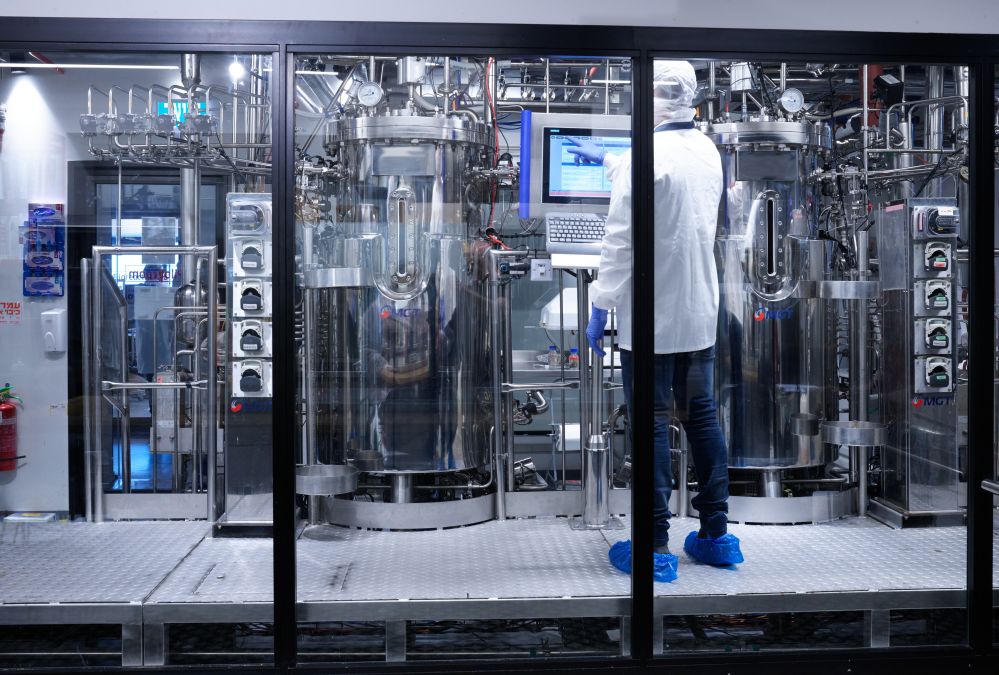
AgFunderNews understands that the plant had 50-L, 200-L, 2,000-L and 20,000-L vessels but had not yet validated the technology at every stage.
Believer Meats has not publicly commented on the size of the reactors at the North Carolina plant, while a peer-reviewed article in the journal Nature in 2024 cites data from small-scale perfusion bioreactors and some “hands-on experience” at the 300-liter scale. Larger production volumes have been discussed publicly in terms of output rather than disclosed reactor size.
A third source told us: “It was a house of cards, and it all collapsed. The technology should never have been scaled the way it was, because it wasn’t working at small scale.”
UK-based Hedosophia, which AgFunderNews understands to be a leading investor in Believer Meats, did not respond to a request for comment.
What they’re saying:
👉 Association for Meat Poultry and Seafood Innovation (AMPS): “Temporary setbacks, while unfortunate, do not represent the whole and thus should not overshadow the momentum, resilience, and collaboration that continue to characterize our industry.”
👉 Didier Toubia, Aleph Farms: “Aleph Farms also planned to invest massively in a US plant following its $105 million B-round in 2021, but decided a year later to pause CAPEX investment and to pivot towards an asset-light approach, and also decided to pivot from a US-first focus to a focus on shorter path to profitability starting outside the US and then moving to the US in a second stage, following reaching its short-term EBIDTA targets.”
👉 Mark Post, PhD, Mosa Meat: “A ‘shake-out’ in the cultivated meat industry is a natural phase of maturation, given the rapid influx of startups in recent years… We have found that investors support a rational, deep-biotech approach that prioritizes fundamentals over speed.”
👉 David Ziskind, Mach Global Advisors: “This reiterates the importance of strategic facility planning, having the right capital project team experience, and careful selection of an EPC partner.”
👉 Tim Olsen, PhD, EdiMembre: “While a large manufacturing plant certainly represents a milestone, it was perhaps built before it was truly needed… but Rome wasn’t built in a day.”
👉 Paul Burridge, PhD, Clever Carnivore: “With an unlimited budget, you can rush to hit certain milestones—like building a full-scale production facility—but you risk putting the cart before the horse and ending up with an expensive factory built around a process and product that aren’t fully proven out.”
Further reading:
Exclusive: Cultivated meat co Believer Meats sued by design build firm for $34m in unpaid bills