News of Halter’s $220 million Series E earlier this year—a round that valued the New Zealand livestock technology company at roughly $2 billion—sent an all-too-familiar ripple through the agtech world. Investors voiced excitement, practitioners advised caution, and everyone debated whether virtual fencing is “the new barbed wire” or another overhyped sector.
The reality, as with most things in ranching, is more nuanced. Away from investor pitch decks and conference booths, a growing number of American ranchers are deploying virtual fencing collars to change the way they manage herd movement and land. While it’s not yet a widespread phenomenon, a growing majority uses the same analogy over and over:
“Just as barbed wire revolutionized the management of agricultural ecosystems around the world in the late 19th and early 20th centuries, virtual fencing offers similar transformational potential,” says Drew Bennett, a professor at University of Wyoming.
“What we’re watching here is the new barbed wire,” adds Zach Abney, who manages roughly 5,100 acres in southwest Oklahoma and deploys virtual fencing across several family office agricultural investments he oversees.
“When we think about huge leaps in animal management — herding, then barbed wire, then electric fence — it’s hard to overstate how dramatic the front end of this technology is as a tool for ranchers.”
At a glance: how virtual fencing works
Virtual fencing systems vary from one company to the next, but all share some basic technology that conditions animals’ behavior in the pasture.
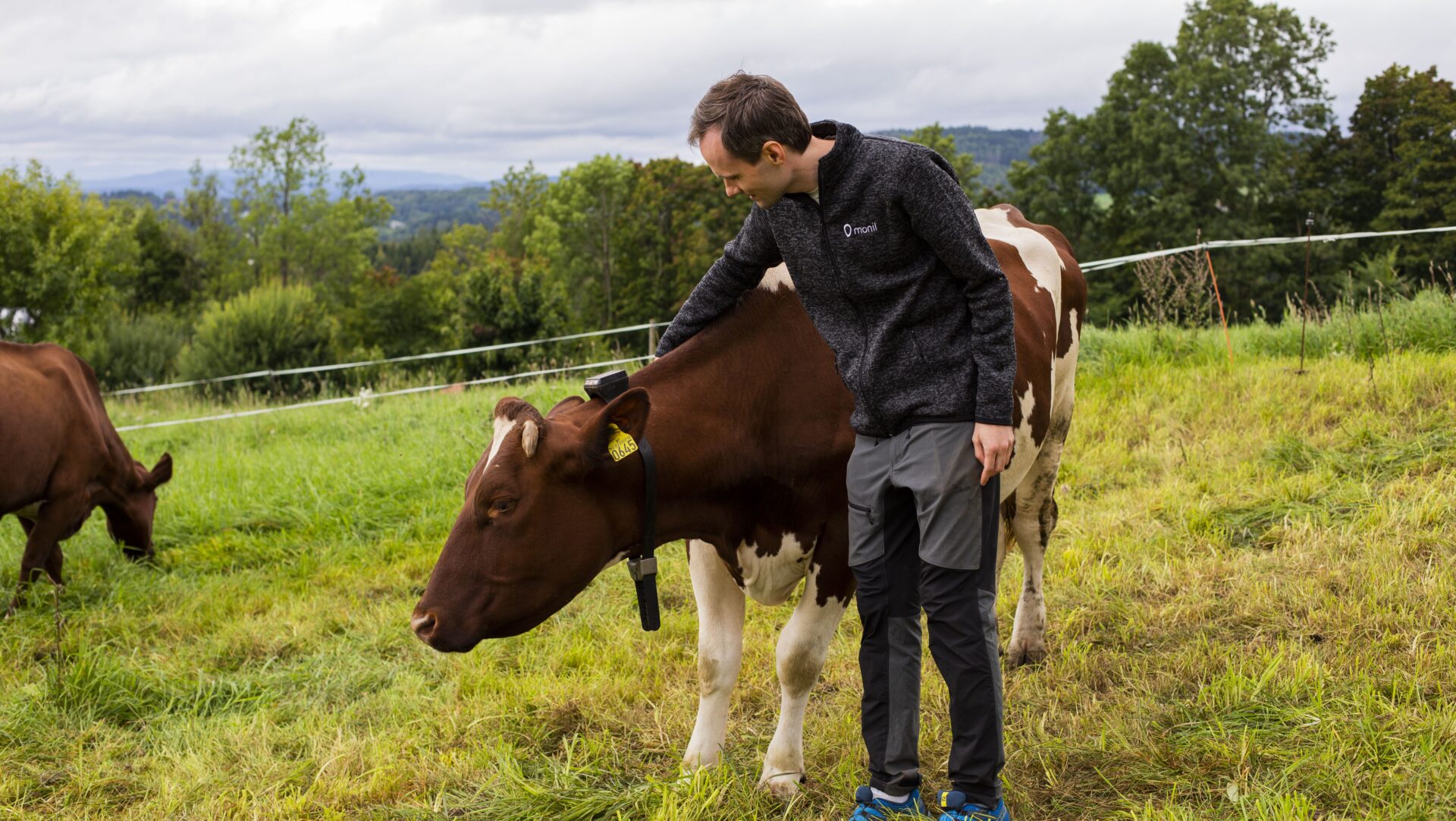
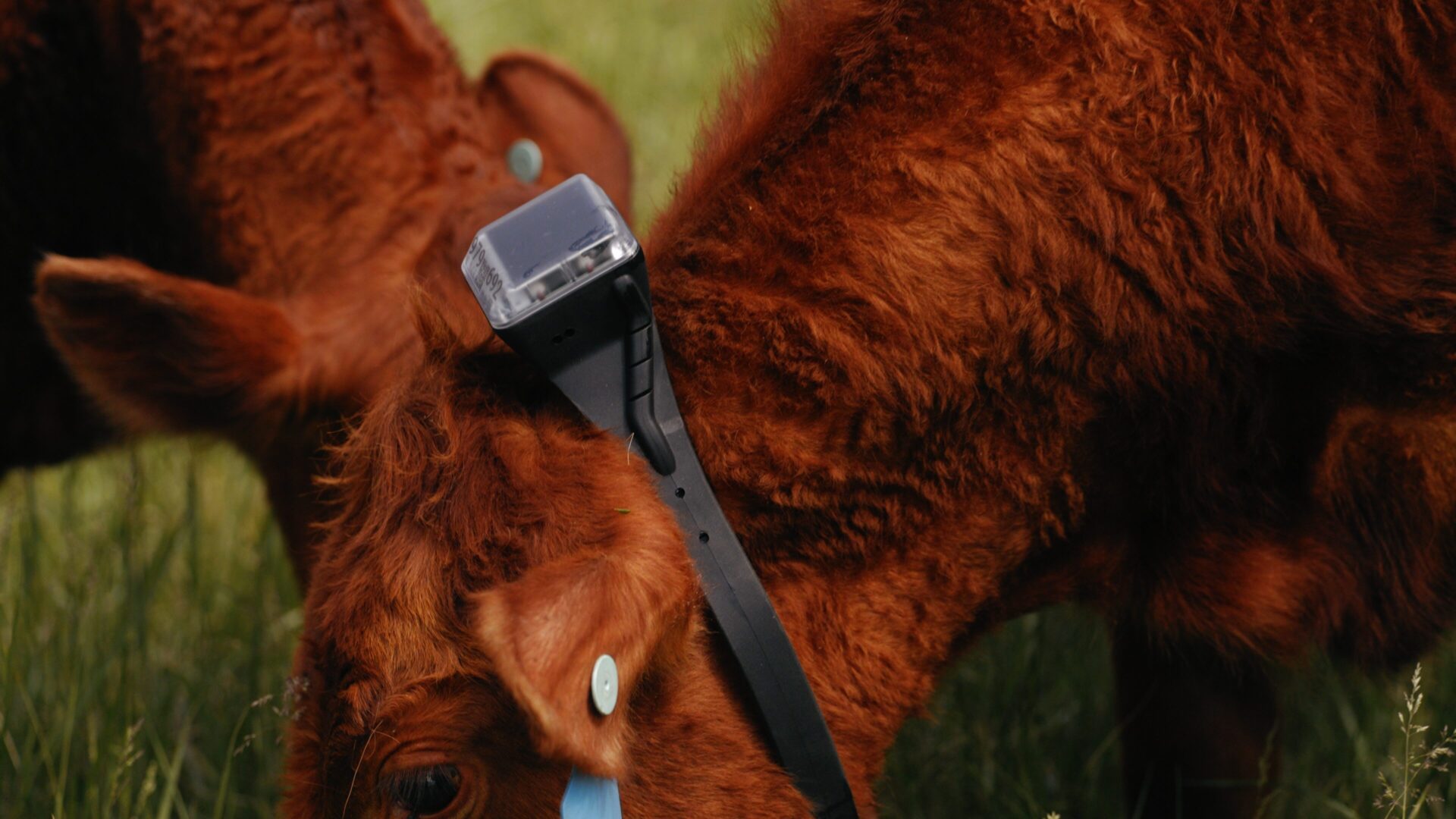
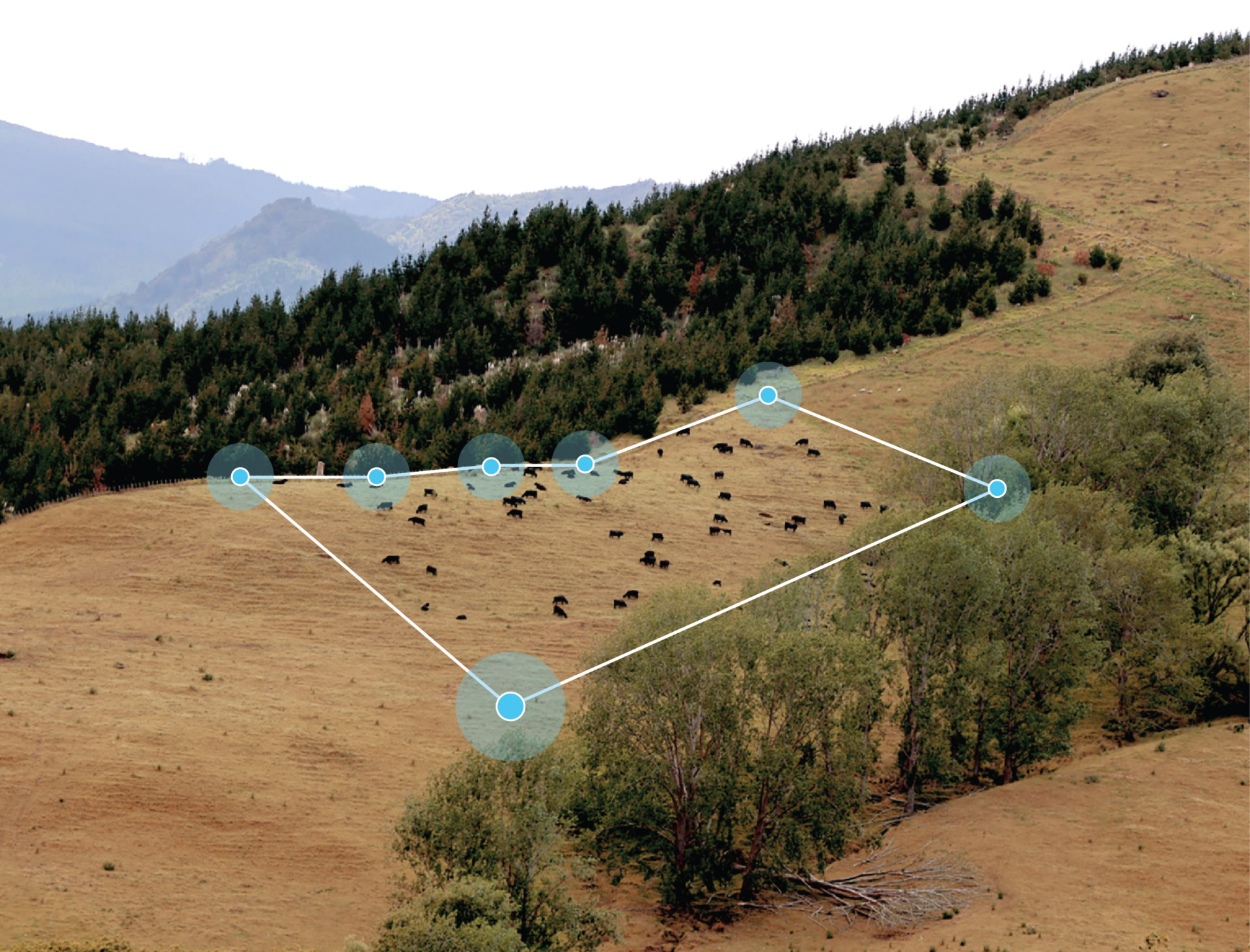
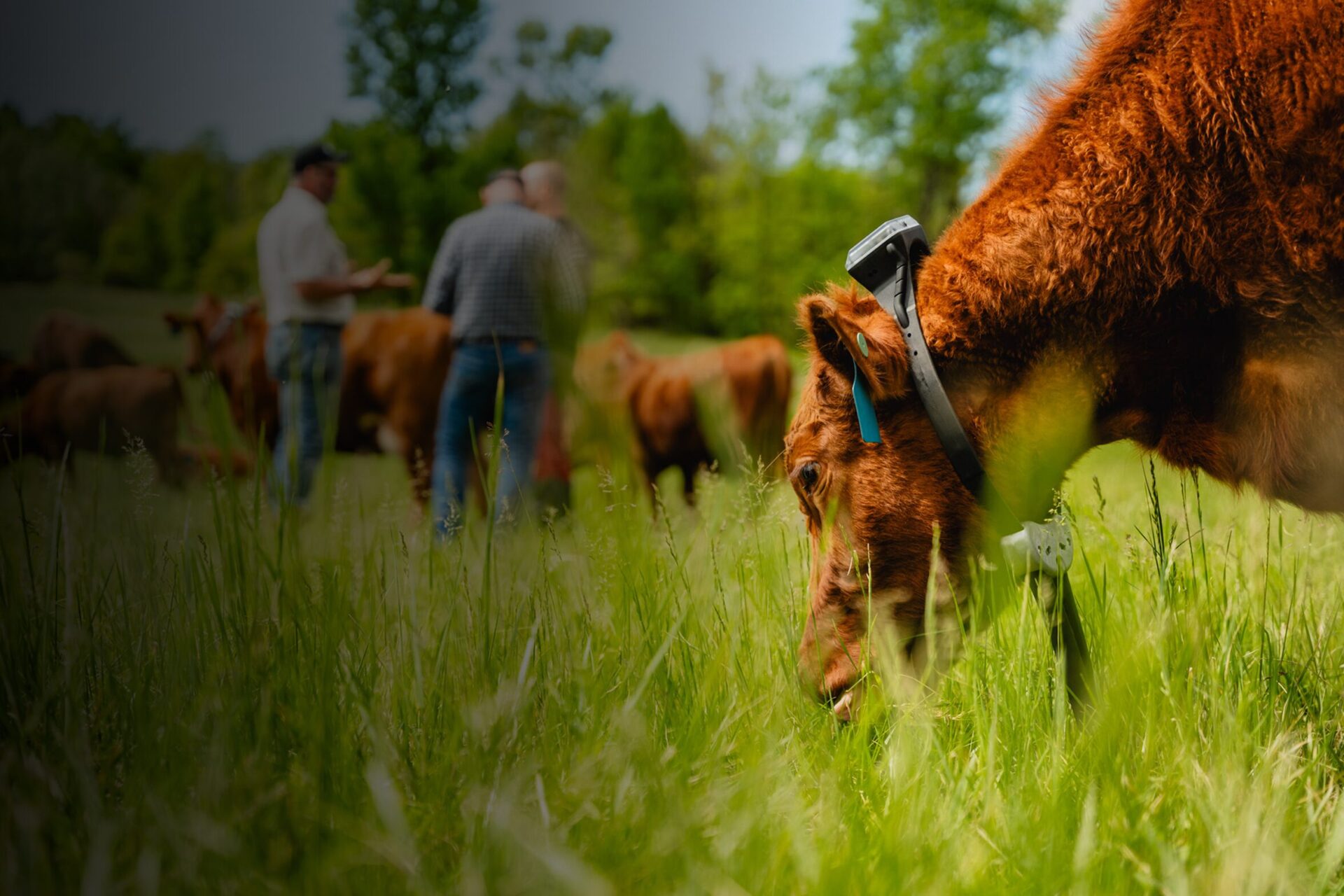
Cows and other livestock wear a GPS-enabled collar that wirelessly communicates with cell networks and base stations to keep animals enclosed within a specific invisible boundary. Livestock managers define those boundaries via software, which tracks each animal’s movements. When an animal ventures too close to the invisible boundary, the collar emits an audio cue (a beep or a tone, in most cases); if the animal continues towards the boundary, the collar then issues a mild vibration or mild electric pulse that, in theory, motivates it to turn back from the boundary.
Meanwhile, collars transmit data back to the software platforms with information on animal movement and health, and overall grazing systems.
The technology has been commercially available for several years, but meaningful adoption in the U.S. is relatively recent. Halter, currently claims collars on over 1 million animals globally across New Zealand, Australia, and the U.S. Monil, No Fence, and Vence, all from Norway, are also expanding across the US.
Bennett suggests that, in terms of both technology and its adoption, it’s still early days.
“We’re somewhere between the Zack Morris brick phone and the iPhone,” he says. “We’re well out of the brick phone era, but we’re not at the iPhone phase yet.”
An ‘enabler of precision livestock management’
The biggest benefits of virtual fencing have little to do with replacing the actual fence line with GPS collars, however.
“The bigger story is really that the collar has become the enabler of precision livestock management for ranchers,” says NoFence CEO Joachim Kähler. Collars are, at this point, mere “table stakes”: they must be robust, effectively contain animals, and function reliably, but the real value lies in helping ranchers better understand their overall operation, he says.
“As a rancher, you want to make the most of the land, but also understand where you can get the primary amount of feed for your cattle. And you want to be precise in how you follow up and monitor each individual cow. That is what this system is allowing you to do, and that is the logical direction of this technology.”
Critically, he says, this is the direction NoFence’s customers have asked the company to take, suggesting an industry-wide need for better ranch management tools.
Ranchers that practice rotational grazing—that is, moving cattle from one section of pasture to another frequently to optimize forage—point to the time and labor savings virtual fencing can bring to this practice.
For example, Abney describes his operation before adopting Halter: moving cattle four to six times a day using polywire (rolls of electric fencing unreeled by hand across pastures).
“Significant labor goes into that,” he says. “You’re talking about all day long.” He adds that the financial benefit of invisible fencing was clear, given the costs of in-person hours.
In fact, precision grazing without the polywire is a primary driver of U.S. adoption, according to Janna Salte Hovstad, chief commercial officer at Norway-based Monil. “The main use case we’ve been seeing so far is actively moving animals to get more out of the pasture, improving pasture utilization and being more efficient in how [ranchers] move animals.”
The labor-saving dimension takes on added significance given the demographics of American ranching. The industry has long struggled to attract and retain ranch hands. Many small and medium-sized operators — which represent the overwhelming majority of the roughly quarter-million beef producers in the country — hold off-farm jobs to stay solvent.
“You can easily move the pasture twice while you’re at the office,” says Theo Beaumont, head of strategy and operations at Halter. According to him, the ability to remotely position a herd is not a convenience but the difference between implementing rotational grazing or not doing it at all.
Virtual fencing also opens terrain that was previously impractical to fence. Colorado rancher Cassidy Johnson whose family manages 70,000 acres, describes a neighbor who uses Halter on cattle that graze a forest lease in summer while he farms elsewhere. “He just wants to know where they are,” she says. In mountainous terrain where electric fencing is impractical, particularly where elk break through wire, virtual collars offer the only viable precision option.
Researchers, meanwhile, point to other economic benefits. Bennett notes potential drought resilience gains from being able to move cattle away from stressed pastures faster, as well as better utilization of forage in areas where cattle would otherwise congregate and overgraze.
“There are a lot of benefits that are economic or financial back to the producer from a management standpoint that traditional fencing is difficult to do,” he says.
The data dilemma
The loudest concern in virtual fencing today is around data privacy. GPS- and satellite-enabled collars generate a continuous stream of location data, movement patterns, calving events, heat cycles, and health indicators for every animal in a herd. That data has obvious value to the companies collecting it, not to mention anyone they might choose to sell it to.
As to who owns the data, the answer is predictably nuanced. NoFence’s FAQ section on its website explicitly tells ranchers, “As a Nofence user, you retain 100% ownership and all rights to the data generated by you and your use of the product.”
“There’s a huge privacy element to this, and that’s why we’ve taken a very clear stance that our customers own their own data,” explains Kähler. “We will never share or sell their individual data, which, to my knowledge, is the most rancher-friendly stance in the industry on that topic.”
However, the company owns the “solution data”—that is, data generated by the collars themselves. According to the company’s Product and Subscription Terms, “Nofence retains all rights and the sole and exclusive ownership of all the Solution Data, including any Intellectual Property Rights vested therein.”
Similarly, Halter customers “own” the data they input, but according to the company’s Terms of Service, “Halter may access, store, use, adapt, modify, analyse, and disclose the Customer Data” for things like marketing, machine learning, internal research, and “for any other purposes in connection with Halter’s commercial operations.” When sharing customer data with third parties, it has to be aggregated so individual customers can’t be identified. Halter owns the data generated by the actual collars.
Not all ranchers mind this, either.
“Halter owns my grazing data. I’m sure it’s going to get sold at some point, because I signed it away,” Abney says matter-of-factly. “I’m okay with that, because I’m making money in the short term and the long term by being more efficient. But there will come a time when that will be the primary question.”
Johnson, who is also an agtech consultant and public speaker, is less sanguine, highlighting in particular the involvement in Halter’s latest fundraise of Peter Thiel, who cofounded data-mining company Palantir.
She advises meticulous analysis of every data ownership clause in a contract: “You have to look in the fine print, and you have to look every single year you sign that agreement or you renew your subscription. Even if it’s copying and pasting it into Claude or ChatGPT, and saying, ‘Hey, is there anything in here about data ownership, privacy, flag, everything about data for me,’”
In a recent research paper, Bennett noted that privacy concerns are compounded by the absence of clear regulatory frameworks around data ownership and governance right now, especially in the United States.
“Some producers worry that mandatory data sharing requirements could compromise their operational autonomy and expose sensitive information about grazing patterns and livestock movements. In the United States, producers also worry that if they use the technology to graze on public lands, federal agencies may be compelled to share the data.”
The concern reflects a well-documented pattern across industries: early adopters accept data terms they barely read, and discover years later what they agreed to. As Johnson puts it, “We’ve seen large companies over and over again misuse and sell user data.”
Set it—but don’t forget it
Going forward, the industry will also need to consider how it educates ranchers about virtual fencing and herd management technology. In other words, there’s a risk of mistaking a management tool for a management substitute.
Craig Piggott, founder of Halter, says it can’t simply be a “set-it-and-forget-it” operation that will work on every single farm out there, at any time.
“You need to be willing to use the product and change what you were doing to some degree. That’s a really important mindset piece,” he notes.
“Virtual fence can’t doctor a cow,” says Johnson. “It can’t teach you to look at the ecosystem in relation to the cow.”
Her concern is that as regenerative and precision grazing practices attract newcomers, some will see virtual fencing as a shortcut around the hard-won expertise of traditional stockmanship. “If we take it as a tool, not as a solution, I think we’ll be okay. If we start relying on it too much, something else suffers.”
Virtual fencing for conservation
One of the more compelling dimensions of the technology, and one that could eventually bring conservation funding into the adoption equation, is its potential for environmental management.
The most direct application is riparian protection. Riparian corridors along streams and rivers are among the most ecologically sensitive zones on ranch land, and government conservation contracts frequently require restricting cattle access. Virtual fencing makes that restriction dynamic and precisely enforceable without the need for permanent infrastructure.
Bennett says that he and his research colleagues are tracking how virtual fencing could enable ranchers to remove interior fences once the technology proves reliable. Physical fencing—especially older barbed wire, is responsible for wildlife injury and death across the American West.
“We’ve seen a couple of examples where producers have been in for two grazing seasons now, and they are moving forward with taking down some of those interior fences,” he says, noting that perimeter fencing remains legally required in most jurisdictions, but that interior fences represent the large majority of fence miles on most operations.
Virtual fencing also has implications for wildfire recovery on public land grazing allotments. When a fire burns through an allotment, ranchers typically can’t return their cattle until infrastructure is rebuilt, which most often takes years. The U.S. Forest Service has been actively exploring how virtual fencing could allow livestock back onto unburned portions of an allotment far earlier, without waiting for perimeter reconstruction.
Bennett notes that conservation is still a niche application for virtual fencing, but can be an important one for how we manage the environment, and it might help get some ranchers on board if there are partners willing to cost share or provide tech assistance and things like that to get folks set up.”
Investment potential: a Rorschach test
Blackbird VC, an early backer of Halter that has continued to invest in the company, declined to comment on whether it believes the company’s $2 billion valuation is overhyped or not.
Samnatha Wong, a partner at Blackbird, did note that her firm has “growing conviction that Halter is delivering a category-creating product in a huge global market, led by a singularly talented founder.”
Blackbird said at the time of Halter’s Series E raise that the company had seven consecutive months of zero customer churn. Piggott himself noted that Halter is not strictly positioning itself as an “agtech” company, and that its investor base reflects that.
Other investors are forthright about the potential of virtual fencing overall. Antony Yousefian, partner at The First Thirty Ventures told us earlier this year, “The market is very much undervaluing the potential” of the technology. A dairy cow can generate $15,000 or more in gross lifetime revenue. “Catch a health issue two days earlier, tighten a calving interval, improve output quality, and you’re expanding the lifetime value of the animal, not just cutting fencing costs.”
“At sub-1% penetration of 1.5 billion global cattle, $2 billion is early innings,” he added.
In many ways, Halter’s valuation is more of a Rorschach test for the virtual fencing sector than anything else.
Advocates point to genuine transformation and a massive global livestock management market. Skeptics see a familiar pattern: offshore founders with limited understanding of American ranching, young sales teams with no ranch experience, and capital chasing a story more than a proven business model.
“That technology is not worth a billion dollars,” says Johnson, though she’s quick to add that Halter’s product is currently the best on the market.
Bennett takes a more measured view: “I’m really sold on the potential of this as a pretty revolutionary technology going forward. How that translates into investment potential is a much more challenging question.”
Concerns about the Halter valuation aren’t unfounded. Agtech, after all, is still recovering from the carefree years when cheap money inflated valuations and funnelled hundreds of millions into vertical farming and plant-based meats. These sectors ultimately failed to live up to their promises and are, at least in some part, a reason for the hyper-cautious investment environment agrifoodtech startups now grapple with.
There are some key differences worth noting, however. Vertical farming saw a series of massive fundraises and valuations between 2020 and 2023: $200 million for InFarm, $300 million for Bowery, and $400 million for Plenty, among many others. Valuations went as high as $1 billion for companies like Plenty and AppHarvest.
Halter is currently the only virtual fencing company to have raised north of $100 million so far. The next-highest figure raise was NoFence’s $35 million round from 2025.
Virtual fencing companies are also reporting fast adoption and technology improvements. In Norway, Monil reports 40% market penetration in the cattle sector. In the U.S., a combination of the smallest cattle herd in decades, high replacement fencing costs, and a generational shift toward tech-comfortable operators is creating conditions for faster uptake. Halter is doubling down on U.S. growth; Monil, commercially available in the U.S. since April, is building out regional support teams across the Midwest.
The question is whether the companies building in this space will earn the trust of a ranching community that is, by nature, cautious. Agriculture, it must be remembered, is an industry based on reputation, and that reputation travels fast.
“Ranching is an art that is run like a business,” says Johnson, quoting a rancher she admires. “If we can find a way to utilize virtual fences to help us run our business better and get better at the art of raising biological beings inside a biological system, then it will be an excellent tool.”
For Abney, the trajectory is simple: “As an adoption curve, it only accelerates over time as costs come down relative to the output that collars give you as a rancher.”
“It’s hard to imagine, 10 or 15 years from now, that some kind of wearable isn’t standard.”