Singapore-based Polybee has what one investor calls “a rare combination of high technical defensibility and immediate, bankable ROI” – which is pretty unusual in the agtech space.
Founded by Siddharth Jadhav in 2019, Polybee operates a fleet of “physical AI agents” or self-recharging drones mounted with cameras to monitor the quality, ripeness, and health of crops to provide AI-powered forecasts helping growers know exactly when to harvest for optimal yield and profitability.
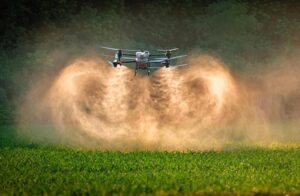
The drones, which are now being deployed commercially in open fields of spinach and broccoli, can also be used in greenhouses for pollination via patented controlled airflow tech: blowing pollen from flowers onto stigma in self-pollinating crops such as tomatoes, strawberries, and blueberries.
This eliminates reliance on bumblebees and maximizes fruit set between peak growing seasons when pricing is higher, says the firm, whose backers include Blue River Technology founder Jorge Heraud.
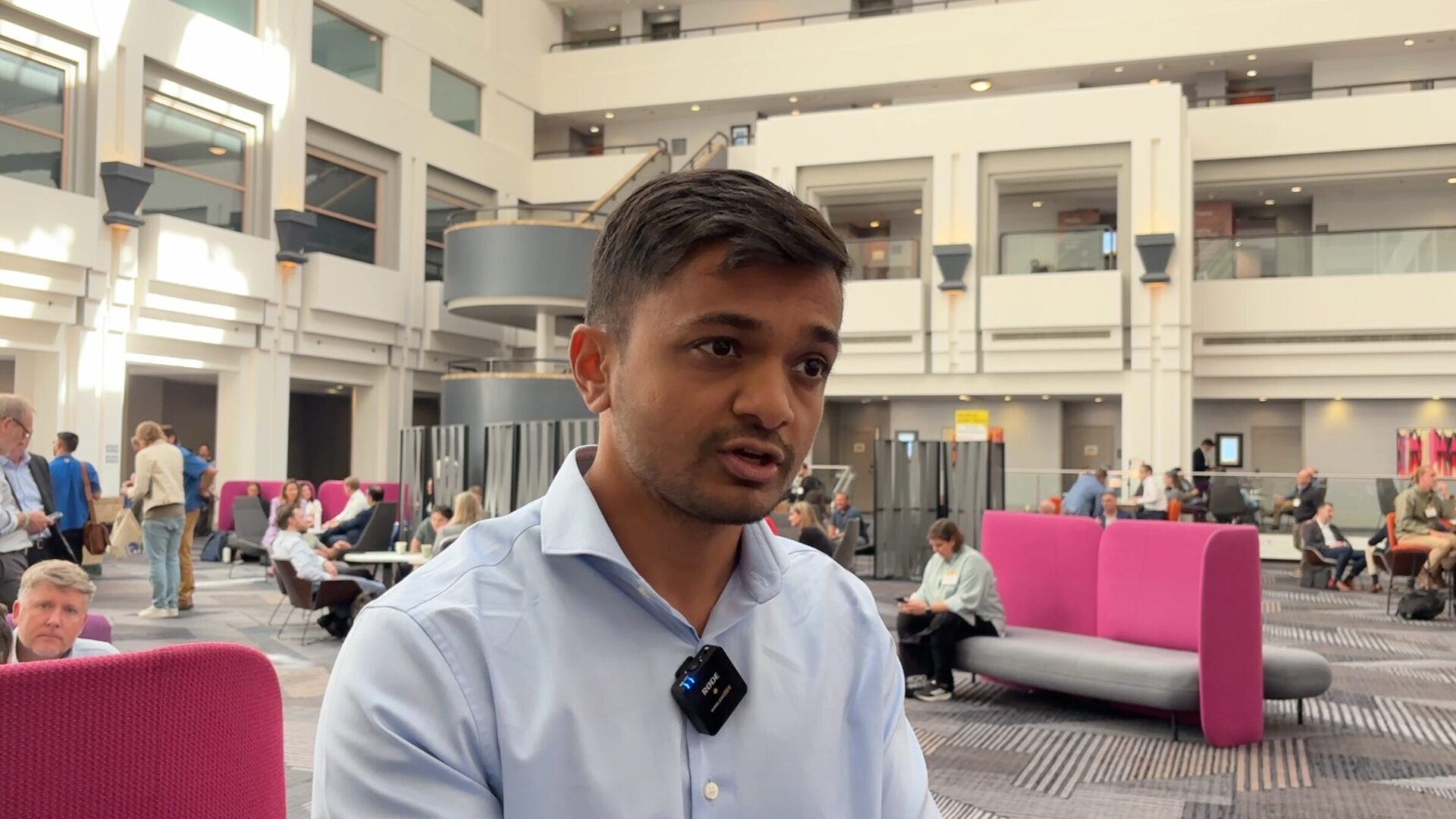
AgFunderNews (AFN) caught up with founder Jadhav (SJ) at World Agri-Tech to discuss how the tech works, why growers are embracing it, and how quickly they can expect a return.
AFN: Give me the elevator pitch…
SJ: At Polybee we are building physical AI agents that turn unpredictable produce farms into data driven factories. For centuries, produce farming has been helplessly unpredictable, and our thesis is that the root cause of that is lack of visibility and control on farming operations.
Our physical AI agent operates a fleet of autonomous drones that runs around the farm and scouts every single plant and gathers intelligence on it.
We’re performing multiple jobs for farmers such as forecasting yield, scouting for stress, and where relevant, performing jobs such as pollination.
Each of these contributes towards higher visibility and control on farming operations, and that’s how we enhance profitability.
AFN: What’s the business model and expected ROI?
SJ: We charge customers a fixed fee per hectare and the expectation is that it yields them at least 3x to 5x return within the same crop cycle.
AFN: Expand on the value that physical AI offers…
SJ: One of the core capabilities that Polybee really focuses on, and took us a while to build, was end-to-end automation.
If you look at any of these tasks, they’re performed by drones that are self-launching and self-recharging; they do not require any user touch points whatsoever at any stage. And that’s a key capability that we had to build in, because if we don’t do that, the product’s just not going to scale.
We’ve seen enough examples in the sector where there were drones involved and they had to be operated by someone, and that was not sufficiently taken care of by companies or service providers.
Essentially our physical AI agents act as the central nervous system of farming operations, where we gather intelligence and give key insights on when to harvest and what volume to expect.
AFN: Why is a drone able to offer superior intel/insights versus an experienced grower?
SJ: One [advantage] is the accuracy of the metrics that growers try to gather.
For example, if it’s a fruiting crop, you need to know exactly how many of these fruits are ripe? How fast are they ripening as a function of weather? And if it’s vegetable crops, how fast are they growing? Are they within the quality and the specs that we need?
You need to have objective metrics to assess what’s in your inventory and how fast it is maturing [in order] to go harvest it [at the optimal time]. Accuracy is not even a metric that can be measured today because all of this is eyeballed. You’ve got growers walking around the field, sampling a few plants and getting a feel of it and basing decisions on that. But growers will be the first to admit that that is not [an ideal way] to run their business.
The second [advantage of Polybee’s approach] is sample size. In produce crops, what’s inherent is a lack of uniformity and variability in how they develop. No matter how advanced the genetics are, even in greenhouses where there is a very controlled environment that is supposed to take care of this, you will still see a lot of variability.
We’re sampling a significant number of plants which is not possible for growers to do.
AFN: How much progress have you made to date?
SJ: Our product is fully commercial and we have launched at multiple locations where it’s operational on 100% of [our partners’] farms. But that said, growers typically first want to build confidence in the system, so in stage one of a deployment, it might be that we target 10-20% of the farm area for a few months so they can compare that to their status quo.
So a comparison can be drawn across the yield forecast that we make versus what they make. For pollination, for example, what’s the yield that they’re getting with our system versus their system? That gives sufficient time and space for everyone to evaluate the ROI.
Once we cross that stage of 10-20% of the farming area, then we’re ready to roll out the solution across their whole farming operation.
AFN: What kind of increases in yield have your partners seen?
SJ: If you look at forecasting, what matters is accuracy and whether our recommendations for harvest timing are leading to higher yield. We’ve already assessed this across open field vegetable crops commercially, wherein when our recommendations are followed in crops like spinach and broccoli, our customers have walked away with at least 10 to 15% higher yield.
Sometimes the recommendations can be quite subtle. A couple of days here and there [when it comes to harvesting time] can amount to yield differences of 10%. We’ve proven, time and again, across multiple crops, varieties, and regions, that if our recommendations are followed for harvest timing, growers can walk away with 10-15% higher yields.
The other application is pollination, which we are just scaling up for a couple of crops, strawberries and tomatoes. Here we see yield gains of anywhere between 5-10% depending on the crop and variety and region, compared to status quo pollination. And what’s super interesting is that these yield gains are not just at any time of the year; these are in shorter seasons where the price is high.
AFN: How do your drones enable pollination?
SJ: Polybee agents perform pollination on self-fertile crops, or self-pollinating crops growing in greenhouses. Today it’s primarily two crops: tomatoes and strawberries.
The drones leverage the turbulent air flow in their downwash in their propellers to vibrate flowers at just the right frequency, just the way a bumble bee would pollinate these flowers. Those vibrations disperse the pollen grains and successfully pollinate the flowers.
Where you have bumblebees, our value proposition is not so much replacing them, it’s more to do with complementing bees where they’re not really doing the work. We’re enhancing pollination success rates in shorter seasons, where bees are very difficult to manage.
In regions where you do not have access to bumble bees such as Australia and some countries in South America, pollination has to be done manually. Here, you’ve got people going around with leaf blowers or with sticks that they whack the plants with, hoping that this leads to pollination. We’re taking labor out of that equation entirely.
Further reading:
Polybee raises $4.3m to automate yield forecasting and pollination with ‘physical AI agents’
Drone-Hand reshapes livestock management from the air with AI-powered precision
Buckle up, say investors as AI reshapes agrifoodtech: ROI may be “unusually tangible’
🎥 Ag’s new toolkit: AI, genomics, and robotics converge at World Agri-Tech