
Singapore-based Polybee has raised a $4.3 million seed round led by Paspalis Capital and elev8 VC to scale its pollination and yield forecasting tech, delivered via a fleet of tiny drones that serve as “physical AI agents” in greenhouses and open fields.
The round—which was also backed by SEEDS Capital plus strategic angel investors including Blue River Technology founder Jorge Heraud—will be used to fuel the firm’s five-fold expansion to 4,000+ acres in 2026.
“We see Polybee as the definitive leader in the next generation of physical AI for agriculture,” said elev8 VC managing director Aditya Mathur. “Its platform offers a rare combination of high technical defensibility and immediate, bankable ROI.”
“What impressed us was not just the technology, but the commercial traction,” added Paspalis Capital CEO Harley Paroulakis. “Growers are already seeing yield improvements and cost reductions.”
Actionable intelligence, rapid ROI
Founded by Siddharth Jadhav in 2019, Polybee operates tiny self-recharging drones mounted with cameras to monitor the quality, ripeness, and health of crops to provide AI-powered yield forecasts helping growers know exactly when to harvest for optimal yield and profitability.
“We have unequivocal evidence by now that if our recommendations and predictions are followed, you get higher yields compared to growers’ own decision making,” Jadhav tells AgFunderNews. “This has been proven across multiple regions, across seasons, and varieties.”
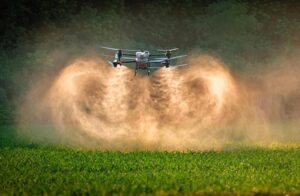
The drones, which are now being deployed commercially in open fields of spinach and broccoli, can also be used in greenhouses for pollination via patented controlled airflow tech: blowing pollen from flowers onto stigma in self-pollinating crops such as tomatoes, strawberries, and blueberries.
This eliminates reliance on bumblebees and maximizes fruit set between peak growing seasons when pricing is higher, says Jadhav.
“In some of these glasshouses in Australia, pollination is a hair-on-fire issue; they’ve got people working for hours every day just whacking the plants with a stick [to shake the flowers and induce pollination].
“But even in places where you have bumblebees such as glasshouses in the Netherlands, they are exploring our solution because first, it’s more consistent, and second, you’re de-risking the spread of certain pathogens from bumblebees [to the crops].”
Visibility and control
According to Jadhav: “Case studies across baby leaf spinach and broccoli operations demonstrate 3x profit improvement through optimized harvest timing and early stress detection. In greenhouse crops, autonomous pollination has delivered up to 15% higher yields.
“This is particularly valuable during shoulder seasons when market pricing peaks. Growers have also reported additional savings from reduced manual scouting time and more informed negotiations with buyers.”
While experienced growers can and do make predictions simply by looking at a sample of their crop, he says, “Instincts don’t scale, and neither does eyeballing a thousand hectares.”
Berries, for example, ripen at different rates across tunnels, he notes. “Pick too early and sacrifice sweetness; wait a day too long and lose them to spoilage,” adds Jadhav, who was studying the physics of flight, aerial robotics and drone control systems at the National University of Singapore before starting his own company.
“An orchard manager commits to contract volumes months ahead, blind to stress creeping through the canopy that will surface as missing tons at harvest.”
In high-value crops such as baby leaf spinach for salads, meanwhile, leaves need to be a particular size, and to pick them at exactly the right time, rows should be harvested in a certain order, says Jadhav. “It’s a tightrope walk. On the one hand, you want to get as close to the spec size as possible, but on the other hand, it can’t be too low in weight.”
In a nutshell, he says, Polybee is about enhancing visibility and control. “If you want to make an accurate forecast, you need to capture the variability, which is such an inherent part of fresh produce. That’s where our solution really comes into its own, because of the [comprehensive] sample size.”
Hardware agnostic system
Polybee has secured multiple commercial contracts with Australia’s largest glasshouse producers, some of the biggest fresh produce growers in the US, and the UK’s second-largest greenhouse berry producer.
Right now it is deploying its tech on off-the-shelf drones from Chinese supplier DJI but says its fleet automation software is hardware agnostic. “We can use any drone that has a docking system,” says Jadhav. The key is that they can self-launch and self-recharge without requiring human operators.
“They just keep flying, recharging, and going back out.”
While growers are always wary of new tech, he says, “Every broccoli grower we’ve spoken to has wanted us to work with them. The bottleneck is our bandwidth at this stage. It’s really a compelling example of a crop where there’s a lot of variability and very low visibility. The same goes for berries. Forecasting in berries is probably the number one commercial problem in the industry.”
The business model
Polybee charges a fixed fee per hectare and does not require customers to buy the drones upfront, says Jadhav.
“We’re offering and end-to-end solution that includes the hardware, the subscription to the software, and any field support that they may need.”
What’s next?
Polybee has initially focused on yield forecasting and pollination but it is also exploring more sophisticated imaging for scouting for stress and disease, says Jadhav.
“We have some drones with multispectral cameras for this, but they’re not self-launching and self-recharging. However, we’re in discussions with manufacturers who can build multispectral cameras that can be a payload on these docking drones, which will enable us to do a lot more with the same piece of hardware.
“So that’s one area that we want to go deeper into this year. We have a layer of intelligence there, but there’s an opportunity to go deeper. We can tell what’s wrong where but for diagnosis, you need deeper insights, and that’s something that we can achieve through multispectral imaging.”