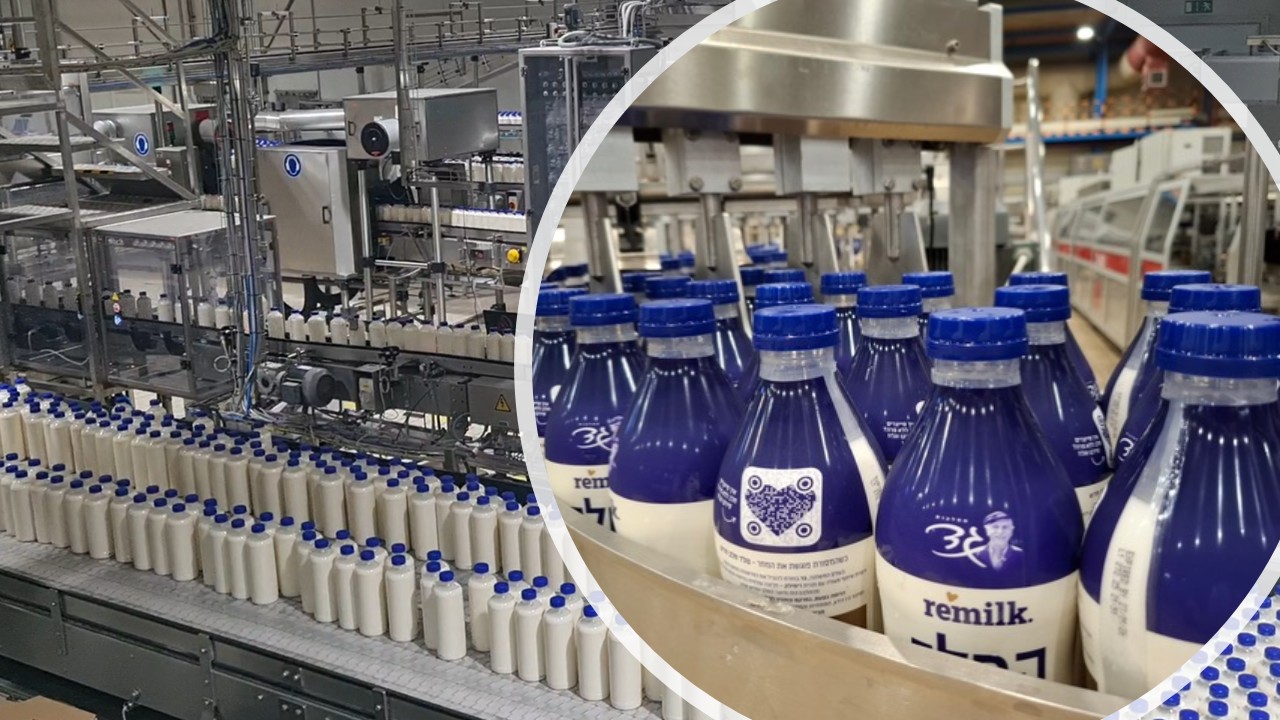
Israeli startup Remilk has partnered with family-owned dairy firm Gad Dairies to launch New Milk, a low-sugar, lactose-free milk featuring recombinant dairy proteins made in fermentation tanks, rather than from cows.
While some players have highlighted the “animal-free” angle for products featuring recombinant dairy proteins, “New Milk” is positioned firmly as milk, with key benefits, says Remilk founder and CEO Aviv Wolff.
The product, rolling out in cafés and restaurants across Israel this week and hitting major retailers nationwide next month, focuses on three consumer benefits: great taste, lactose-free, and 75% less sugar, leaving consumers to learn about the cow-free angle from the back of the pack.
“It doesn’t look like another ‘alternative’ product,” Wolff told AgFunderNews. “It gives you the same experience as traditional dairy without the downsides and [performs better than] plant-based from a nutritional and functionality standpoint.”
Existing lactose-free dairy products containing lactase, which breaks down lactose into simple sugars, are “growing pretty significantly,” said Wolff. “We are playing a similar game, but we’ve also got less sugar, more calcium, and other benefits.”
While New Milk has less protein than regular milk (and no casein), this can be dialed up or down in other products, he noted, adding that protein is not a primary concern for milk added to coffee.
Do the unit economics of recombinant dairy stack up for products like milk?
While some recombinant dairy startups are prioritizing higher-value products such as lactoferrin or exploring functional or nutritional add-ons that enable them to access higher-value markets, Remilk believes that it can make the unit economics stack up for core dairy products such as milk and yogurt, added Wolff.
The firm—which has raised $150 million to date—had originally planned to build its own large-scale precision fermentation facility in Denmark but now works with co-packers in North America and Asia that have capacity to scale with growing demand, he said.
“I think there are many opportunities in high value markets. But we believe fermentation has the potential to really capture significant market share in the traditional dairy market because we can deliver on taste and cost. It’s very challenging, which is why we’re seeing very few companies doing that.
“The short answer to how we’ve been able to do it is the efficiency of the microorganism [a strain of the yeast Komagataella phaffi that Remilk has engineered to produce beta-lactoglobulin], which is unheard of in the industry.
“This gives us a huge advantage in cost. Obviously scale is an important piece, and we are now starting to get some substantial scale. But even before this scale, we are seeing high positive growth margins with products that are very competitively priced because of the high efficiency of our process.
“Of course it’s materials, downstream processing and the efficiency of everything, but titer [the amount of an expressed target molecule relative to the volume of liquid] is the king, and if you can unlock triple digit titers, this is the real game that is needed to achieve competitive pricing and profitability.”
That said, the ultimate test is how the consumer products perform, he said. “We need to see actual market adoption for people to believe precision fermentation can deliver on its promises. But we’re already in advanced discussions with very large CPGs in America that follow what’s going on in Israel.”
New Milk in focus
👉 Made with Remilk’s recombinant beta-lactoglobulin (the primary protein in whey), coconut and shea fat, a small amount of cane sugar, added calcium, vitamins D and E, natural flavors, and dietary fiber, New Milk is kosher-pareve, enabling the 66% of Israelis that maintain separation between meat and dairy to consume it in coffee after a meat meal, for example.
👉 Made via joint venture between Remilk and Gad Dairies, New Milk will sell at a premium that puts it on par with alt-dairy products such as plant-based milks or premium dairy products such as Fairlife.
👉 Additional products will follow in the coming months.
Dairy without cows: where is the market opportunity?
According to advocates of dairy via fermentation, real dairy without cows offers the best of both worlds: more sustainable and ethical products that deliver the nutrition and functionality of “real” dairy.
As for the market opportunity, it’s still early days, with key stakeholders still exploring how best to communicate the concept to consumers, how to navigate the regulatory pathway in some markets, and how to position the opportunity for food companies.
French precision fermentation startup Verley (formerly Bon Vivant), for example, is developing a suite of “functionalized” animal-free whey proteins that will hit the market in 2026, unlocking novel applications and adding value for food and beverage formulators. Dutch startup Vivici, in turn, says its beta-lactoglobulin is attracting interest in premium protein beverages and snacks, sports nutrition, and active nutrition.
ImaginDairy, meanwhile, is working with Israeli food giant Strauss Group on “cow-free” drinks and cream cheese sold under Strauss’ established Yotvata and Symphony brands.
Scaling animal-free dairy
On the manufacturing front, most firms in this space are working with co-manufacturers as VC funds have proved reluctant to fund large-scale capex projects and banks have been unwilling to finance technology that has not yet been proven in the marketplace.
The best-known player in the segment—industry pioneer Perfect Day—has said that a new fermentation facility run with joint venture partner Zydus Lifesciences in Gujarat, India, would come online in 2026. The firm, which became embroiled in a legal dispute with Italian co-manufacturer Olon last year, told us in February 2025 that it was in “active discussions with a number of key partners who will serve as anchor customers for our new plant,” but has not responded to requests for updates since.
Vivici meanwhile, has European partners “able to produce at full industrial scale” and recently struck a deal with Liberation Labs to produce beta-lactoglobulin at its biomanufacturing facility in Indiana that’s expected to come online next year. It has also established a strategic partnership with the Abu Dhabi Investment Office (ADIO) to “explore the establishment of a 4-million-litre industrial-scale facility for alt protein production” in the UAE along with fellow startup The EVERY Co.