
Japan’s food innovation ecosystem is maturing, with rising agrifoodtech startup investment and new cross-sector partnerships emerging across the value chain.
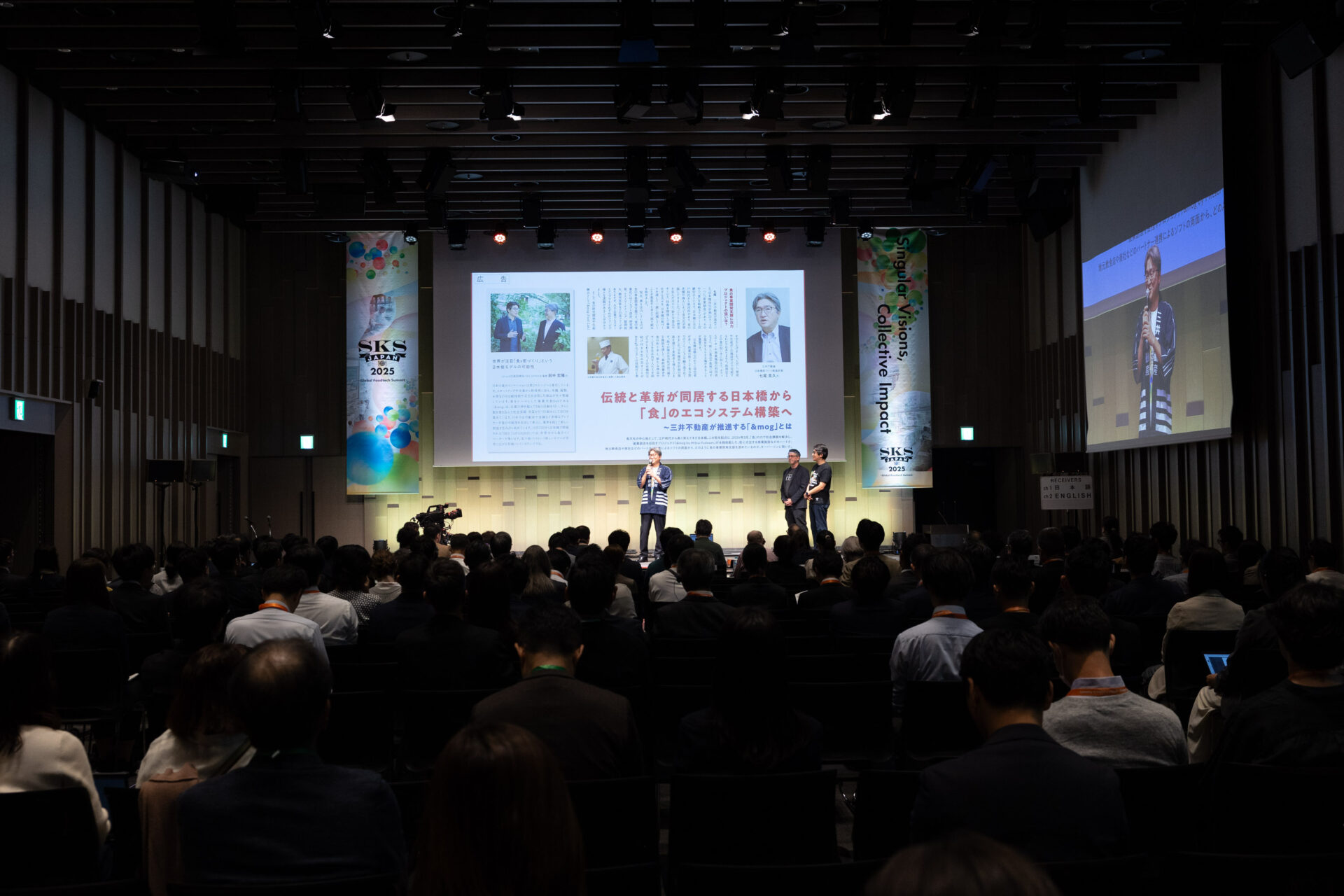
That momentum was clearly on show at last month’s SKS Japan summit in Tokyo, where Japanese innovators, investors, and agrifood corporations emphasized the importance of collaboration in buoying the ecosystem.
Why it matters: Conference speakers, including the new ag minister, mentioned frequently the challenges facing the sector: over 80% of farmers are over 70 years old and the country imports over 60% of its food.
Japan agrifoodtech investment reaches new heights
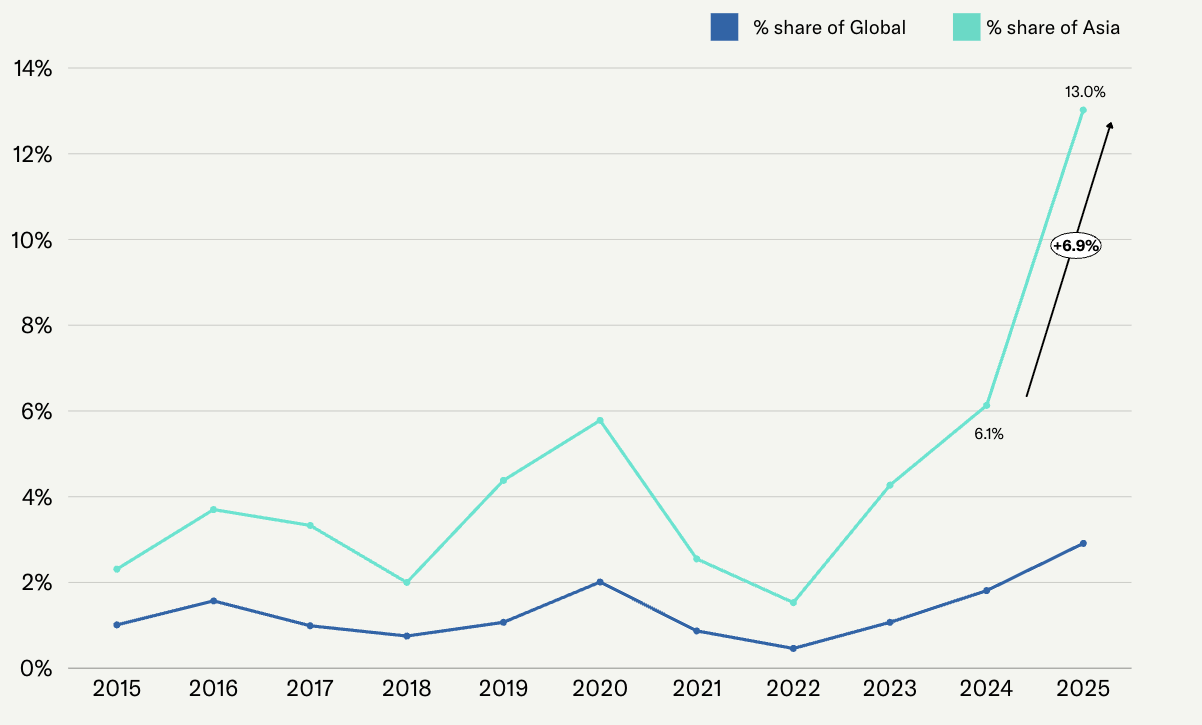
The surge: Japan’s share of Asian agrifoodtech investment has jumped to 13.0% so far in 2025, up from 6.1% in 2024, according to AgFunder research cited by yours truly at the event. Within Asia, Japan is now the third-largest agrifoodtech funder, behind India and China.
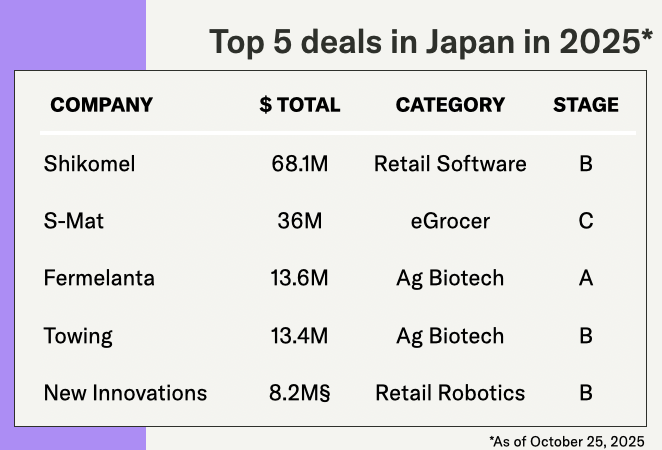 What is being funded: While the top five deals so far in 2025 are predominantly consumer-facing, three of the five are deeptech. These include biotechnology companies Fermelanta and Towing, and restaurant robotics startup New Innovations.
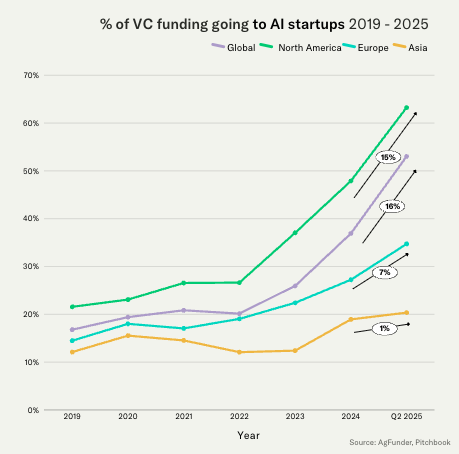
Artificial intelligence is driving a dip in agrifoodtech funding from the US, where venture firms are captivated by AI startups, investing nearly 65% of all funds in AI startups in Q2 2025. While Asia lags the US and Europe in AI funding, China, South Korea, and Japan attracted the most venture capital for AI in the region, according to Pitchbook. Japan is also demonstrating leadership for deeptech innovation within agrifoodtech in the region, as showcased by its top deals in 2025.
The broader context: While global agrifoodtech venture capital continues to shrink, regional dynamics are shifting. Europe and the US are almost on par with one another for the first time on record. The US usually accounts for 40-50% of global agrifoodtech funding; so far this year, it stands at 38%. Asia has also taken market share, accounting for 23% of global investment this year.
Partnerships proliferate across sectors
New collaborative models: The conference showcased multiple partnership announcements spanning traditional finance, real estate, food companies, and startups.
- MUFG’s Food X Project exemplifies how traditional financial institutions are partnering directly with food companies on competitiveness, open innovation, and international regulatory challenges. The project provides financing support, facilitates quarterly meetings between food companies and startups, brokers partnerships, and runs the “FOOD X TECH Mercato” accelerator program for restaurant tech.
- Real estate company Tata Mono announced plans to set up test kitchens and food startup hubs.
- Givaudan x Bühler’s Protein Innovation Centre was featured as an example of a cross-industry innovation hub pooling expertise to accelerate product development.
A cultural dimension: “One of the things I kept hearing all the time was collaboration,” said Tobias Peggs, CEO of US indoor farming platform Square Roots, who is currently establishing a presence in Japan. “How can we all work together? It really does seem to be sort of the default mode over here that people tend to think about how we can collaborate to make our neighborhood better, or our society better, and if that happens, then we will all win.”
Japanese market characteristics and strengths
Food quality as a foundation: Peggs identified Japan’s core advantage. “The food here is unbelievably delicious and healthy,” he said, adding that the agrifoodtech ecosystem has this foundation to work from, but also to preserve.
- Many traditional foods face climate change risks, such as seafood and rice. “There is sort of an implied mission, which is not to see this amazing food disappear. We have to keep preserving that. I really love that there is that implied mission that wants to preserve that beautiful Japanese food culture.”
Functional ingredients everywhere: GABA-enhanced products are widespread across Japan’s retail landscape. Adam Yee, the food scientist and podcast host, said: “I have never heard a lot about GABA, but I see it everywhere in Japan.”
- Fiber-infused Coca-Cola was highlighted as an example of Japanese innovation. “If Coca-Cola really wants to take advantage of the United States market, they just take that fiber Coke from Japan and put it in the US,” said Yee.
- Convenience proteins: Refrigerated chicken breast pouches available at 7-Eleven stores in Japan could also appeal to US protein consumption trends.
AI revolution: From generative AI redefining recipes (e.g. Samsung Food) to AI slashing R&D timelines (e.g. Atinary), Japanese corporates are looking for technologies to transform product development.
The internationalization challenge: Despite domestic innovation, one investor noted that Japanese food startups have had limited success penetrating broader Asian markets.
Diversifying innovation: Michael Wolf, founder of the Spoon and the SKS Summit, referenced the increasing diversity of the startup ecosystem in Japan, especially in recent years, during which it has evolved away from a heavy focus on alternative proteins and home cooking tech (its previous name was the Smart Kitchen Summit.)
- The 15-company pitch competition was a case in point, featuring solutions ranging from seaweed-farming data services in Borneo, fermentation innovations, automated beer dispensing using artificial intelligence and facial recognition, to AI-powered materials R&D acceleration, carbon-tracking systems, and home food-waste solutions.
Decision makers at the table: Food companies, startups, real estate players, and others sent senior-level executives to attend the SKS Summit, highlighting the weight they’re putting on food innovation, argued a few attendees. “The conversations that you were having in the corridors or when you bumped into people or backstage with other speakers, they were with people who can actually affect change,” said Peggs.