The administrator for Australian insect waste management firm Goterra says it is “continuing to trade the business at a reduced level as we assess the best outcome for the company, its employees and creditors” and aiming—in the first instance—to sell it as a going concern.
“We are exploring a potential sale of the business and engaging with a number of interested parties,” Ben Sullivan, manager at advisory firm Teneo, told AgFunderNews.
His comments came after the firm—one of the insect ag industry’s earliest entrants—entered voluntary administration after running out of runway while pursuing the investment it needed to scale.
An unhelpful blame game
The move has prompted a flurry of post-mortems, many of which play into an emerging narrative that blames industry pioneers for all the sector’s woes and contributes to a “contagion” that is destroying confidence in the whole sector, claims Goterra founder and CEO Olympia Yarger.
Speaking to AgFunderNews after the company she started building 11 years ago was forced to throw in the towel, Yarger acknowledges that investors got their fingers burned after backing industry pioneers such as Ÿnsect and AgriProtein.
But in the scheme of things, the overall amount of capital pumped into insect ag over the past decade or so (under $2 billion) has been trivial for a novel, infrastructure-based industry, says Yarger. And while early players made mistakes—which she says is inevitable if you’re building a plane and trying to fly it at the same time—the next generation of players has learned from them.
However, ongoing sniping from within as well as beyond the industry at those who helped build it is not helping, argues Yarger. And some investors, she says, are now writing the whole category off.
“We criticize the amount of money raised by first wave companies in some belief that doing so legitimizes the second wave. But investors just interpret that as: If $600 million wasn’t going to do it, why would AUS $25 million do it for Goterra? We have eaten out our own tail in pursuing that narrative.
“I think the contagion issue is immense in our industry. You’re seeing it in vertical farming, cultivated meat, and certainly in the insect industry. We criticize the amount of money raised by first wave, foak [first of a kind] companies but it costs money to build something new and the narrative reduces the belief that anything after that can be profitable.”
Industry pioneers such as AgriProtein, which went into administration in 2021, have created knowledge, talent and infrastructure that later players have all benefited from, claims Yarger. “Agriprotein created some of the most exceptional members of our industry. It hired some of the best scientists, it did exceptional R&D work, and yet the story is that they wasted all that money.”
The capital gap: contracted demand, but not enough money to scale
According to Yarger, Goterra has spent a modest amount—AUS$25 million ($17.5 million)—to build its technology, IP, regulatory approvals, the manufacturing process, and secure seven years of operational data, and had been seeking to raise about the same amount again to scale the business.
“It costs AUS$25 million to build a fairly standard composting facility. Infrastructure costs money. But venture capital, since the late 90s, has been designed for incredibly explosive returns with minimal capital expenditure. They just want the SaaS play where it’s like six dudes and a hot desk.”
The firm, which has automated insect farms up and running with clients including Woolworths, found itself stuck in a strange place from an investment perspective, she adds. Some investors viewed it as too old not to have reached Series B-style revenue levels, while others questioned whether it had raised enough to build an infrastructure business.
“We were stuck between the, you’ve been around for a really long time, you’re a Series B, you need to be at AUS$10 million ARR, and then the sort of counter to that, which is, why haven’t you raised more money?”
The frustrating thing for Yarger is that the firm has AUS $8 million ($5.6 million) in signed contracted revenue for FY26/27 that she says could be unlocked with a capital injection. Meanwhile, regulatory tailwinds are working in the company’s favor as governments increasingly legislate organic waste out of landfill.
Waste management, not alt protein
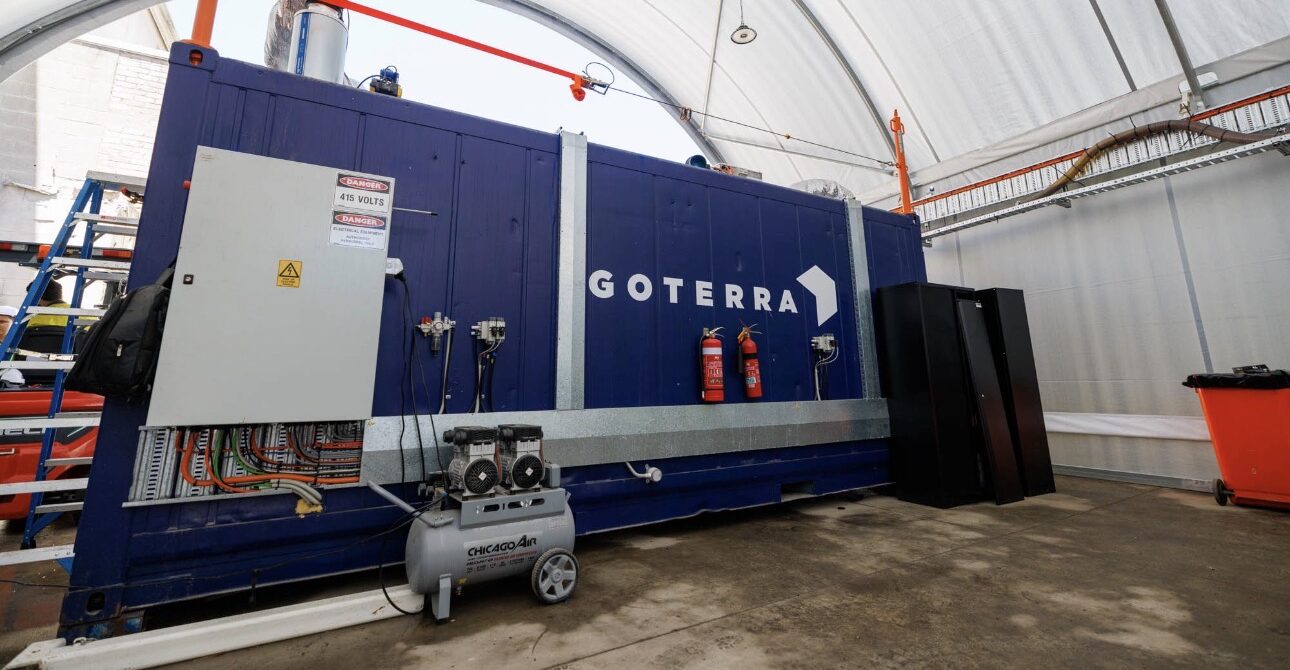
Goterra—which has a container-based system that can process up to 1.7 tons of post-consumer waste a day—has always viewed black soldier flies first and foremost as a tool for organic waste management, rather than as an alt protein play, says Yarger.
The company’s model was to take low-value post-consumer household and commercial food organics, for which it was paid, process them with black soldier fly larvae, and then sell the resulting dried larvae into poultry feed markets. Not as a replacement for soy, but a feed supplement used at low inclusion levels that provided material health benefits.
“We were being paid AUS $250 a ton on our food organics input company so we could wash our face on waste management alone,” claims Yarger.
Rather than building a centralized insect farming facility or a vertically integrated protein company, Goterra was developing a distributed waste management network and tapping into existing infrastructure. It bought larvae from another provider, had a service agreement with a local rendering facility to process insects, and worked with composters for frass.
Asked who might be best placed to take Goterra forward, she says: “I think it’s a great fit for waste companies or other insect companies that align with the [waste management] thesis.”
Variable feedstocks
Yarger also challenges a narrative currently gathering steam on social media that inconsistent feedstocks were somehow to blame for Goterra’s problems, arguing that variability in agricultural inputs is commonplace and that Goterra’s hub-and-spoke model could manage variability across a network by blending larvae fed on different feedstocks to meet nutritional criteria.
“We have a full data set that shows us that if this waste is coming in, it’ll create this protein on the other end,” she says.
At the site level, meanwhile, customer profiles were relatively stable, delivering a waste profile more predictable than critics suggested, she adds, noting that in any case, Goterra’s dried larvae was seen as a feed supplement or additive, not a 1:1 replacement for other feed protein sources.
She added: “I can’t tell you how long I have fought Europe-specific narratives. One that you cannot use actual waste to feed insects and create a safe product [EU regs ban the use of post-consumer waste as a feedstock for insects; whereas many other markets do not]. And two, that you have to compete with soy on price as an alt protein company.”
Many firms in the EU are paying for their feedstocks, she points out. Goterra was being paid to take waste as its feedstock, so the model is very different.
Circular economy needs adaptable infrastructure
When it comes to optimal sizes and locations for insect ag, meanwhile, there is no one size fits all model, says Yarger, who argues that the circular economy needs distributed, adaptable infrastructure rather than large, centralized plants located far from the waste source.
Smaller distributed sites can also outperform large distant facilities when transport costs are factored in, she claims. “Four sites logistically optimized is bigger than one site very far out of town.”
On commercial traction, Yarger says Goterra had long-term offtake agreements, but lacked the capital required to convert contracted demand into realized revenue.
“We had multiyear contracted revenue [for waste management] unable to be realized due to capital requirements, and long-term take or pay protein contracts on the offtake side.”
Further reading:
Insect ag recalibrates after a brutal shakeout: Where are the key players now?
FlyBox founder: Insect farming can work in Europe, but not as a VC-backed protein play
Dutch insect ag firm Protix shifts focus to Asia: ‘We could be cost competitive there from day one’