Monarch Tractor’s collapse reflects the limits of an ambitious full-stack hardware model in a changing economic climate—not a failure of the underlying technology, insists cofounder Praveen Penmetsa.
While three dealers have filed lawsuits alleging the firm’s electric tractors are “defective” and winegrower Patrick O’Connor blasted the “failed” equipment in a viral video as Monarch laid off its remaining staff and shut up shop, Penmetsa insisted that the tech had delivered, but that the firm’s business model had not.
Speaking to AgFunderNews this week, Penmetsa said the decision—made last fall—to pivot from selling machinery to a tech licensing model took place too gradually and too late for the firm, which raised $240+ million from backers including Astanor and HH-CTBC.
As a result, Monarch was unable to turn things around and has sold its core technology to a “large global equipment manufacturer” first named by Bloomberg as Caterpillar (although neither party has confirmed this).
The full-stack bet
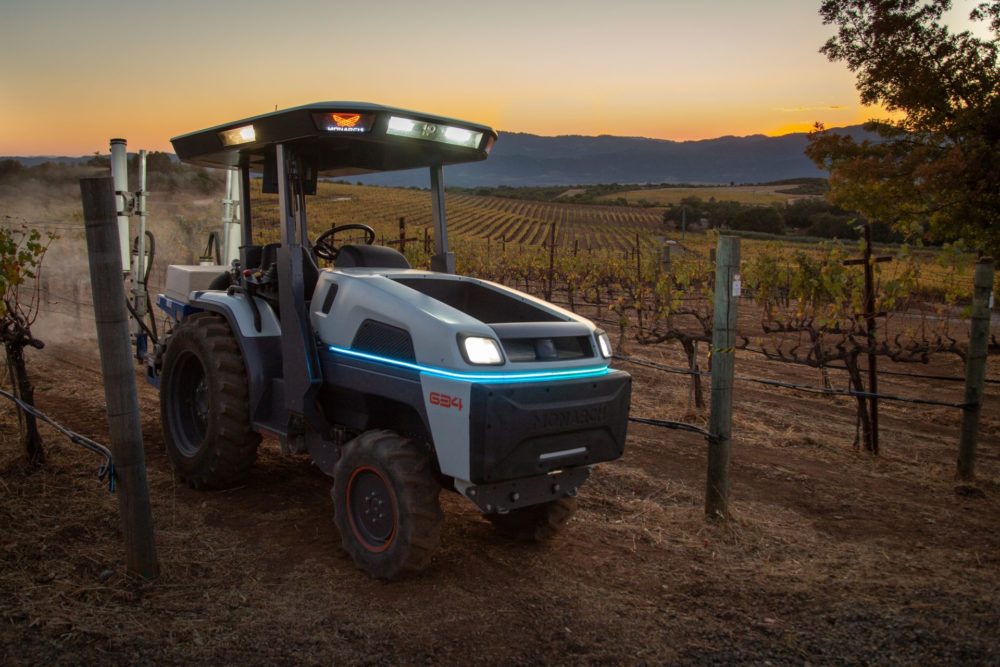
Founded in 2018 by Penmetsa, Mark Schwager, Carlo Mondavi, and Zachary Omohundro, Monarch Tractor’s original vision was to combine electrification and autonomy on multi-purpose tractors that smaller farms could afford, rather than building single-use machines or retrofitting existing equipment.
“We wanted a tractor platform that every farmer could buy and use for different operations,” said Penmetsa. “And not a retrofit, because we wanted both the electric savings and labor savings and the collection of data, which made our tech unique.”
In practice, however, this vertically integrated approach started to make less sense as investor sentiment soured on the whole agrifoodtech sector and tariffs on globally sourced components such as batteries and electronics from China and parts from India dramatically increased costs.
This pushed Monarch toward a late-stage pivot to a software and tech licensing model, where it would partner with OEMs that already had manufacturing scale and distribution.
“With the benefit of hindsight, we should have pivoted faster,” said Penmetsa. “If we had done that two years ago, it would have been a different story, because by the end of last year [following a restructuring and significant round of layoffs], we were gross margin positive as a company, which is a big deal in agtech, but it was too late.”
Pivoting under pressure
Similarly, rather than moving quickly when it became clear that dramatic changes were needed, the company made gradual cuts, added Penmetsa: “In 2024, we went through three rounds of layoffs, and my lesson to the rest of the founders out there would be, when you need to pivot, you need to pivot hard and do it in one shot.”
But Penmetsa pushed back on claims that the technology didn’t work, citing more than 500 machines deployed and over 130,000 hours of customer usage, along with examples of autonomous features such as camera-based row following and driverless operation in specific use cases such as dairy feed pushing.
He added: “We also showed that our platform worked on very different kinds of machines [not just tractors] including augers [to move grain], utility vehicles, and construction equipment.”
The payback depends on usage, he said. “But just switching from diesel to electric could save farmers $7–$12 an hour in operating costs, before you get into the benefits in terms of labor savings and sustainability. For example, vineyards owned by large corporates have to report carbon emissions, and so there were benefits there [through reduced CO2 emissions from switching away from diesel].”
However, he conceded that scaling autonomy across different farm types proved more complex than anticipated.
“The electric machine can stand alone on its economics. But on the autonomy side, what we learned the hard way was different farms have different operating domains, and each one required a huge amount of effort to automate. In hindsight, I wish we had focused on maybe just one at a time.
“In dairy, feed pushing autonomy was a success story and the payback was clear. But even dairy farms in California are different than dairy [farms elsewhere] and every vineyard has different quality expectations and operational requirements.”
When the model broke
Penmetsa declined to comment on the dealer lawsuits but acknowledged that service levels to some customers became harder to maintain as capital became more constrained. “Once we made the strategy shift, it was hard to support them.”
By 2023, he said, “The capital markets changed from saying, ‘You should own all of it and hold the margins’ to ‘You should be capital efficient, not margin efficient.’ So the vision we had at the start was valid in 2019 but in 2023 the funding world was not willing to fund it.”
In 2025, meanwhile, the company’s reliance on parts from overseas suddenly became a huge liability.
“We had parts from all over the world: batteries, motors, and electronics from China, tractor parts from India, and then these huge tariffs came in. So suddenly the hardware side became unprofitable, even though we were assembling in the US. A lot of our capital was also going towards distribution, service and support costs, and building up an infrastructure, supporting dealers,” added Penmetsa, who noted that the firm had also set up offices in Singapore and India.
In 2019 there was “no proof that farmers would even buy electric equipment,” he added. “We proved that farmers would buy it and we also proved how much we could save for farmers on a per hour basis so we could go to OEMs later on and say, Hey, if you build a machine and use our software, we will be playing to each of our strengths, because they already had distribution, more resilient supply chains, and better economics the hardware side.”
But by late 2025, the writing was already on the wall, said Penmetsa, who said he could not comment on the details of the deal with the large equipment manufacturer beyond confirming that it had acquired Monarch’s “software-defined vehicle platform, perception stack, and electrification systems.”
‘A very disappointing end for the company’
Asked what the collapse of the company meant for the wider industry, he said: “It’s a very disappointing end for the company but I’m very proud of what the team has done, and very proud of the fact that when we started this company in 2019, people were saying autonomy for small farmers will never happen, and we’ve since put 500+ machines out at very low cost. Even today, none of the big OEMs are selling electric machines with autonomous features in our class, at our cost.”
He added: “We were the first to showcase our whole electronics cost was under $10,000 for our autonomy system, the complete electronics cost, which included sensors, GPS, compute, everything, so that’s a legacy that is going forward.
“Also, because we were deploying our stack across multiple states and domains, we had to figure out how do we service and support our machines remotely. So for example if there is dirt and our cameras get clogged, we have software to identify what’s happening and then after a certain point, provide alerts to the farmers, saying you need to go clear it.”
The takeaway
He added: “The reality is we did not succeed in our mission but we moved the needle on the tech side and we have proven what is possible. But we need more investors coming into ag now that a lot of the questions have been answered.”
Asked whether Monarch’s collapse might instead send investors running for the hills, he said: “John Deere spent more than that in just acquiring battery technology. We have seen how much capital it takes to solve big problems.
“I come from the on-road space, where we’re finally seeing autonomy after 15 years. But many small autonomy companies did not succeed before the big success stories came, and that did not stop the funding. We need more players in the field before we find the one [that will be a huge] success.”
Further reading:
Frontier AI heads to the farm with Carbon Robotics’ Large Plant Model
Frontier AI heads to the farm with Carbon Robotics’ Large Plant Model