Virginia-based Capra Biosciences—a startup making retinol (a form of vitamin A) and other high value ingredients via biomanufacturing—is working with Boston University on a new generation of wireless free-floating biosensors designed to help firms in the space optimize fermentation and save money.
“For biomanufacturing to be really competitive with petrochemical manufacturing on a global scale, sensor technologies that allow us to run more efficiently are really going to be differentiating in terms of expanding the types of molecules that we can be cost competitive on,” CTO Andrew Magyar, PhD, told AgFunderNews.
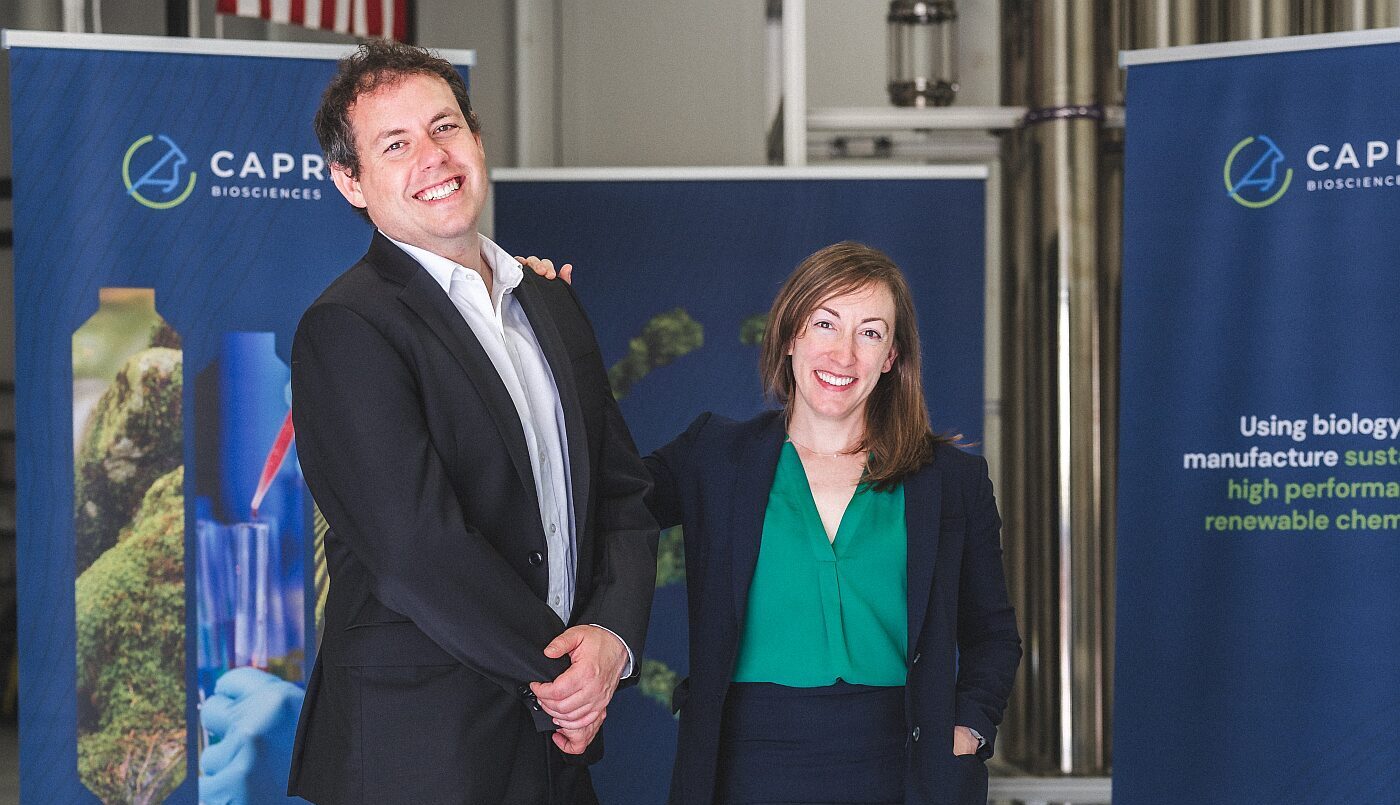
Founded by Magyar and Elizabeth Onderko, PhD, in 2020, Capra’s microbes consume feedstocks from industrial side streams such as thin stillage and glycerol in a modular platform comprising multiple 1,000-L units rather than one large fermentation tank.
Its host organisms can be removed from the bioreactors, “washed” with solvents to extract retinol, and then returned to the bioreactors where they will keep producing retinol, enabling a highly efficient continuous fermentation process.
Novel biosensors could further optimize this process, says Magyar, who has been working with Boston University on a new project funded by the National Science Foundation and BioMADE to test a wireless network of microbial-electronic sensors deployed directly inside its bioreactors.
A wireless window into fermentation
The hybrid sensors combine engineered microbes that emit light in response to cellular stress with embedded electronics that detect optical and chemical signals. This enables continuous measurement of key fermentation parameters including redox state, media composition, and cellular metabolic activity, without intrusive sampling or fixed probes.
During the project, the platform will be further miniaturized and tested at Capra’s 10,000 sq ft pilot production facility in Sterling, Virginia, said Magyar.
“We’ve been working with Boston University for a few years. They started with a small wireless sensor that went into our bioreactor to allow us to measure pH, dissolved oxygen and other things and we now have two new projects, one funded by BioMADE and one by NSF.
“The BioMADE project is focused on making these sensors more reliable, and the NSF side is layering this microbial sensor on top. Miguel Jimenez, PhD at Boston University is engineering cells that will go inside these sensors and Rabia Yazicigil, PhD is building the semiconductor chip that’s basically measuring that light from the cells and wirelessly communicating it back.”
The biosensors “could eventually be as small as maybe say a chickpea and because they are made with these traditional semiconductor fabrication techniques they could be $10 to $100. So when produced at scale, this would be massively less expensive than the probes used in traditional biomanufacturing,” claimed Magyar.
This is particularly important for Capra, which has a modular system and could potentially have hundreds or even thousands of reactors in a given facility, “so the cost of sensing can really drive the overall cost.”

Programmable biosensors
Rather than traditional probes—instrumented rods that poke into the fermentation broth and can sometimes introduce contamination—the tiny biosensors can be placed at different points inside the reactor or can float at different places in the broth, providing some visibility into what is happening in different parts of the vessel, he said.
The cells in the sensors are programmable so could be engineered to emit light at an intensity that relates to multiple parameters from pH or the level of a critical chemical intermediate to stress signals, he explained. “It’s a platform technology, so they’re going to validate it for one or two modalities, but it’s something that would be vastly extensible.
“We see it as technology that has potential to not just transform biomanufacturing, but a lot of other industries as well, you can imagine them being used for environmental monitoring, or wastewater treatment, or things of this sort.”
Cutting the cost of sensing
With traditional probes, which can cost $5,000 to $10,000 a pop, “the costs can add up quickly if you want to have a pH probe, a dissolved oxygen probe, a CO2 probe, all of these different things… whereas with these [biosensors], you could measure multiple analytes on a single small wireless sensor.
“Essentially, at the core of these devices is an onboard potentiostat so it can do full electrochemical measurements in a very, very small package. Really anything that’s conceivable electrochemically can be packaged down into these small devices. The key things we’re looking at right now are dissolved oxygen, pH, and then looking at the correlation of electrochemical signals more generally with what’s happening in the bioreactor.”
Here, he says, AI has an important role to play by correlating data from the sensors with performance characteristics.
He added: “One of the great things about Capra’s platform is that we have our own in-house data analytics and manufacturing execution system so we’re able to take our traditional sensors that are already there and correlate the data from these new wireless sensors in real time, so we can really validate their performance and also see areas where the new sensors can be more informative than conventional ones.”
Asked what happens to the sensors at the end of a production run, he said: “The aim is to have these be reusable, but the design is such that it will be low cost enough to be single-use for certain regulated applications such as pharma as needed.”
Replacing petrochemical ingredients
Capra has just launched bio-manufactured salicylic acid for personal care applications as an alternative to petrochemical-derived products, says Magyar.
“We don’t know of another fermentation-derived salicylic acid on the market today. Today it’s [typically] produced from phenol [from petroleum derivative naphtha] and from the personal care standpoint, our product is exciting because we don’t have any of that residual phenol, which can be problematic. There are some natural salicylic acids out there that are derived from wintergreen, but they’re quite expensive.
“One of the exciting things for salicylic acid is that we’ve been able to run [production of] that product continuously up to about 100 days.”
As for its fermentation-derived retinol, he said, “We’re working towards commercialization and continuing to scale in our facility with our modular reactors.”
Security of supply
Stepping back, he said, “Our company has been really focused on products with supply chain challenges. At the beginning, we were trying to sell investors on the supply chain story, and people just sort of looked at us blankly.”
Today, after years of supply chain disruption caused by a global pandemic, war in Ukraine, and the recent invasion of Iran, the message about domestic production and security of supply is hitting home, as long as the price is right, he said.
“We see biotechnology as a really a powerful way to bring back chemical manufacturing to the US that could be hard to bring back otherwise, so almost all the products in our pipeline are traditional petroleum produced products.”
Further reading:
Ruby Bio aims to launch “world first” fermentation-derived clean label emulsifiers in 2027
Biosphere lands Pentagon funding to build portable “protein from air” bioreactors
Fermeate raises $2m to deliver “step change” in precision fermentation economics with optogenetics
Funding dip for alt protein fermentation signals shift from promise to proof