

Food waste goes up about 25% this time of year, with households the largest source, according to think tank ReFED. Reasons vary, from confusion over date labels to individuals not wanting leftovers, and ReFED estimates the US will waste more than 300 million pounds of food this coming Thanksgiving.
In many ways, food waste generation during the holidays is an amplified version of consumer behavior throughout the rest of the year: per ReFED’s Insights Engine, US residential homes generate almost half of all surplus food in the supply chain on average. Curbing holiday food waste is a matter of finding (and funding) tools that can become part of consumers’ kitchen routines 365 days per year.
By the numbers:
- 73.9 million: tons of surplus food the US generated in 2023 (the most recent year for ReFED Insights Engine data)
- 1.75 million: number of tons of surplus food donated in the US
- 43.7%: share of surplus food represented by produce
- 35.2%: amount of overall surplus food coming from residential settings
- $640 million: amount of private investment deployed in 2024 to fight food waste—down from nearly $2 billion in 2021
- 320 million: pounds of food expected to go to waste during Thanksgiving 2025

Consumer food waste solutions:
New technologies to help consumers run the gamut from apps that prevent waste through smarter cooking to tools that extend the life of perishable items.
For most of these, it is still unclear how much consumers might pay to have them. As ReFED notes, “Even if consumers are educated on the issue, they may not care enough for the increased upfront financial commitment.”
Smart home devices
Smart hardware devices help take the guesswork out of tracking food freshness and answering the “what’s in the fridge” question. The big hurdle is cost. Smart fridges such as those from Samsung or LG “can be cost prohibitive for most consumers,” according to ReFED.
At-home food recycling tools, especially those built for the kitchen like The Mill and FoodCycler, are another hardware option. However, as with smart fridges, cost may be a prohibiting factor.
In the last decade, there has been a bigger push for smaller devices that can turn a regular fridge into a smarter one to track food. Smarter FridgeCam, for example, is a small camera device that goes inside the fridge and connects to a user’s smartphone. Similar technology is available from RetroLabs.
Inventory management and smart visibility tools
Apps and software can help consumers track existing fridge inventory, understand expiration date labels (a common source of confusion in the US), and in some cases assist with using up leftover ingredients for new recipes.
The Sayvr app is a notable example here, allowing users to scan ingredients at home and even “deconstruct” leftover restaurant meals for use in new recipes. The idea is to keep food waste from happening by providing consumers with tools for smarter cooking.
Further up the supply chain
While not understanding proper food management is a big cause, much of the food waste coming from consumers occurs because of decisions made by other actors upstream in the supply chain, says Minerva Ringland, senior manager of climate & insights at ReFED.
“We try to encourage businesses as much as possible to think about their consumer-facing communication and the potential for education.”
Helping consumers better understand date labels is a big opportunity for retailers, and shelf-life extension technologies (coatings and sachets) can also be employed at the retail level, she adds.
“We always point to date labels and the standardization of that and education around what the dates actually mean so that people are not just throwing things out.”
At a government level, California passed its Senate Bill 1383 that requires jurisdictions to provide organic waste collection for residents and businesses.
“We’re hoping to see federal uptake of the policy that California introduced last fall,” notes Ringland.
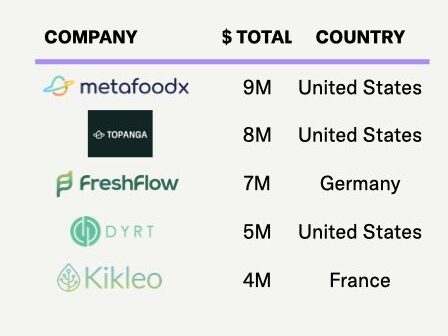
VC funding for food waste solutions still primarily goes to foodservice tools and upstream stages of production. Four of the top five rounds so far this year are for restaurant-focused technologies, according to preliminary data from AgFunder. [Disclosure: AgFunderNews’ parent company is AgFunder.]
Examples include Metafoodx‘s AI-powered inventory scanners for commercial kitchens and “smart” scales for commercial kitchens from Topanga.