
Soaring fertilizer prices are pushing farmers to a “breaking point” but the Iran conflict is only part of the story, witnesses told lawmakers at a hearing of the Senate Agriculture, Nutrition & Forestry committee this week.
Experts called to testify also pointed to consolidation in the domestic fertilizer industry, lack of transparency around margins and capacity utilization, and growing concern that dominant players have too much control over pricing and supply.
Referencing jumps in gross margin at leading fertilizer companies in recent years, Andy Green, principal at Washington DC-based Center Market Strategies told the Senate Agriculture, Nutrition & Forestry committee that, “Where there is smoke, particularly in supranormal profits, antitrust enforcers should look for fire.”
Green, who described his firm as a “bipartisan advocacy and legal strategy firm,” noted that farmers have endured price spikes for five years for reasons that “seem largely unconnected” to underlying input prices or changes in demand.
“It may be appropriate to reconsider recent mergers that have helped form this highly concentrated sector.”
In the interests of transparency, meanwhile, disclosure of gross margin percentages and capacity utilization rates would also be “valuable for both investors and farmers,” said Green, who is backing a new bill (The Fertilizer Transparency Act of 2026) that would require USDA to collect and report more detailed fertilizer pricing and market data to help farmers make better purchasing decisions.
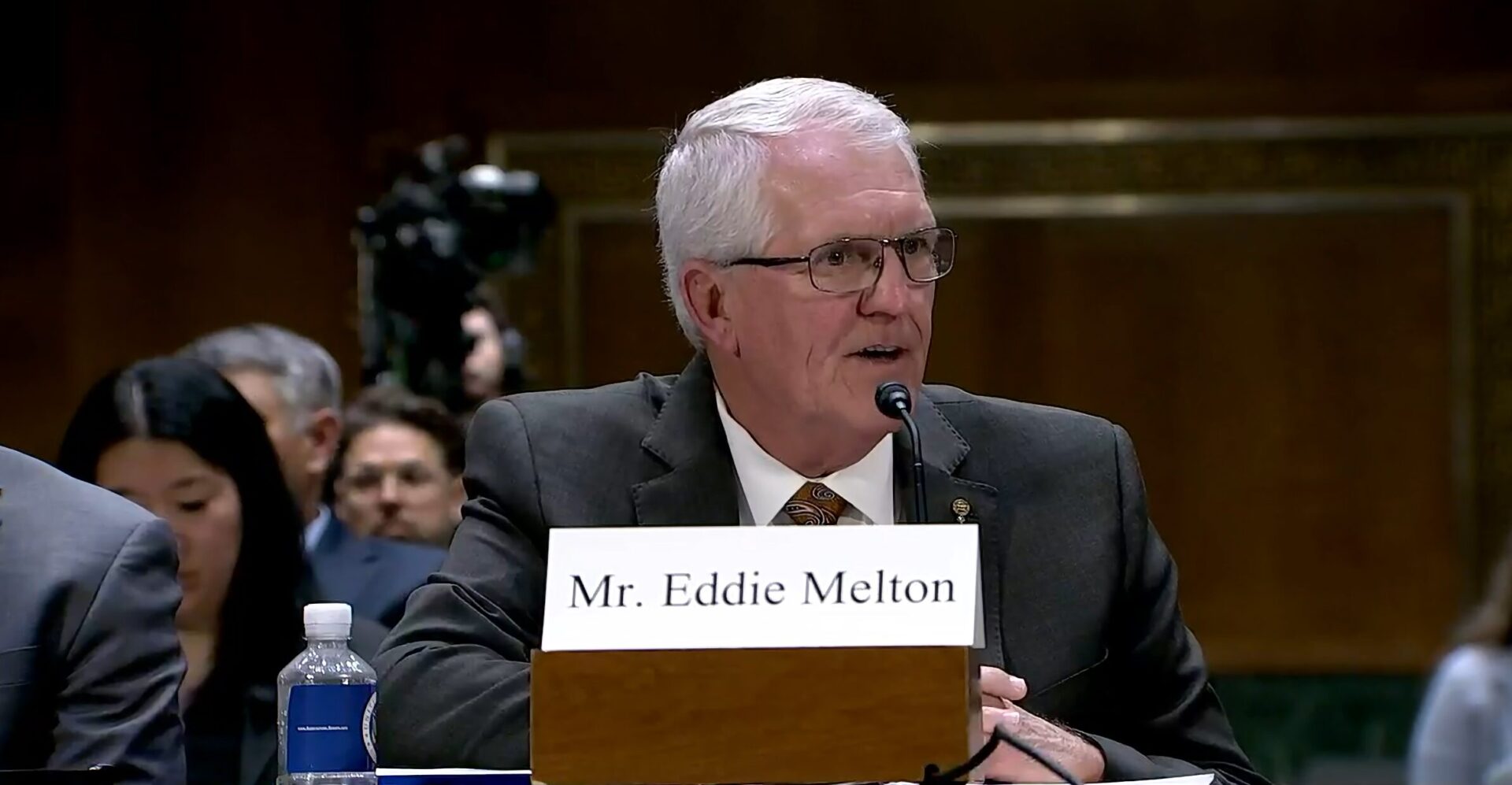
Eddie Melton, president at the Kentucky Farm Bureau Federation added: “Today’s fertilizer price challenges did not begin with the recent conflict in Iran.”
Transparency key in highly-concentrated industry
Trent Kubik, president at the South Dakota Corn Growers Association, expanded on the theme, arguing that dominant players have the power to restrict supply, cancel contracts, and sustain elevated prices, noting that:
👉For nitrogen fertilizer: CF Industries, Nutrien, Koch, and Yara US have a combined 75% market share in the US.
👉For phosphate fertilizer: Mosaic controls 70- 80% of the US market and 60% of phosphate rock production.
👉For potash fertilizer: Nutrien and Mosaic control 90 – 100% of the US market.
“From my experience, the market power of fertilizer companies gives them the ability to control the price we pay and restrict supply when it suits their financial needs, without regard to competitive pressure,” said Kubik.
“As an example, a corn farmer recently had a fertilizer contract cancelled not once, but twice after signing a new, second agreement. In this instance, the third time was not the charm. While the product was offered again, it was priced at approximately $200/ton more.”
He added: “We strongly suspect that years of consolidation and the resulting market power in the hands of these companies lies at the root cause that aids and abets these practices that are pushing producers’ margins past the breaking point.”
‘Durable price relief’ requires more competition
As for capacity, despite the cost of natural gas in the US being relatively cheaper than many fertilizer-producing areas of the world, the price of nitrogen fertilizer in the US has continued to rise in concert with prices in areas with higher cost natural gas, said Kubik.
A resulting rise in margins for US manufacturers should, in theory, encourage expansion of production and higher capacity utilization for the industry, he theorized. “Instead, market power has allowed manufacturers to maintain higher prices while also limiting efforts to use existing manufacturing capacity, at the expense of US farmers.”
He added: “Simply put, farmers need more competition in this marketplace. Increased competition from more participants in the fertilizer manufacturing space is the only thing that can deliver meaningful and durable price relief.”
![Trent Kubik, president, South Dakota Corn Growers: "Simply put, farmers need more competition in this [fertilizer] marketplace."](https://agfundernews.com/wp-content/uploads/2026/05/Screenshot-2026-05-13-120421.jpg)
Precision ag tools
Asked by lawmakers if precision ag tools could reduce farmers’ reliance on pricey fertilizer, Kubik noted that farmers are applying it with greater precision where it is most needed.
“Fertilizer costs a lot so we can’t just throw it on and waste it and kind of hope it got there right so we’re very precisely applying it. We’re variable rate applying it. Parts of the field are getting more than others based on our soil testing.”
Many farmers are also exploring “bio-based” solutions, he added: “The biological space has definitely garnered a lot of attention over the past couple years with the increase in fertilizer [prices]. I have tested multiple different ones on our farm.
“The problem with that, unfortunately though, senators, we live in reality and they’re not enough right now to rely on. We still need fertilizer to grow our crops and we’re hopeful. I dream of a day where I don’t need commercial fertilizer anymore. That’d be the best thing ever.”
Biostimulants
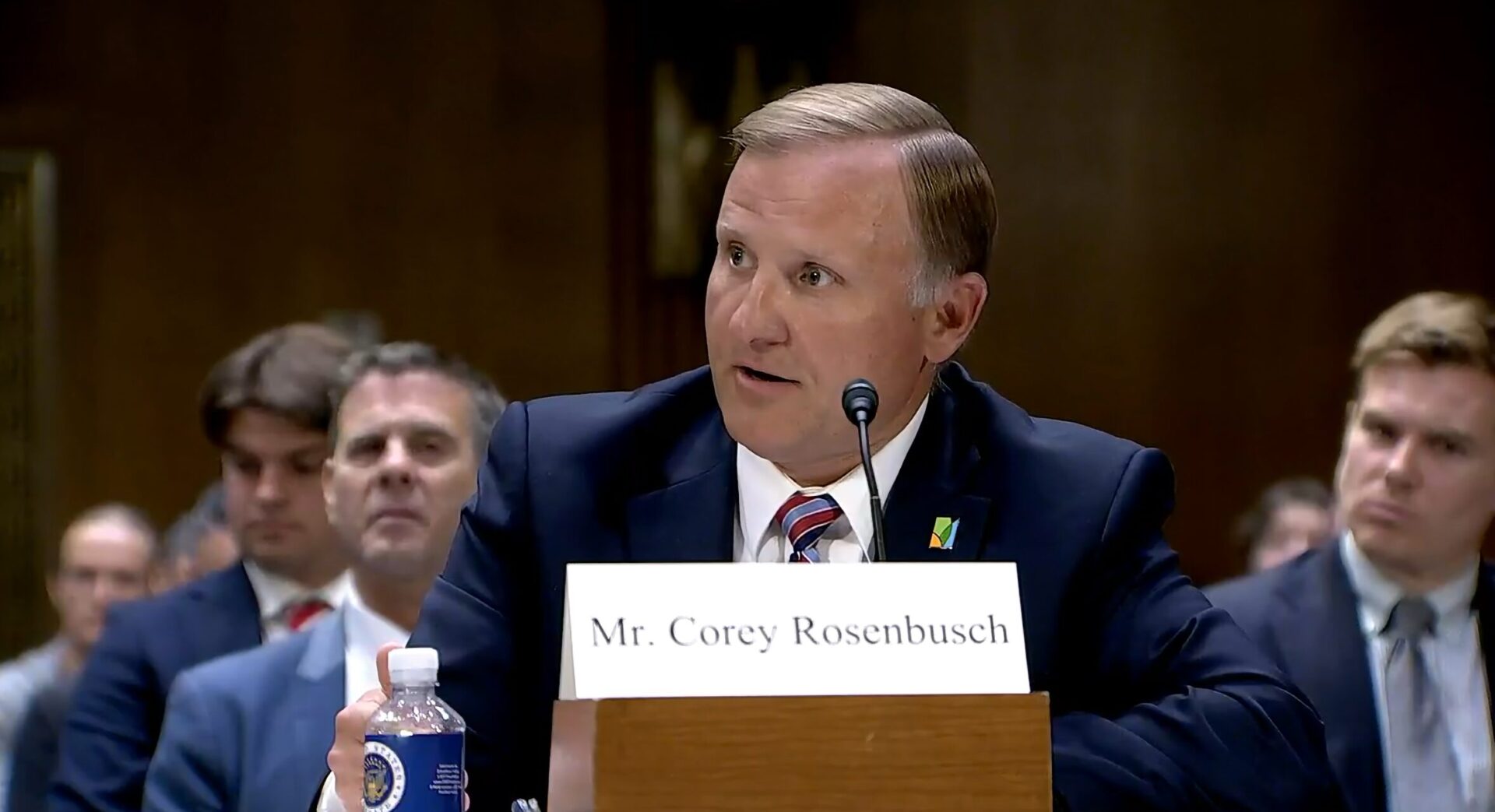
Corey Rosenbusch, president and CEO at The Fertilizer Institute, drew attention to The Plant Biostimulant Act, a bipartisan bill that would create a clear federal definition for plant biostimulants—products designed to enhance natural plant processes such as nutrient uptake and stress tolerance—and establish a more predictable regulatory pathway for bringing them to market and ensure they are not regulated as pesticides.
“Despite their clear benefits,” said Rosenbusch, “biostimulants currently lack a consistent federal definition and regulatory pathway in the US. This ambiguity has created significant barriers to innovation, investment, and commercialization.
“Without clarity, product developers face uncertainty in bringing new technologies to market, and growers lack confidence in product consistency and claims. Globally, other major agricultural economies—including Canada, the European Union, Brazil, and India—have already established clear regulatory frameworks for biostimulants under fertilizer or supplemental product laws. The United States risks falling behind in the development and adoption of these technologies if it does not act to provide similar clarity and certainty.”
Weather, war, and uncertainty
When it comes to purchasing decisions this year, Kubik said that due to unpredictable weather, “We try and limit the amount of fertilizer we purchase and apply at the start of the year and determine if we need more while the crop is growing, which in turn, does not allow us to early book and/or prepay for all of our fertilizer needs.
“We also cannot write our crop planting intentions in stone as we may need to make changes to the crops we plant to sustain our feed supply for our cattle herd. As an added layer of complexity to the 2026 growing year, we had some organizational changes… in the first few months of the year and were not in position to book/prepay for any fertilizer.”
He added: “We expected that our costs could be higher as we would be purchasing closer to peak demand season but are now left with costs almost doubling after the unforeseen circumstances that occurred in the Middle East.
“As I speak today, much of our fertility is still not purchased as we wait until we absolutely need it in hopes of market stabilization bringing the cost down.”
Exploding sulfur prices
Rosenbusch at The Fertilizer Institute focused most of his testimony on the impact of market disruptions tied to the Strait of Hormuz, Russian export bans, China’s export restrictions, and surging sulfur prices, noting that sulfur and sulfuric acid costs have risen more than 1,000% since early 2025. He also warned that natural gas shortages are curtailing ammonia production in several countries and increasing competition for global fertilizer supplies.
Rosenbusch argued that US fertilizer producers operate in a highly competitive global market shaped by state-supported producers in countries such as China and Russia. He called for faster permitting, critical mineral incentives, and tariff relief on equipment needed to expand domestic fertilizer production.
Sen. Warnock: No viable plan from the White House
In the short and medium term, however, farmers are caught between a rock and a hard place, said Sen Raphael Warnock (D-GA): “Has anyone seen a viable plan from the White House that gives them confidence that fertilizer prices will decrease in the near term? No takers.
“Fertilizer prices are increasing. Diesel costs have increased by over $2 a gallon compared to this time last year and there’s no end in sight. At this point, the best-case scenario for farmers is the reopening of the Straight of Hormuz, which was open before the war started.”
But even then, he pointed out, the fertilizer market “will not bounce back overnight. If it were to open tomorrow, you’ll still be dealing with these prices. And so, between the war in Iran, spiking fuel and fertilizer prices, and illegal trade wars, increasing the cost of equipment, and limiting market access, it’s no wonder that farmers in Georgia I talked to say that they can’t take much more.”
‘An urgent need for near-term economic relief’
Joshua Westling, who is developing a $1bn+ fertilizer complex in Nebraska, said farmers are “being squeezed by prices they cannot control, on inputs they cannot do without, in markets that are increasingly concentrated and vulnerable to foreign disruption.”
Since February, said Westling, “We have seen a 33% rise in anhydrous prices, a 55% rise in urea prices, a 25% increase in liquid nitrogen, a 5% increase in DAP, and a 3% increase in potash. At the same time, farm diesel prices have surged 72% since the end of February, increasing the cost of fieldwork, fertilizer transportation, and irrigation.
“Taken together, these pressures are weighing heavily on farm finances, with nearly six in ten farmers reporting worsening financial conditions, underscoring the urgent need for near-term economic relief to keep farm operations viable.”
According to The Fertilizer Institute:
👉 “State-supported” production in China coupled with export restrictions on phosphate fertilizers and sulfuric acid are distorting supply, trade flows, and investment incentives for US producers.
👉While 65% of US fertilizer demand is met domestically, the industry remains exposed to imports and global disruptions, especially in sulfur, natural gas, and phosphate markets.
👉Prices of sulfur and sulfuric acid (critical to phosphate based fertilizers) have risen more than 1,000% since early 2025 amid export constraints from Russia and the Middle East.
👉The closure of the Strait of Hormuz and broader Middle East conflict have disrupted LNG supplies and ammonia production globally, forcing countries such as Pakistan, India, and Bangladesh to compete more aggressively for fertilizer imports.
Startups working on solutions to reduce or replace synthetic fertilizers:
TerraBlaster: Uses laser-induced breakdown spectroscopy to determine levels of NPK and other nutrients in the soil, which can be used to guide the more precise application of fertilizer, delivering ROI in the form of reduced input costs and increased yield.
Pivot Bio: Engineers microbes that fix nitrogen directly on plant roots, reducing synthetic fertilizer use by 20-25%, a number CEO Chris Abbott reckons he could get to 40-50% over the next five growing seasons as the firm optimizes its wares.
Kula Bio: Leverages nitrogen-fixing soil bacteria to reduce reliance on synthetic fertilizers. The bacteria are fortified in a proprietary process that helps them build up larger than normal stores of energy and nutrients.
Joyn Bio (Bayer + Ginkgo): Developing engineered microbes for nitrogen fixation.
Switch Bioworks: Pioneering an approach that enables engineered microbes to first compete and establish themselves on plant roots before “switching on” nitrogen fertilizer production.
Azotic Technologies: Biological nitrogen fixation using a naturally occurring bacterium that lives inside the plant, fixing nitrogen inside plant tissues throughout the season.
Sound Agriculture: The firm’s soil activator (applied as a foliar spray) mimics a plant signal that activates soil microbes to improve nitrogen and phosphorus uptake in crops, reducing growers’ reliance on synthetic fertilizers.
Nitricity: Produces organic nitrogen fertilizer from air, water, renewable energy, and upcycled almond shells. Its new plant should be at full capacity (8,500-tons) later this year. The liquid “Ash Tea” fertilizer is designed for application through irrigation lines.
Windfall Bio: Uses methane-eating microbes to convert waste methane from farms and landfill sites into nitrogen-rich organic fertilizer.
Solugen: Use its enzyme-based biocatalysis platform to convert nutrients in hog manure into a certified organic liquid nitrogen fertilizer.
NitroVolt: Decentralized ammonia production via converting a lithium salt in solution into metallic lithium using electricity. The metallic lithium reacts with nitrogen gas to form lithium nitride. This is converted into ammonia by adding hydrogen (obtained from water via electrolysis). The lithium is then released back into the system and reused. This makes ammonia in milder conditions vs Haber-Bosch, says the firm, which is building its first container-sized demo unit.
Atmonia: Deploys low-temperature ammonia synthesis utilizing a novel catalyst in an electrochemical cell to reduce atmospheric nitrogen and split water to form ammonia in a single step process. Currently still at lab-scale.
Nium: Developing modular systems to enable decentralized “green ammonia on demand.” Its small-scale reactors combine hydrogen (sourced from water via electrolysis) and nitrogen from air using a proprietary catalyst to synthesize ammonia at low temperatures and pressures, significantly reducing energy consumption and carbon emissions vs the Haber-Bosch process.
N2 Applied: Uses plasma technology powered by renewable energy to convert manure into nitrogen fertilizer on-farm.
Aqua-Yield: Develops nanotechnology-based crop nutrition and input delivery systems to improve nutrient uptake and efficiency.
Phospholutions: A dry phosphate fertilizer developed to improve phosphate-use efficiency in plants that also minimizes runoff.
Ostara: Recovers phosphorus from wastewater and sells it as slow-release fertilizer.
EasyMining: Extracts phosphorus from sewage sludge ash at scale.