

[Disclosure: AgFunderNews’ parent company AgFunder is an investor in Solinftec]
Solinftec now has over 300 solar-powered robots to spot spray weeds and collect intelligence operating on farms globally, with up to 60 expected to utilize autonomous refilling capabilities this year.
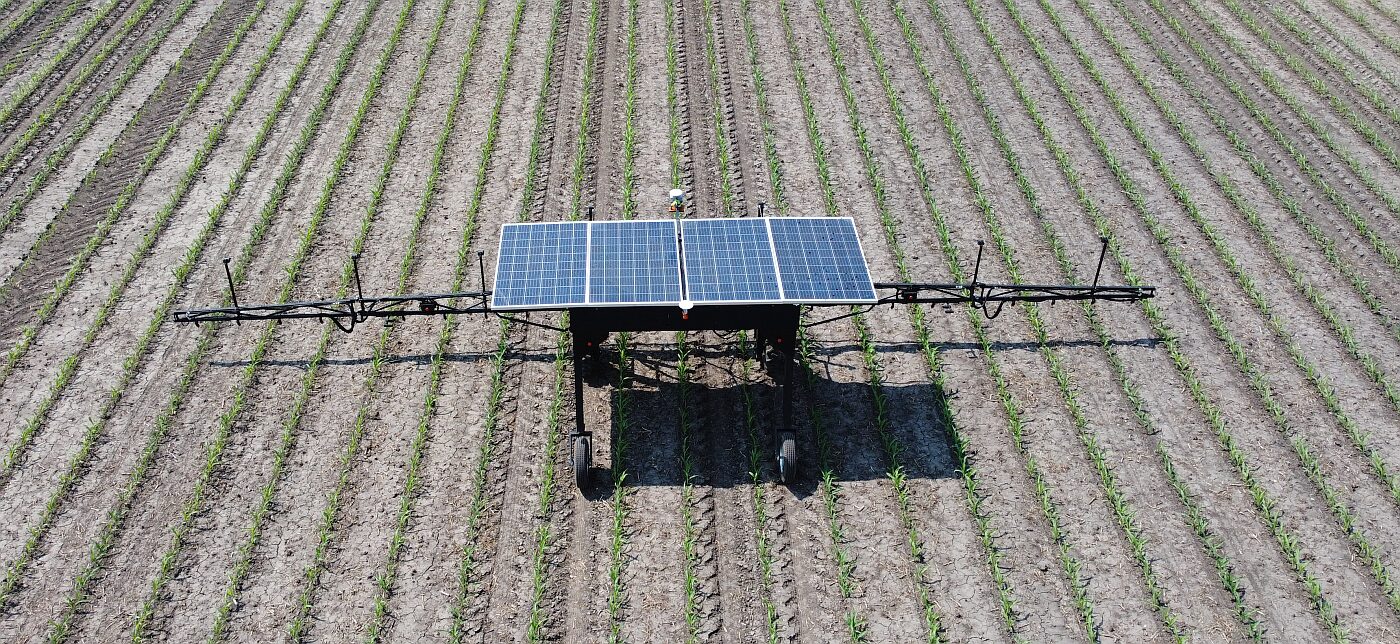
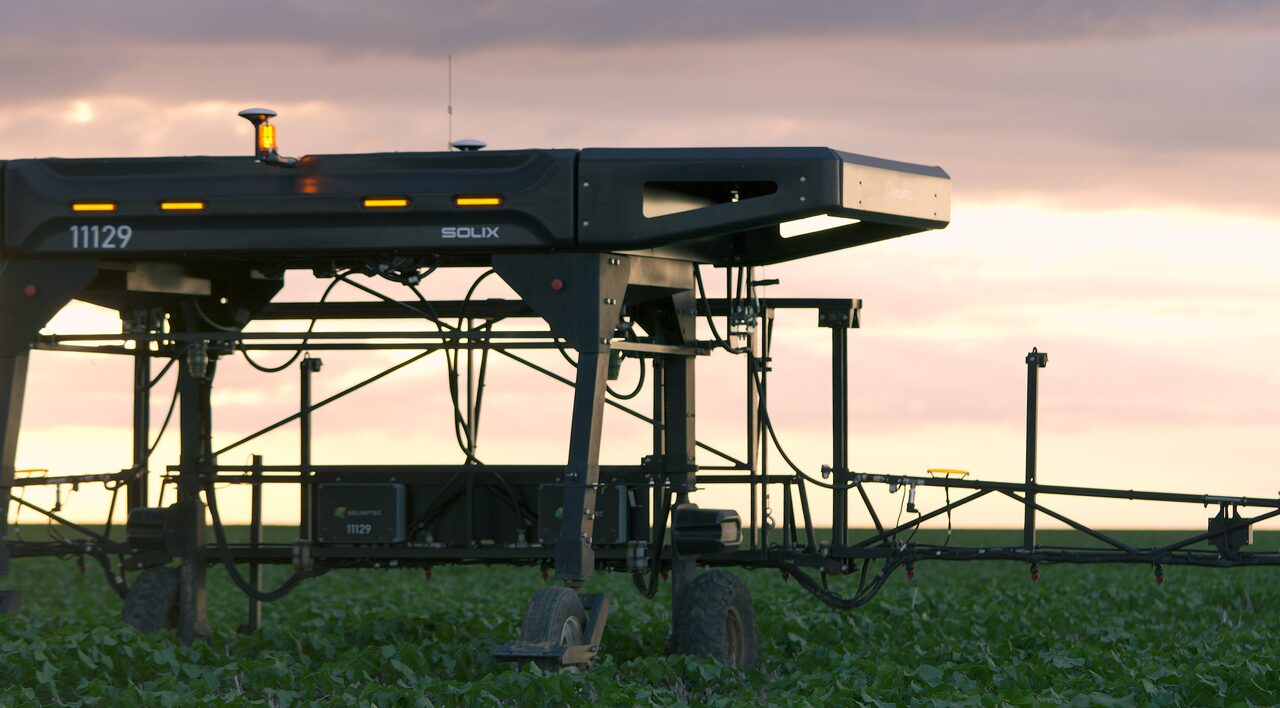
The Brazil-based firm—which has built a farm operations platform that optimizes how machines, labor, and inputs are deployed across the field—moved into the robotics space in 2021 with solar-powered Solix ‘bots designed to “live in the field,” monitor crops and apply targeted spray throughout the season. The hardware—produced by third parties in the US, Brazil, and Mexico— is deployed in the US, Brazil, Colombia, China and Mexico.
“We have been doing very good work on the [software] platform side with logistics and traceability and on-board computers and have 35-million acres now being monitored by our solutions,” North American COO Guilherme Guiné told AgFunderNews at World Agri-Tech in San Francisco last month.
“This has permitted us to invest the profit from that into new tech such as robots,” added Guiné, who said Solinftec had completed a $36 million bond issuance in 2025. “In the robot side, which is more early-stage, it is a different game and we are still investing, but we are at the breakeven point overall at the company.”
Closing the loop on autonomous spraying
He added: “In the next three to five years, we are going to scale a lot, and the curve now is more towards how we fulfill the cycle of the autonomy with the refill stations. This is going to be the first commercial year for those and means we can have 24/7 field operation without human intervention.”
When the robot senses it is running out of product, it goes to the docking station, connects itself, refills with chemicals and then goes back to work, he said.
“We are going to have just shy of 60 [refill] units in commercial fields in 2026 and it’s progressing really fast, because now we can fully close the loop on the autonomy piece.”
Equipped with AI, sensors, and high-resolution cameras, Solix ‘bots continuously monitor crops and perform targeted applications, enabling up to 95% reduction in herbicide use. They also capture field-level intelligence including plant emergence, weed density, pest presence, stand gaps (where plants failed to emerge or died), and crop growth stages.
The information is delivered via Solinftec’s ALICE software platform and is accessible via phones or laptops.
Guiné added: “We have more than 10 different sensors that are looking for the crop and taking millions of [datapoints] for analysis. But the good thing about our solution is that we are just running at about one mile per hour, which give us the ability to check the same plant 10 times in one pass.
“There will also be multiple opportunities during the season to return to the same spot and check what we did before. With a weed, for example, I might go to one portion of the field, detect a weed and spray on it. I geotagged that weed, and I come back later and ask, is that weed dying? If it is not, maybe my chemical mix is not right for that weed or there is resistance?”
Continuous monitoring
The same applies to crop health, which Solix ‘bots can track over time, he said. “It’s not just a matter of going there, flying a drone and getting a picture that is just a snapshot on the crop. We want to see a timeline, a video of how this crop is performing over time. That is the value of living in the field.”
As the bots “live in the field all season long,” he said, “That gives us an ability to be at the field at the right time. I’m not waiting on weeds to emerge and then go and control them. I’m controlling them as soon as they emerge, which means, if you have a one-inch-tall weed, I’m going to go for that weed, because our cost to keep running as we are solar is marginal.”
Asked how actionable the data the ‘bots are collecting is, Guiné said: “We have a massive amount of data, and we transform that into something that the farmers can easily handle and then use AI to give easy feedback. For example, if a portion of your field is having a lower growth stage, we can correlate that with soil moisture, the weather, or some problems on the planter.”
The system also knows what is important for any given crop, he said. Knowing the height of cotton, for example, is vital, and will influence PGR (plant growth regulator) use, whereas with wheat, crop height is not super important. “Here, farmers want to monitor canopy coverage [how dense and complete the crop blanket is across the field]. Our sensors might be the same for both crops but what we show the farmer will depend on the crop and what problems they want to address.”
Positioning for mass-market adoption
The ROI for farmers comes from reduced inputs, labor savings and yield bumps, although Solinftec does not guarantee the latter.
Row crops are the sweet spot, particularly in the US market, said Guiné, “But we do have some operations in sugar cane and citrus orchards, and we are touching some specialty crops.
“What we are trying to do is to position ourselves in a different way than some other robotics companies. Most of them are in California, in the [Central] valley, or in the specialty crop space. Our dream is that if we can make our tech affordable for row crop farmers, it’s going to be a market fit for the high-value specialty crop market.”
Solinftec is targeting ag retailers and dealerships, farmers, and crop protection companies, who are generally buying the ‘bots outright, he said. “It’s a very low price point compared with other ‘bots. It’s $50,000 per unit, and for our latest version you pay a subscription fee for the use of the software and to keep receiving upgrades.”
Clear returns, minimal babysitting
With tractor-mounted retrofitted robotics solutions offered by some other companies, he said, “You still have the labor [costs], you still have the fuel [costs]. Am I saying that those are not good solutions? Not at all. But our long-term view is that if you need to have a tractor, if you need to have a person to manage that tractor, the autonomy is not solving a real problem.
“Our dream is that the technology will take care of itself. Solix is like a vacuum robot that you have at home, but for farmers. It lives in the field all season long, taking care of the crop for you.”
As for the hardware, said Guiné, “We don’t really care if it’s a sprayer, a spreader, a planting machine. We made a sprayer as a first step, but moving forward, we’ll have different versions. The beauty is that the platform will be the same.”
When approaching potential customers, he said, “The common feedback is that they want to see clear return of investment. The second thing is how user-friendly is your solution? They don’t want a solution that they need to babysit or is too hard to implement.
“And that is why building our solution together with them in the field is vital. Farming environments are not standard and not controlled. We had tornadoes, rain, even snow. Being in the Midwest with row crop farmers with large operations, that gives us an ability to understand their environment and promote a solution that works for their daily life.”
Data integration and maintenance
The sweet spot for the ‘bots is close to 500 acres, he said, “But our dream is that units should be feasible for a very small farmer.”
On maintenance, “90% of our components, you can find at Amazon and order them to be shipped to your home,” he added.
“It’s not something that is super hard, but we do have local support through ag retailers or our team. But agentic AI is also so important here, as the robot will [diagnose that] my problem is in this camera; here’s the link at Amazon where you can order it, and here’s the manual for you to switch that camera on.”
Asked if there will be 10 robots for 10 tasks in future or more multi-tasking ‘bots, he said: “Our roadmap is that we are going to have a family of robots,” some more specialized than others. “But in general, he said, multi-tasking is going to be important. “If you’re going after weeds, why not check crop health at the same time? And as you’re doing that, why not trigger another robot to go and apply fungicide?”
Further reading:
🎥‘Like a Roomba for vineyards…’ Bien Nacido puts Saga Robotics’ UV-C robots to the test
Guest article: What CES really told us about robotics in the produce sector
Seascape Aquatech bets on robotics to reinvent oyster farming