
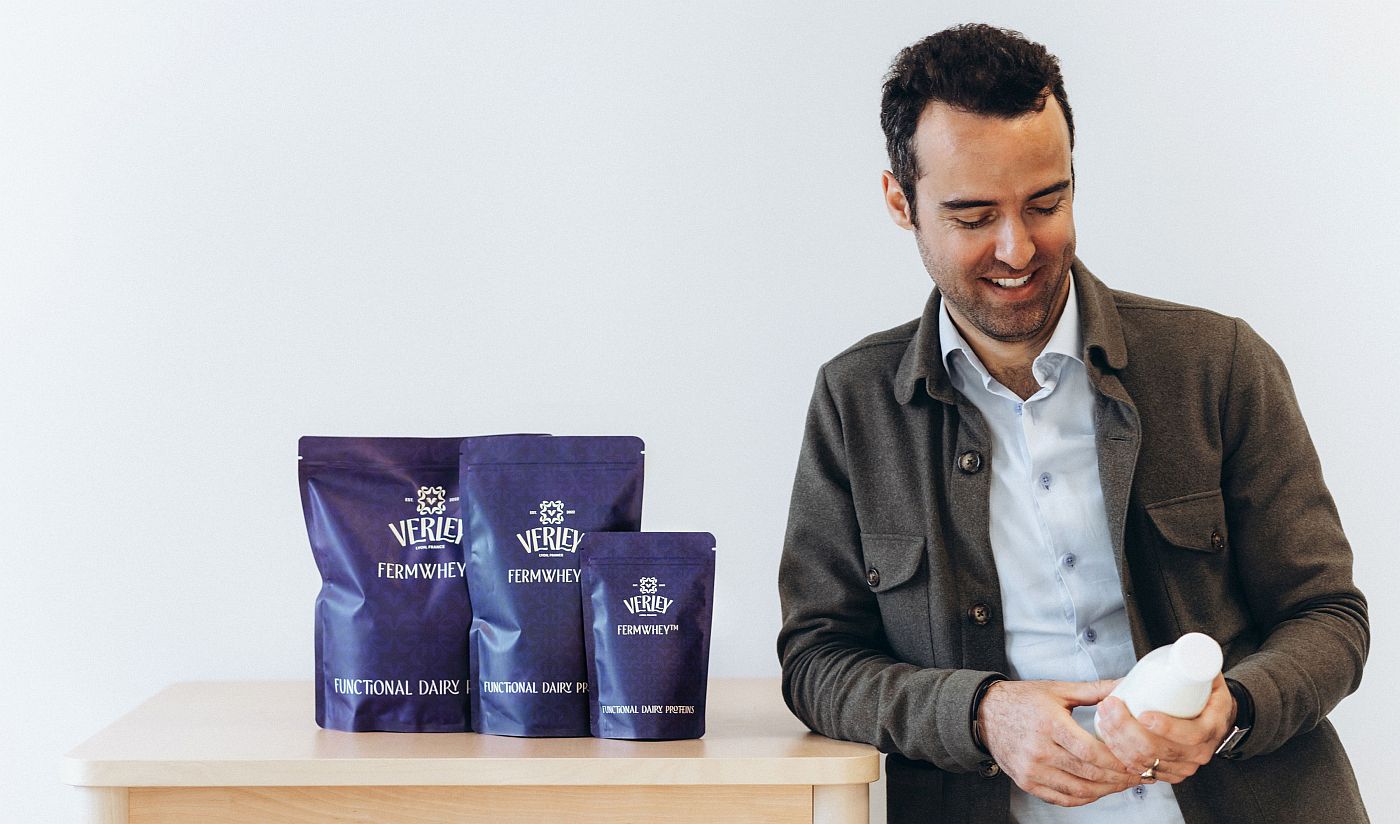
– Verley—one of a handful of players making a whey protein called beta-lactoglobulin (BLG) via precision fermentation—has raised €32 million ($38 million) as it gears up to enter the US market later this year.
– The round includes €25 million ($30 million) in equity funding from Alven, Blast, Sofinnova, Captech Santé, Sparkfood, Founders Future and €7 million ($8 million) in non-dilutive support from French national investment bank Bpifrance.
As protein targets climb, formulators look beyond conventional whey
While demand for protein continues to rise in the US with increased penetration of GLP-1 drugs and new dietary guidelines that recommend a near-doubling of protein intakes, the current toolbox has its limitations for formulators looking to add protein powders to their wares, says Verley cofounder Stéphane Mac Millan.
Plant proteins can present sensory and technical challenges, while whey protein isolate (WPI), historically the go-to protein for food formulators, is in short supply, pushing prices up significantly over the past year.
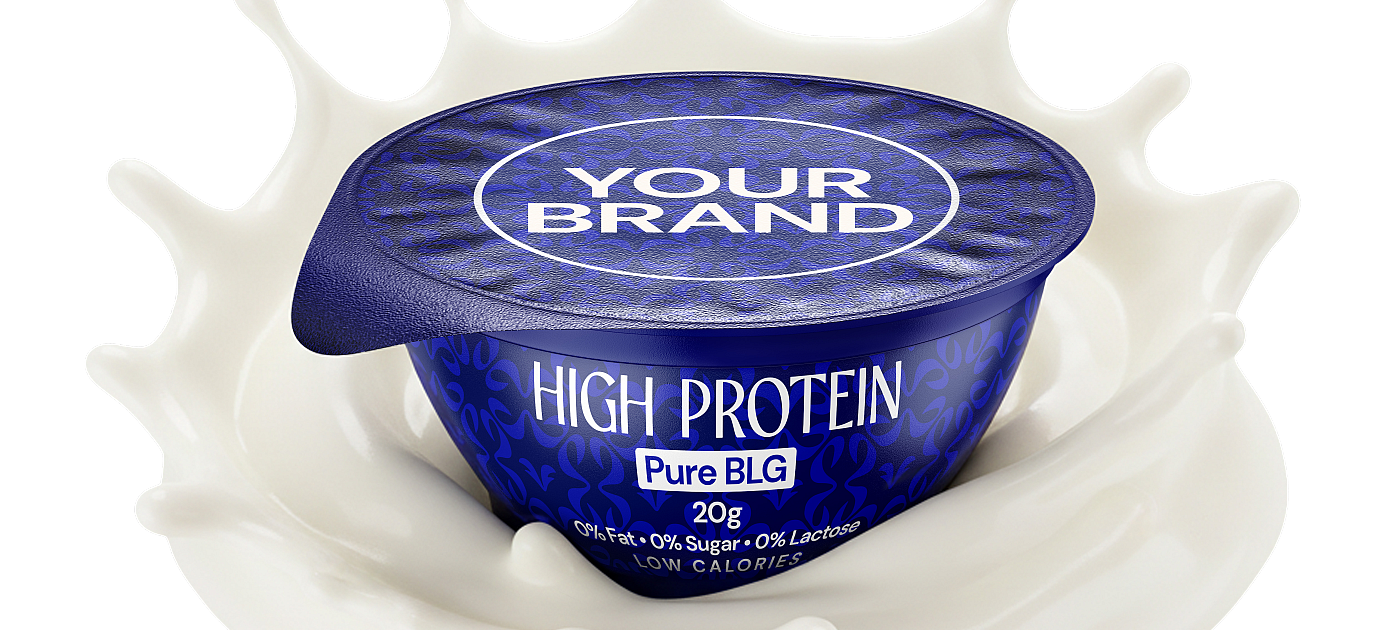
Against this backdrop, individual dairy proteins produced via precision fermentation such as beta-lactoglobulin (BLG) can find a sweet spot in the market by enabling firms to add significant quantities of protein to shots, clear beverages, yogurts and other products without compromising taste or texture, says Mac Millan.
“If you try to pack 25 grams of regular WPI into a protein shot, it won’t work because you will not have the solubility you need,” he claims. “Same thing for high protein yogurt. Once you go beyond 9% protein, the texture can be super sandy. With our microparticulated BLG we can get to a 15-16% inclusion rate.
“So for these kinds of applications, we’re not really in competition with WPI, we’re complementary, we’re opening doors and unlocking new possibilities.”
Functionalized whey proteins
Verley (founded in late 2021 as Bon Vivant by Mac Millan and Hélène Briand) now offers food formulators three products:
👉 Native 100 BLG: lactose-free, fast-absorbing BLG that works well in sports nutrition products and clear beverages.
👉 FermWhey MicroStab: a micro-particulated BLG promising “unprecedented heat and acid stability,” making it ideal for UHT drinks, fresh dairy, and high-protein low-fat formulations.
👉 FermWhey Gel: BLG with gelling properties enabling formulators to clean up labels by replacing stabilizers, gums, carrageenan, and modified starch.
Tech transfer, approvals, and the path to market
Armed with the new funding, Verley can now focus on scaling up its tech and securing regulatory approvals, says the firm, which has secured a GRAS ‘no questions’ letter from the FDA and is preparing dossiers for submissions in the EU and the Middle East.
“We’re at the 50 cubic meter (50,000-L) stage of production but need to go above 150 cubic meters,” says Mac Millan. “We are in the tech transfer stage and finalizing scale up with co-manufacturers. If everything goes well, we should be able to start [supplying US customers with commercial quantities] in Q3 or Q4 of this year.”
Unit economics continue to improve at Verley, which produces BLG from a strain of Aspergillus oryzae, he adds. The protein is secreted into the fermentation medium, separated from the biomass by filtration, and concentrated by a second filtration step.
“We are ahead of our R&D plan in terms of getting the [efficiency metrics] numbers, which is one of the reasons we have been able to raise this round. Another thing that is helping is that massive demand for protein is pushing [animal-derived] whey prices up and up. So reaching price parity is getting easier.”
BLG steps out from behind the whey label
Another fairly recent phenomenon is the fact that food marketers now want to call BLG out on product labels, he says.
“When we started, no one really knew much about BLG. Now that’s changed, which is also helping us [in pricing discussions], because then people understand that it’s not about competing directly with WPI but offering something purer for muscle recovery. We will reach price parity [with WPI] and maybe even below, but on a different product [BLG] that is even better [in some applications].”
He adds: “Some consumers are now super well educated about BLG and leucine [an amino acid known for muscle recovery],” he adds, noting that gram for gram, pure BLG will deliver slightly more leucine than WPI.
Raising capital as foodtech cools and matures
Raising money in the current climate is challenging but investors that are still in the space have gained a better understanding of the technology, which is becoming more mature, he says.
“If we manage to commercialize this year, it means that we will have done it in a little over four years, which is amazing. We are past the time of exuberance for foodtech investing but investors can see that the potential for offtake [agreements] is enormous. That said, you have to be able to tick the boxes on technology readiness, regulatory, and scaling.”