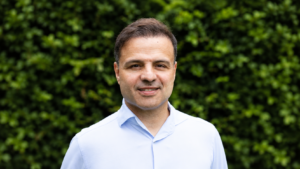

“People see smallholder farmers in India, and they assume that, oh well, you must not use technology. Well no, dipsh*t, we really do,” observes Omnivore cofounder Mark Kahn, who says too often, outsiders still frame the market through the lens of charity or impact.
From hyper-fragmented supply chains that have steadily organized, to service-based business models that turn expensive equipment into affordable opex and a new wave of farm-to-consumer success stories, India has evolved its own highly efficient agricultural playbook, says Kahn.
And after a couple of lackluster years following a market correction that happened across global agrifoodtech, India is poised for growth, predicts Kahn, who is paying particular attention to biomaterials, full stack CDMOs, and robotics.
For exits, expect both M&A and IPOs, he says. “India has much better public markets than the United States and Europe, so I do think in the next year or two, you’ll see the first IPOs in the space.”
As for homegrown talent, the Indian startup ecosystem has it in spades, he claims. And while there was a brain drain in the late 20th century, “People are also coming back from the West, either because [the] H1B [visa system] is basically glorified indentured servitude or because nations are now cracking down on legal immigration, even if it means shooting themselves in the foot.”
AgFunderNews (AFN) caught up with Kahn (MK) to discuss the unique trajectory of Indian agrifoodtech, what global investors still get wrong about smallholder agriculture, and where the next wave of opportunity—and exits—is likely to come from.
AFN: How did Omnivore get started?
MK: I was working at [Indian agribusiness] Godrej Agrovet originally in an operational capacity as head of strategy and business development and started seeing that while the startup ecosystem in India was growing, almost no investment was going into the space from a venture perspective. It just felt like someone needed to do something.
I met [cofounder] Jinesh Shah, who had the VC experience from Nexus Venture Partners, whereas I was an agro business guy, and we originally launched effectively as a corporate venture fund in 2011 and operated that way until 2017 when we had an opportunity to become independent.
The corporate venture fund was around $30 million, the first independent Omnivore fund in 2018/19 was $75 million, and the most recent fund was $215 million.
AFN: What was it like early on? Did you catalyze investment into the space?
MK: It was a lonely few years, and we were plagued by self-doubt. But from around 2017 other people started investing and the ecosystem began to really take off.
AFN: Has investment in Indian agrifoodtech followed a similar trajectory to the rest of the world?
MK: Yes in the sense that global venture capital increased in that time, but no in that the drivers of agrifoodtech in India looked nothing like agrifoodtech in the West, where you had billions going into alt protein and vertical farming. The agritech liftoff in India had very little to do with the agritech liftoff in the US. It really had to do with the fact that starting in 2016, what had been an e-commerce boom [in b2c] from 2008 onwards, stalled, though not in a bad sense.
Suddenly, no one was giving people any more money to do a new [b2c] e-commerce platform, so people turned their attention to the b2b opportunity in India, in particular, this concept of b2b marketplaces. The first big one was called Udaan, which was founded by alumni of [b2c e-commerce site] Flipkart. And then other things came from that… because the second you start looking at small businesses in India, you suddenly discover that a lot of them are agrifood related.
Probably the first big one was Ninjacart. Then came WayCool, DeHaat, and AgroStar. And then parallel to that, there was also an interest in farm-to-consumer brands as part of verticalized e-commerce and brands like [b2c meat & seafood e-commerce platform] Licious and [b2c dairy e-commerce platform] Country Delight started taking off.
If you look at the boom years of Indian agritech, it’s really about b2b marketplaces and b2c, basically, eGrocery that is farm-sourced. And there are also some agrifintech elements.
So the takeoff started in 2017, and then by 2019, holy shit… and 2021 was crazy. And then at some point in 22 things started to cool before dropping like a rock in 2023. And then they stabilized a bit. 2024, 2025 have been kind of flat and I think 2026 will be a little bit better. But we’ve definitely seen a meaningful correction from the peak.
Broadly the Indian story has been about organizing hyper fragmented supply chains and I think that there has been some success there.
AFN: What about biomanufacturing?
MK: From a very low base, it is going pretty well, but it’s still early days, and very little money has gone into it relatively. But I think there’s a huge amount of opportunity, which is why we helped set up an NGO focused on the life sciences investing challenge in India called BioWave.vc in partnership with IndieBio and Nucleate, recognizing that India has an insane opportunity and insane potential in biomanufacturing, which isn’t fully realized.
So we’re very committed to backing the biomanufacturing revolution. We’ve invested in Loopworm, BioPrime and we will do more deals in this space.
AFN: Will Indian agtech startups become global category leaders?
MK: Pixxel [hyperspectral imaging for earth observation] is serving global customers and Niqo Robotics [robotics, precision ag] is absolutely crushing it in California.
AFN: Are Indian agtech startups finding it easier or harder than, say, US startups to raise money right now?
MK: I actually think it might be easier right now for Indian startups. Tractor Junction [a startup enabling farmers to research, buy, sell, finance, and insure tractors and commercial vehicles] has raised a [$22.6 million Series A] round; Varaha just raised [a $20 million Series B].
AFN: Where are exits going to come from in 2026?
MK: I think product companies are going to be trade sales. We sold [aquaculture tech co] Eruvaka to Nutreco [in 2022]; we sold Mitra [Mitra Agro Equipment] to Mahindra [in 2023]; and we sold Barrix [Agro Sciences] to Sumitomo chemical [in 2023]. So in general, there is quite a bit of M&A activity.
The second thing is that India has much better public markets than the United States and Europe, so I do think in the next year or two, you’ll see the first IPOs in the space.
AFN: You say India has much better public markets than the United States and Europe?
MK: I think India is one of the best markets in the world to do venture in. Your ability to IPO in India is 100 times easier than in Europe or the United States. That’s the funny thing. India will see IPOs in agritech well before America or Europe does because it’s just much easier to list.
And not because our exchanges are a joke but because America and Europe have made it almost impossible to take companies public, which is why America has SPACs, which are kind of a clever workaround [whereby a shell company raises money in an IPO with the sole purpose of merging with a private firm to take it public without a traditional stock market listing].
India is a lot like the NASDAQ in the 1990s, right? There’s tremendous retail investor and institutional investor appetite and you’ve seen a lot of great startup exits in the last couple of years.
AFN: What’s the deal pipeline like right now?
MK: India has world class founders and world class talent; that’s why the CEOs of Google and Microsoft are Indian. And while there was a brain drain from India in the late 20th century, most Indians are now very happy to be part of this nation-building effort that has defined the last few decades in India.
We see very strong engineering and science students, very strong MBAs, and really great talent in our startup ecosystem. People are also coming back from the West, either because [the] H1B [visa system] is basically glorified indentured servitude, or because, nations are now cracking down on legal immigration, even if it means shooting themselves in the foot.
A great example: the cofounders of altM [which makes bio-chemicals and biomaterials from ag and industrial residues]. One went to Berkeley, one went to MIT, and they came back because the H1B is a horror.
AFN: Is it hard for agtech companies to scale rapidly in India because the end market is so fragmented with millions of smallholders?
MK: The entire Indian agricultural ecosystem is built around sourcing from smallholders or selling to them. Every village has a farm store that sells to thousands of farmers. In dairy, every village has a couple of collection points that work with thousands of smaller farmers. The whole system is built around that.
There is a layer of how to do that engagement; that is a known playbook.
As for affording solutions, the average farmer in India is small and poor, but you also have farmers with five hectares of bananas that are living very well. If you’re trying to sell a product, you’re probably going to go towards the top 20% of Indian farmers by income.
Also, a lot of the platforms in India are meant for smallholder farmers; the way someone engages with a DeHaat [Indian agritech platform that provides farmers with inputs and services] is through a village level entrepreneur [as well as directly via an online platform].
A lot of times I think people also turn capex into opex in India. For example, India is one of the largest markets for harvesters in the world, but no farmer buys a harvester. Harvesters are bought by micro entrepreneurs that then do harvesting as a service and sweat the assets. So I just think India has different business models. If something is very expensive, people turn it into a service.
AFN: What’s one narrative about Indian agtech that international investors still get wrong?
MK: One thing they get wrong is not understanding that even though India is a smallholder ecosystem, it is one of the largest agricultural economies in the world, a critical market for [huge global ag companies such as] John Deere, for Bayer, for Syngenta, for Yara, for Cargill.
People see small farmers, and they assume that, oh well, you must not use technology. No, dipshit, we really do… Or they think this is charity or impact. And my response to that is, I don’t know if you’ve noticed, but UPL is now the fourth largest agrochemical and seed company in the world now that [leading agrichemicals firm] FMC has kind of immolated.
People have built enormous businesses that started out serving this smallholder ecosystem, so there’s a tremendous business opportunity here.
AFN: Given what you’ve just said, are international investors now looking at India differently?
MK: The nice thing in India is that we have pools of capital that that are unconcerned with the US. If you look at who led the [recent $45 million Series B ] deal in [carbon project developer] Varaha, for example, it’s Westbridge Capital [a global investment firm focused on India].
Look at [Belgium-based investor] Astanor and Tractor Junction [Astanor recently led a $22.6 million round into Tractor Junction, an Indian startup enabling farmers to research, buy, sell, finance, and insure tractors and commercial vehicles] or [fellow Belgium-based investor] Edaphon coming into [Indian ag biologicals startup] BioPrime, or [US-based investor] S2G Investments coming into [Indian AI-enabled aquaculture platform] AquaConnect.
AFN: Climate has moved down the agenda in the US lately; what’s the situation in India?
MK: The United States has fallen off a cliff from a climate perspective. But I find it very funny that climate-focused VCs aren’t plowing into India, where climate is a bipartisan issue.
The Indian right and the Indian left both know it’s getting hot as hell. And so I am amazed that these global climate funds are continuing to prioritize the United States and ignore a much bigger and, frankly, much better and much less political opportunity in the Global South.
AFN: What areas of ag are you most excited about?
MK: I remain very interested in material science and biomanufacturing, and we’re working on some deals in that space. We were very active marketplace investors for a while but I think these days the marketplaces that we’re excited by are really full stack CDMOs [contract development and manufacturing organizations].
That’s a concept that’s very common in India, and less common in the West, but if you think about it, Scimplify and Agrizy are CDMOs, these organizations that work with hundreds of small manufacturers and basically build innovative products and serve global customers.
AFN: You’ve done a lot of work to built connections between India and the Gulf region?
MK: There is a huge opportunity for Indian startups in the GCC [Gulf Cooperation Council] and the MENA [Middle East and North Africa] region and it’s something we’re working on very actively as we see this as an opportunity for our portfolio companies. People forget that Dubai and Mumbai are a two-hour flight from each other.
But there are other regions where we’re working on agrifood corridors, including Japan.
Growth capital has kind of fallen off the face of the earth in the last few years, so any place where there’s a strong interest in growth capital is very exciting. And we’re seeing that in the GCC and Japan, so I’m helping my portfolio companies access growth capital, [connect with] the largest corporates, and identify partnership opportunities.
AFN: What mistakes have you made as an investor?
MK: Like everyone in this sector, we’ve made plenty. One was underinvesting in the farm-to-consumer space. Should we have been in Licious or Country Delight? But thankfully, we have done some really great deals there. Farmley’s growth has been spectacular, and so is [the growth at] Sid’s Farm.
I wish we had done less in marketplaces; there was an incredible bullishness about the potential of marketplaces to disrupt. And I think the ones that had good unit economics have gotten stronger but many others just didn’t work out; either the unit economics were terrible or the working capital cycle was terrible.
I think the space of digitization also didn’t pan out as expected; everyone who’s ever done farm software has been disappointed and we are no exception. Skymet was disappointing, BharatAgri [which shut down last year] was disappointing, right?
Maybe AI will be different, but let’s see. And honestly, I wish we had done a bit more on deep tech, because I think that’s a space where we really see a lot of fundamental transformation coming.
👉 Checkout the latest interviews in our Investor Q&A series.