When Kishore Indukuri returned to India from the US after a six-year stint at Intel, he wasn’t chasing the next big thing in agrifoodtech, but trying to address a pretty basic question: why are millions of small dairy farmers still struggling to make money, and why do consumers lack confidence in their milk?
A materials scientist with a Master’s and a PhD from UMass, Amherst, Indukuri started Sid’s Farm in 2012 with 20 cows, selling raw milk directly to customers in Hyderabad after learning that a middleman would only pay half of what it cost him to produce it. “I was getting 13 rupees a liter; my cost of production was 25.”
Today he runs a premium dairy brand serving 60,000+ customers across Hyderabad and Bangalore with everything from ghee and curd to high-protein milk in cans, selling 60–70,000 liters of milk a day from 5,000 farmers in 185 villages.
The company, which generated about $21–22 million in revenue in the year ending March 2025 and expects to hit around $30 million this fiscal year, has ambitions to reach $150 million within five years.
Operating a tightly controlled, hyper-local supply chain built around intensive milk testing and local chilling infrastructure, Sid’s Farm has a direct-to-consumer delivery model. This is supplemented by fast-growing sales through quick-commerce platforms such as Zepto, which now account for more than a third of the business.
AgFunderNews (AFN) caught up with Indukuri (KI) to explore how a dairy startup VCs might initially dismiss as “low tech” has quietly built a data-rich, trust-driven operation; why Indian consumers are willing to pay a premium for milk they can trace via a QR code; and how Sid’s Farm plans to evolve from a milk business into a broader “clean food” brand.
AFN: Give me the brief origins story…
KI: I got into a very good school in India for engineering and then got a full scholarship to study at UMass Amherst [in the US] and did my Master’s and PhD there in material science. I then worked for Intel for about six years in semiconductor manufacturing but was always looking for something more impactful and meaningful that would push me to my boundaries.
My wife and I had a one-and-a-half-year-old son and we’d been away from family for several years so we wanted to move back, be closer to home and do something that would really interest us.
AFN: Does the dairy industry in India need disrupting? What problem were you solving?
KI: India has enough milk now, but it doesn’t yet have the same standards as larger developed nations, and I felt, why not figure out a solution?
Until the 1990s, the industry [comprised] predominantly government owned dairy coops in each state, with more private dairies coming in. But the average size of dairy farms is quite small, and if farmers are just producing, say, 200 liters of milk, having chilling infrastructure is not a viable option.
So back in 2012, I bought 20 cows. I was getting paid 13 rupees per liter and my cost of production was 25 rupees. In this environment, nutrition is not taken care of and animal productivity suffers, so it’s a vicious cycle. Because I had a formal education, I said, Okay, let me take this milk to the city and sell it directly, but for the bulk of small farmers, this option is not available.
So I thought how can I help them get a fair price for quality milk?
AFN: What happened next?
KI: In the first couple of years, I sold raw milk from our own cows, and later we did a basic pasteurization process. As demand grew, farmers around us started saying, Hey, Kishore, can you get us a better price for our milk?
So we started getting really focused on testing, first of all for thickness. The basic testing machine for this around the world is an ultrasound sensor. But it doesn’t know whether it is thick because of milk solids or some other solids, and as milk fat is five times more expensive than vegetable fat, there’s an incentive to skim it off and replace it with vegetable oil or starches.
We wanted to give customers a guarantee that this wasn’t happening, so we run tests that are very cost efficient to determine sugars, salts, starches, melamine, vegetable fat, antibiotics, hormones, aflatoxins and preservatives you don’t want in there such as hydrogen peroxide, caustic soda, or baking soda.
Then we chill the milk at bulk milk chilling centers, where we have one for every 20 villages in which we operate. Good milk then goes via tankers to our main processing facilities.
We also support our farmers with veterinary care, access to quality feed, help with loans, and tools to manage their own P&L.
AFN: All this sounds like a volume game and not something a startup can make money out of?
KI: This depth of testing, nobody else does. We charge a premium, but people are willing to pay. Currently, we serve about 60,000 customers in Hyderabad and Bangalore, selling between 60,000-70,000 liters of milk every day. It’s still small scale compared to some of the large dairies, but our goal is to look at a metropolis like Hyderabad, which has about 11 million people, and get to about 100,000 customers there within a subset of households that can afford premium dairy.
Right now we work with 5,000 farmers in 185 villages. We did around $21… $22 million in the year to March 31, 2025, and expect that to be $30 million [in the year to March 31, 2026]. We intend to be doing $150 million [per year] or so in the next five years.
AFN: How do Sid’s Farm products get to the end consumer?
KI: Once the milk gets to the plant we process and package it and send it to distribution centers. From here it goes to local dark stores and is then delivered by third party contractors on bikes with insulated bags between 4am and 7am directly to the doorstep of end consumers, who can order via our app up until 10pm the night before.
When our consumers receive a packet of our milk or yogurt, they can scan the QR code, and we’ll tell them the last three days of test results. Customers are paying us a premium because they trust us.
AFN: How are you getting the message out to new consumers?
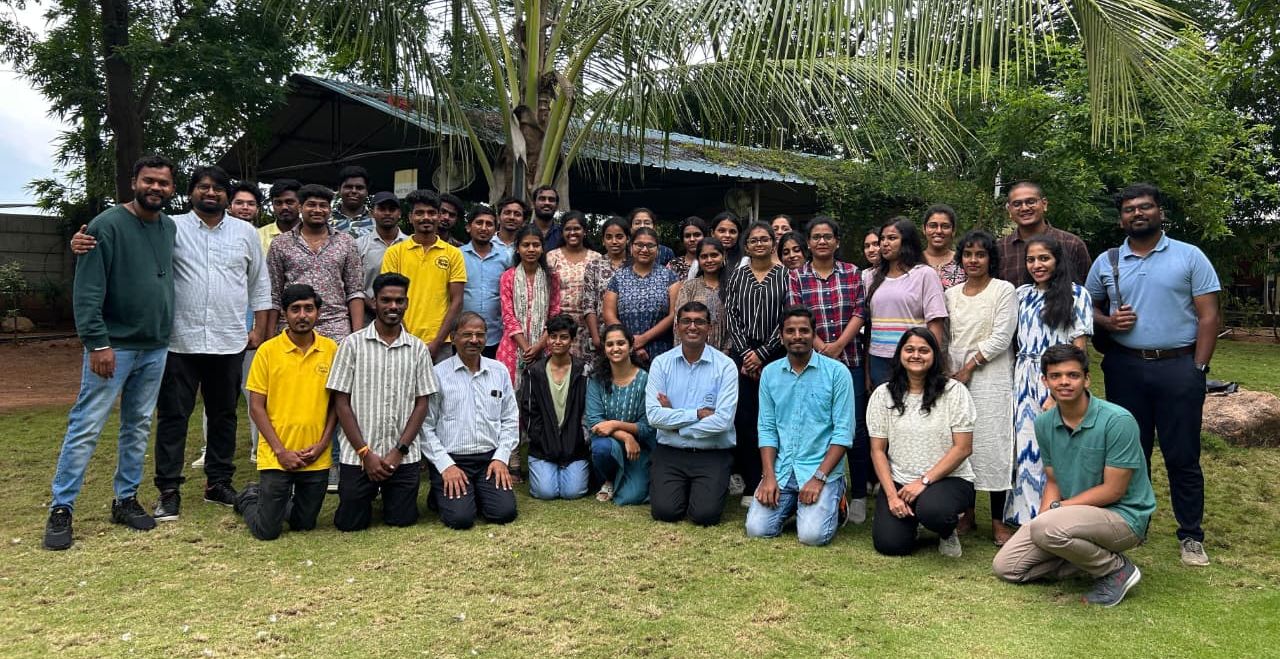
KI: We use digital channels, so Google ads, Facebook, Instagram and so on, but we also use mom influencers, parent influencers, plus we also invite customeres to the farm to show them the process. Every Saturday for the past 10 years, we have always done a farm visit.
I feel this is one of the most important things we do, so we put a lot of effort into it. When people walk into our farm and see the process, they become customers for life. We also do community events at apartment complexes where we take all of our testing apparatus. Kids can don lab coats and we have them test the milk, but in a fun way.
We also do digital ads in lifts [elevators] in apartment complexes.
AFN: Why do you package your milk in plastic pouches?
KI: This is traditionally what India does, but wearing my material science hat, as the milk is cold-filled, the interaction of the plastic with food is minimal. It behaves like a glass at lower temperature, so it’s absolutely safe. From an environmental perspective, meanwhile, glass bottles may seem like the greener choice, but they need more fuel to transport and a lot more energy to clean. It takes three grams of this plastic pouch to transport a liter of milk vs 650 grams of glass to transport the same liter of milk.
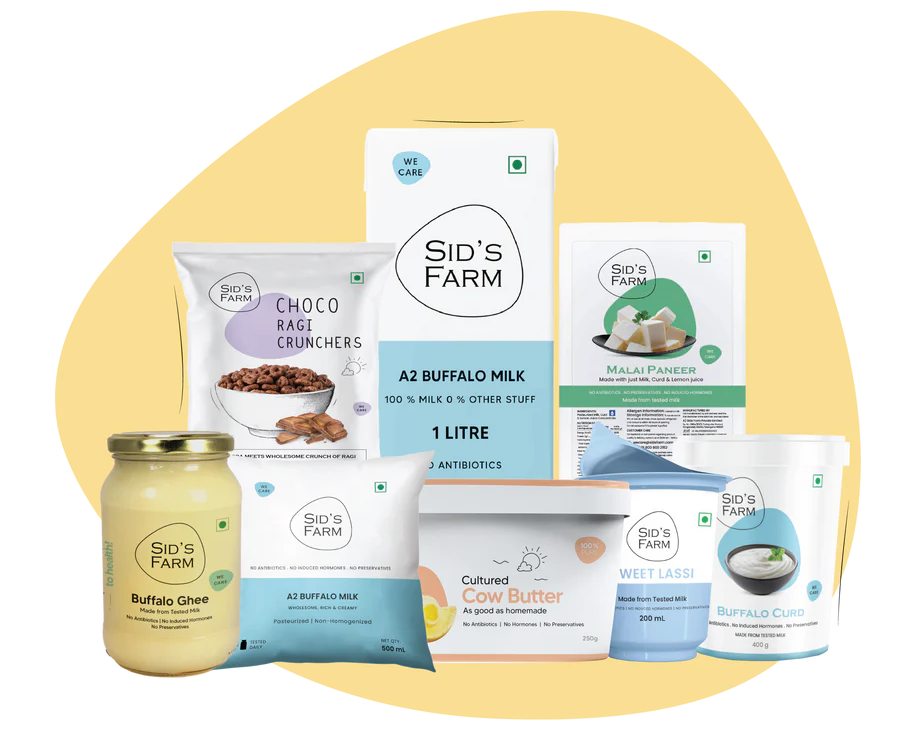
For products like ghee, which are filled at higher temperatures, we use glass, and then for our new high protein milk, which is fat-free and lactose-free, we package it in a 250ml can.
AFN: How broadly can the Sid’s Farm brand stretch?
KI: India is going through a protein journey, so we’re working on more high protein product variants and we’re about to launch cheeses, but we also have cereals, butter and yogurt to try and build a larger average basket.
AFN: How successful has Sid’s Farm been?
KI: In the last two years, we’ve really started to build a team that can scale up. In Hyderabad, we are very close to profitability but we are spending a little bit more aggressively on marketing.
We have a 45-48% raw material margin, so if you look at the production cost, the cost of running our factories and stuff like that, that’s about a 10% cost, so our gross margin should be at 35%+ right? Today, however, it’s lower than that because when we procure milk from our farmers, we agree to take all of their milk. Anything we are not able to sell, we have to sell in bulk [to other dairy companies] at a price that hits our margins a little bit.
But as we scale and introduce a lot more products, this [sale of] bulk [milk] is slowly coming down [as the firm can incorporate excess milk into other dairy products it sells that have a longer shelf-life]. For example, our yogurts have a 15-day shelf life, and then we have UHT milk and so on, so as we expand our product range, we are cutting down on that bulk.
Last year we were selling about 10 tons of ghee a month. Now we’re selling about 30 tons a month.
So today, that bulk [milk sales] is at 6% and the idea is to bring it down to 3% this year. By next year, we want to bring that down to 1%.
As we scale our volumes we reduce our factory costs, so we demonstrated 8% EBITDA profitability two years ago and think we can do 15% by 2028.
AFN: How have you funded the business?
KI: I initially started with my own savings, and then a little bit more from family. And from 2016 to 2022 whatever money that we generated from the business, we put it back in and kept growing it.
In 2023, we got our first raise [of outside capital] from essentially our customers, so close to 20 people investing small checks. And then in 2024, we raised money from Omnivore.
AFN: What’s next?
KI: We’ve started operating in another city called Pune and we’re also looking at Vijayawada. Milk will always be local, but moving butter or ghee [clarified butter] is not a large task. Ghee has a six-month shelf life, so we can move it between each of these locations if needed.
AFN: A dairy business doesn’t sound very high-tech or VC-backable on its face…?
KI: It’s how we position ourselves. We understand our customer deeply because we deal with them directly and have all the data about their buying patterns.
We also have a new product development team and we’re continuously innovating on products and technology.
Everything is also tracked, both in terms of the product and the testing but also the bike person who goes to our dark stores with a login that he enters when he arrives. This records the time he picks up the milk and pops out a route to him. Once he delivers to each customer on that route, that location is ticked off.
So in addition to the physical infrastructure, there’s a good amount of tech we’ve developed over the years that any dairy could potentially use and plug and play in future.
Dairy in India is growing rapidly, especially premium dairy, but only 40% of milk is organized.
AFN: How do you see your business model evolving?
KI: Today direct to consumer (DTC) is about 50% of our business, but we also sell on [quick commerce] platforms such as Zepto, so that is about 35% of the business. Companies in this segment are investing very rapidly: if we have 35 dark stores, Zepto has 150 in Hyderabad alone.
We are currently 11% of Zepto’s entire basket of dairy and we have very focused marketing plans with them so we’re super confident that we can get that number up.
Retail is about 10% of our business, but it’s expensive. The idea is, let people discover us digitally through DTC, through quick commerce, and once we become a sizable brand, that’s when we want to do it. Otherwise, you can lose a lot of money, so we’re only doing retail in Hyderabad at the moment.
The remaining 5% of the business is the bulk I was talking about [selling excess milk to third parties] that is negatively affecting our margins. The idea is, long term, this milk will be utilized internally.
We may not even be selling milk right five years from now. Our aim is to create great products that people love and keep pushing the envelope; we want to stand out as a clean food brand out of India.