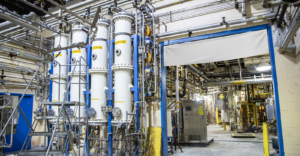

Invisible losses are creeping through the dairy industry, hidden in the pipes.
There are 12,000 dairies in Europe alone, and those produce around 160 million tons of raw milk every year. On average, 4% of that milk is wasted because of inefficiencies and inability to control every aspect of liquid processing.
Finish company Collo is addressing this with a new instrument designed specifically for liquid process intelligence.
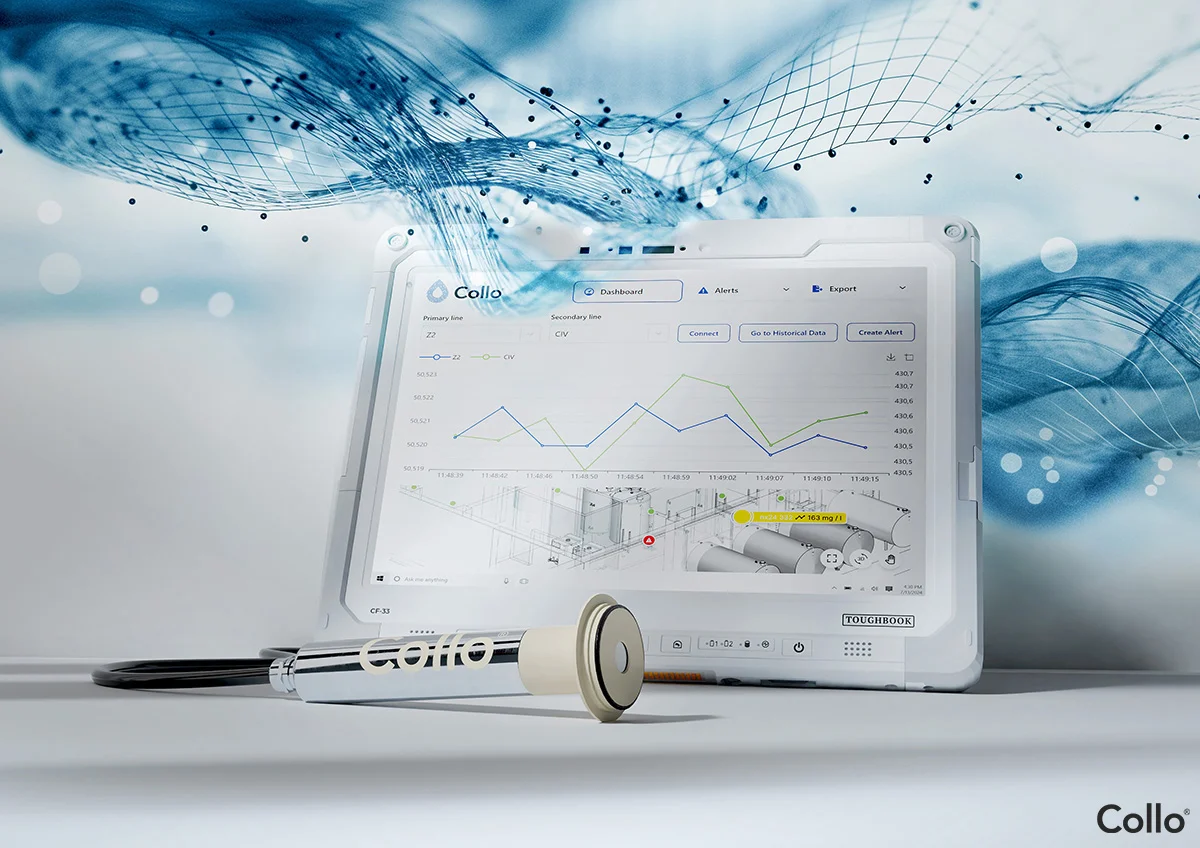
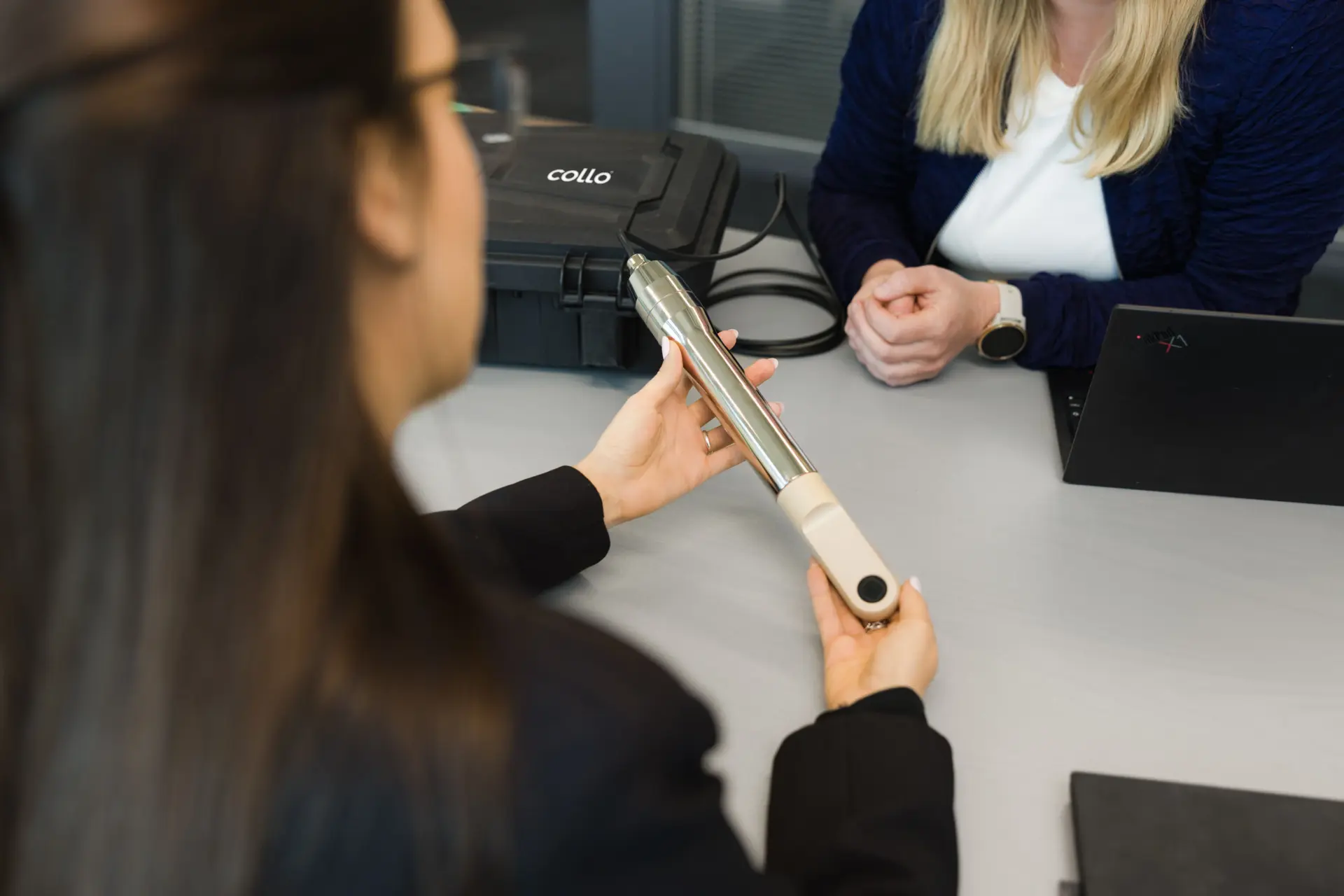
Its core innovation is an advanced sensor technology designed to continuously measure, in real time, liquid properties. These electromagnetic field resonators go inside the pipes at liquid processing facilities and create radio frequencies inside the liquid.
The resulting quality and process control could save beverage companies—from dairies to major bottlers—potentially billions, says Collo CEO Jani Puroranta.
“You can basically start saving money from day one.”
He recently caught up with AgFunderNews to discuss the benefits of this technology and how the company plans to scale its business to reach facilities across Europe.
AgFunderNews (AFN): Give us a bit more background on the company as well as yourself.
Jani Puroranta (JP): The company dates back to 10 years ago, to Tampere University, as a science project where some big companies were struggling with the current instrumentation they were using in their fluid processes, or liquid processes.
The major drawbacks with those instruments were, first of all, fouling: the instruments just get dirty over weeks and months in operation, and then they’re unusable.
They also weren’t universal across the process, so you couldn’t measure with the same instrument at the beginning and end of the process.
[They also needed] something that stays healthy and doesn’t have maintenance needs, so that the operations team doesn’t always have to be replacing [the instruments]. So they needed remote health diagnostics and things of that nature.
The science project started to tackle this problem and came up with the early versions of the instrument that we built and sell today, tackling those very issues.
After a few years, it turned into a company, and now we have been in the food and beverage business a couple of years and been very successful—it turns out that the instrument developed originally for that science project is very good at measuring water-based matrices, complex liquids, like in dairies. Milk is a very complex liquid. It has salts, sugars, fat, proteins and other compounds.
I joined the company just a couple of months ago. My background is in scaling startups, as well as in the processing industry. I was [previously] at a major mining technology company called Metso, where I worked as chief digital officer to deliver remote condition monitoring solutions for minerals processing plants.
That’s where I was introduced into the space of processing liquids and the challenges that major mining companies have with instrumentation. I also spent three years at a packaging materials company, running a plant myself, and saw firsthand how it’s difficult to manage liquid processes. It’s kind of a black box, with very few instruments that work in complex processes.
AFN: What are the potential benefits of Collo’s technology?
JP: There are 12,000 dairies in Europe alone, and those produce around 160 million tons of raw milk every year. On average, 4% of that milk is wasted because of inefficiencies in the process and inability to control the process. The best companies operate below 1%, and then there’s some companies around 7%, but the average is about 4%.
Of that 4%, if we are able to squeeze a quarter out of it—so go from 4% on average to 3%—that’s almost $1 billion in monetary savings.
The other side of the equation is that the environmental load gets reduced. So imagine 6.5 million tons of milk going into the drain every year. You need different types of chemicals to clean that, and some of that will end up [going] into the environment, so it has a CO2 impact. We are reducing that by putting that milk into use and not wasting it.
AFN: Does this apply only to milk or any liquid in food and bev?
JP: The problem is universal. All dairies or beverage companies are struggling with two things: the product losses we just discussed, and then also the issue of facilities consuming just too much water.
For instance, Coca-Cola has publicly announced that they are using 1.78 liters of water to produce one liter of [soda]. Where does that .78 go? It goes down the drain or evaporates somewhere in the process.
Every major food processor in the world is on a journey to reduce the product losses and reduce water consumption, which will also contribute to environmental targets.
AFN: How is Collo’s instrument different from what’s historically been available?
JP: Current instruments are either time-and-flow based, or sometimes they use a conductivity sensor, but that gets fouled many times and it’s not also accurate. Or they use optical instruments where the fouling is significant and it gets soiled and it doesn’t work after a few weeks or months in the process.
[Collo offers] a radio frequency field type of device. Think about the submarine: if you’re under the water and raise the periscope, you don’t see much, and it gets soiled quickly. But if you use the radar in the liquid, you’ll see a lot more. So this is kind of the radar-type of technology where you generate an electromagnetic field into the pipe and then you read the response.
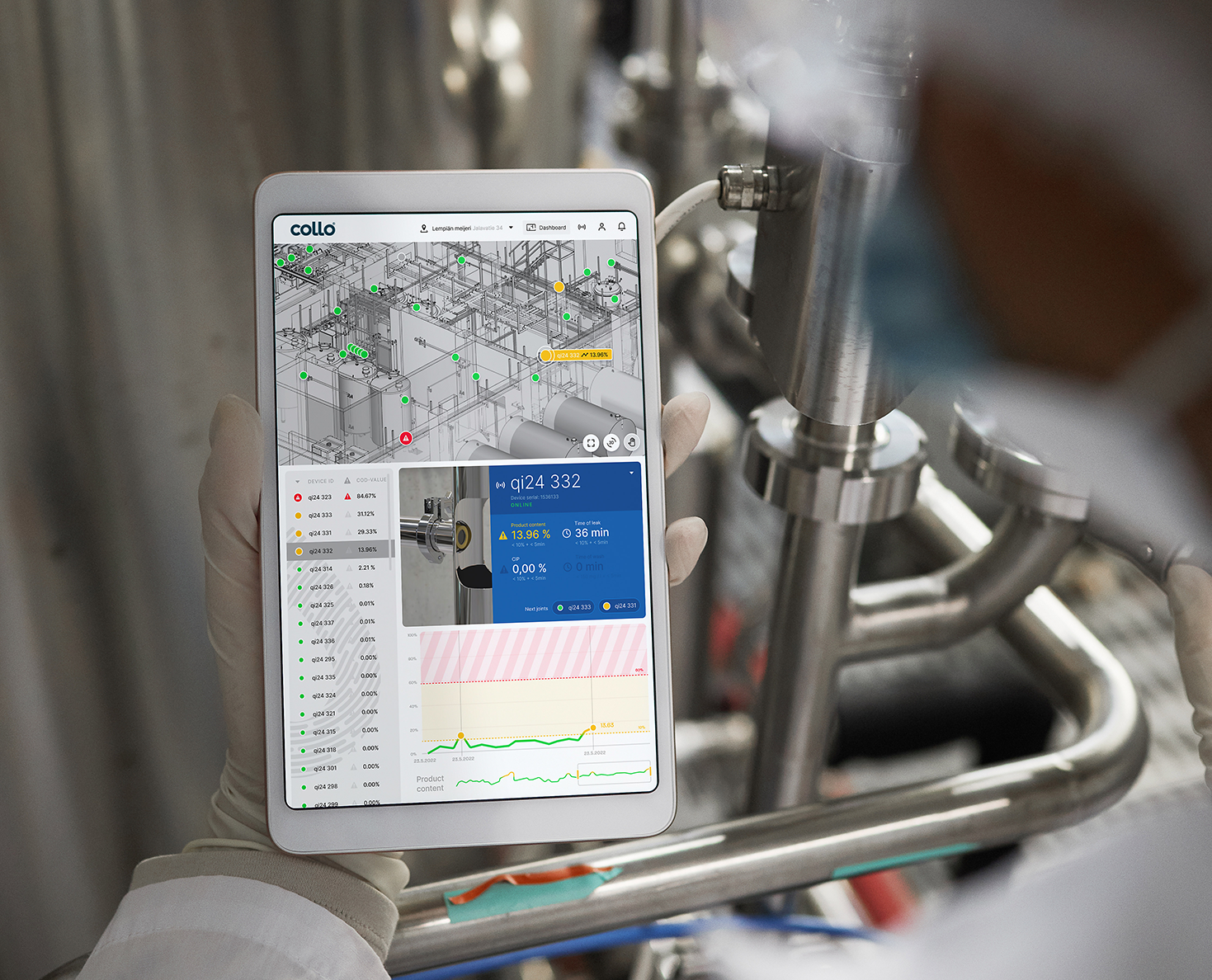
That response then goes into our system. We have machine-learning algorithms that turn that into an automation signal so you can directly control the process based on that signal. You can basically start saving money from day one.
What the typical customer would of course want first is the validation of the technology in their own process. So we would deliver this instrument to their process, have it installed into one of their pipes, and start measuring what goes in the pipe and how much money and product they are losing.
Typical use cases are for CIP [clean in place] optimization, when you clean the pipes, and during push out, when you change from one product to another [in the pipes]. We measure the losses in those two processes.
A great additional benefit of this is also quality control—we can actually see, for instance, if some CIP chemical is left in the product when it continues from the process. So we can warn about that and see that food safety is not compromised.
Then we collect the data and we analyze it for the customer. We can do initial analysis on the data in the background for the customer, where we can actually show how much they are losing and how much they are benefiting from our technology.
AFN: What’s the biggest challenge to scaling this technology?
JP: This is new technology for the customer, so [customers] need to be convinced about the usability of the technology in their particular process and tackling their particular challenges.
Actually, one of the bigger problems for us is that once the customer sees our technology, they start thinking of so many applications for it, and it’s hard to get them focused on one thing.
That’s why we want to focus on the CIP and push-out applications, because they save money and the environment. It’s kind of instant payback.
There’s many applications for the technology. We want to focus on the biggest-ticket items first and and then see [about] other use cases later.
AFN: What’s next for Collo?
JP: Our main focus is to scale the technology in food and beverage companies, mostly in Europe.
We are already in talks with major food and beverage companies in Europe. We have around three dozen already in our pipeline for testing next year and then scaling out from there.
We’re really on a growth journey. We’ve been focusing the past past few years on building the technology and tailoring it for the food and beverage segment, and now we are scaling up.

Sign up for our weekly newsletter.