
Chinese drone maker DJI says the Federal Communications Commission’s (FCC’s) recent move to block new foreign-made drones could cost it $1.5 billion in lost business in the US this year.
The firm, which dominates the US ag spray drone market, recently filed an appeal* with the Ninth Circuit Court of Appeals challenging a bombshell ruling from the FCC that cut off authorization for all new drone models and key critical components manufactured outside the US.
The Dec 22 ruling—which has upended a sector dominated by overseas vendors such as DJI —is “procedurally and substantively flawed,” claims DJI.
In its latest filing in the case, DJI says it has every legal right to challenge an FCC action that “causes DJI and its customers acute and immediate harm.”
“The FCC’s action violates the constitution and federal law, yet the FCC’s motion to dismiss [DJI’s appeal] asks this court to endorse the remarkable proposition that the agency can insulate its decision from any judicial review—now and potentially forever—if the agency simply fails to act on a reconsideration petition that it contends DJI was required to file.”
‘Serious constitutional concerns’
Meanwhile, the national security assessment cited by the FCC to justify its ruling did not specifically analyze DJI’s products, raising questions about whether it followed the statutory process set out in the National Defense Authorization Act (NDAA), which required a government agency to determine if DJI and Autel presented a threat to US national security, claims DJI.
“Accepting the FCC’s view that it can ban entire categories of products from the United States without any judicial review of that decision would defy common sense and raise serious constitutional concerns.”
DJI now “faces a potential loss of $1.5 billion in 2026,” claims DJI, which supplies drones for agriculture, police and fire departments, energy and utility companies, and hobbyists, among others.
“The FCC has set aside authorizations for 14 existing DJI products, including five UAS models and nine non-UAS models, which DJI estimates will result in a loss of $700 million. DJI projects that it will lose an additional $860 million if it cannot sell in the United States the 25 new UAS and non-UAS models it plans to launch in 2026. The FCC’s arguments…. have staggering real-world consequences, and raise serious constitutional concerns.”
According to DJI, the appeals court should pause the case for six months to allow the FCC to act on DJI’s petition to reconsider its Dec 22 ruling.
FCC shock ruling triggers market upheaval
👉 On Dec 22, the FCC sent shockwaves through the US drone market, adding all new foreign made drones and critical components to the covered list of communications equipment and services “deemed to pose an unacceptable risk” to national security.
👉 In an instant, this cut off FCC authorization for any new drone models—or essential components such as motors, flight controllers, navigation systems, and batteries—manufactured outside the US.
The move is already reshaping the market, as domestic manufacturers scale up and overseas firms explore partnership models—licensing designs or software to US companies that can assemble and manufacture drones domestically.
Some key players navigating the new landscape include:
- Exedy Drones: A unit of EXEDY Globalparts (owned by Japanese firm Exedy Corp), Exedy Drones is repurposing Globalparts’ automotive engineering and Michigan manufacturing base to build US-made agricultural spray drones.
- Revolution Drones: Founded by North Carolina farmer Russell Hedrick to create domestically assembled spray drones tailored for American farming.
- Hylio: Texas-based drone maker accelerating “Made in America” spray drone production.
- Agri Spray Drones: Missouri dealer turned manufacturer planning US production of spray drones originally designed by Chinese partner EA Vision under license.
- Ceres Air: Vermont-based company beginning US manufacturing of Black Betty spray drones, redesigning a proven platform from Chinese firm Vector AGR to meet American farming needs with larger payloads, proprietary software, and radar/LiDAR.
- American Autonomy: Software developer launched to build US-centric drone operating systems that keep flight and agronomic data onshore and integrate with farm systems; its first partner is Exedy Drones.
Acreage soared in 2025, but drone sales slumped amid import shock
According to the American Spray Drone Coalition’s annual industry survey, total treated acreage covered by ag spray drones in the US surged by 58.7% year-over-year to 16.4 million acres in 2025.
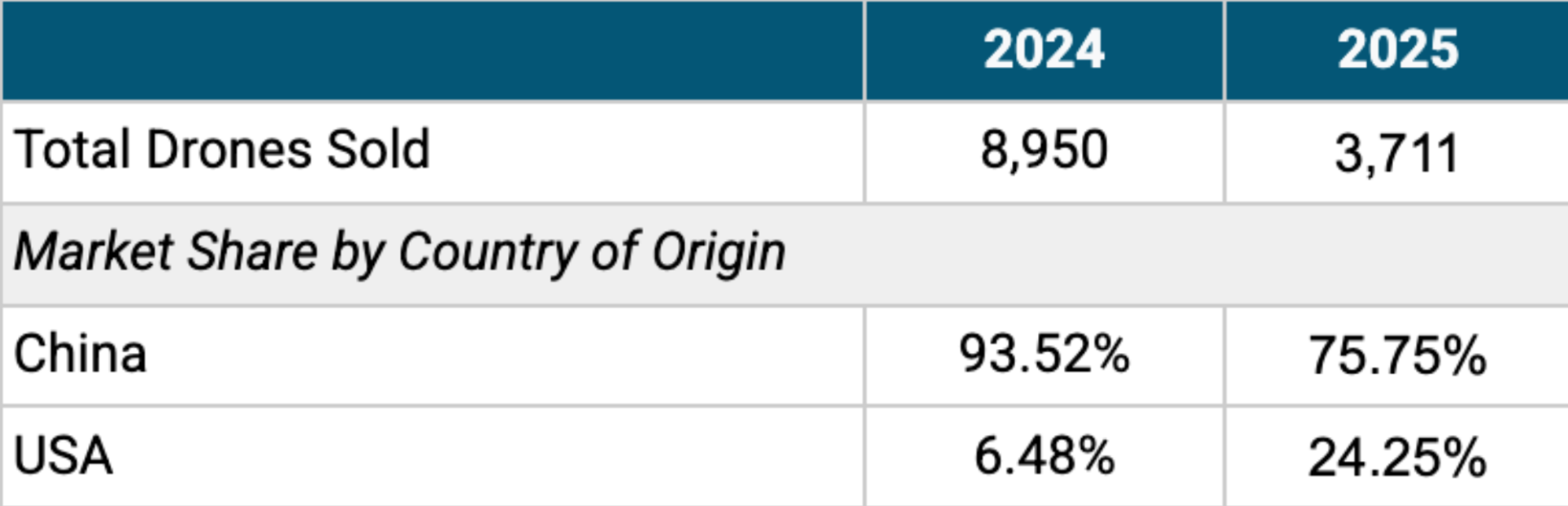
However, sales of new spray drones plummeted 59% from about 8,950 units sold in 2024 to about 3,711 in 2025 due to import restrictions on DJI shipments blocked by US Customs and Border Protection on the grounds that DJI may be using forced labor. DJI says such claims are “unsubstantiated and categorically false.”
*The case is SZ DJI TECHNOLOGY CO., LTD., and DJI SERVICE LLC vs FEDERAL COMMUNICATIONS COMMISSION. Case 26-1029, filed Feb 20, 2026, at the Ninth Circuit Court of Appeals.

Sign up for our weekly newsletter.