
“About a year and a half ago, a buddy of mine posted on Facebook, ‘How is it that I have a 10am appointment at a grain elevator, I arrive at 9:55am, and this what I see,’ and he shares a picture of 18 trucks in front of him,” recalls GrainFlow founder Bryan Wattie.
“I thought that’s dumb, I bet if you knew how long the wait was, since you live only 10 minutes away, you probably wouldn’t have left; you’d have done something else with your time. That’s a fixable problem.”
Some research quickly revealed that a surprising number of grain facilities across Western Canada still coordinate deliveries through phone calls, whiteboards, spreadsheets, and manual scheduling, creating chronic bottlenecks where dozens of trucks arrive simultaneously while facilities sit underutilized later in the day, he says.
In many cases, he claims, trucks simply arrive and line up. “There is no appointment system, no slot reservation, and no sequencing based on what the facility actually needs that day. Farmers who drove 90 minutes to deliver get stuck behind someone who lives five minutes away.”
During harvest, facility managers might field 30-40 calls per day, leaving some farmers waiting hours while handlers in turn face operational inefficiencies and penalties further down the supply chain when rail cars or barges are held longer than the allotted loading or unloading time.
And this is not a fringe problem, says Wattie. “This is the default operating model for the majority of inland grain facilities in Canada. The facility runs either overwhelmed or underutilized. There is no in-between because there is no visibility into what is coming.”
Visibility is key
Vancouver-based GrainFlow—Wattie’s AI-powered inbound truck scheduling and yard management system for grain elevators, crush plants, ethanol facilities, and fertilizer terminals—is on a mission to fix it.
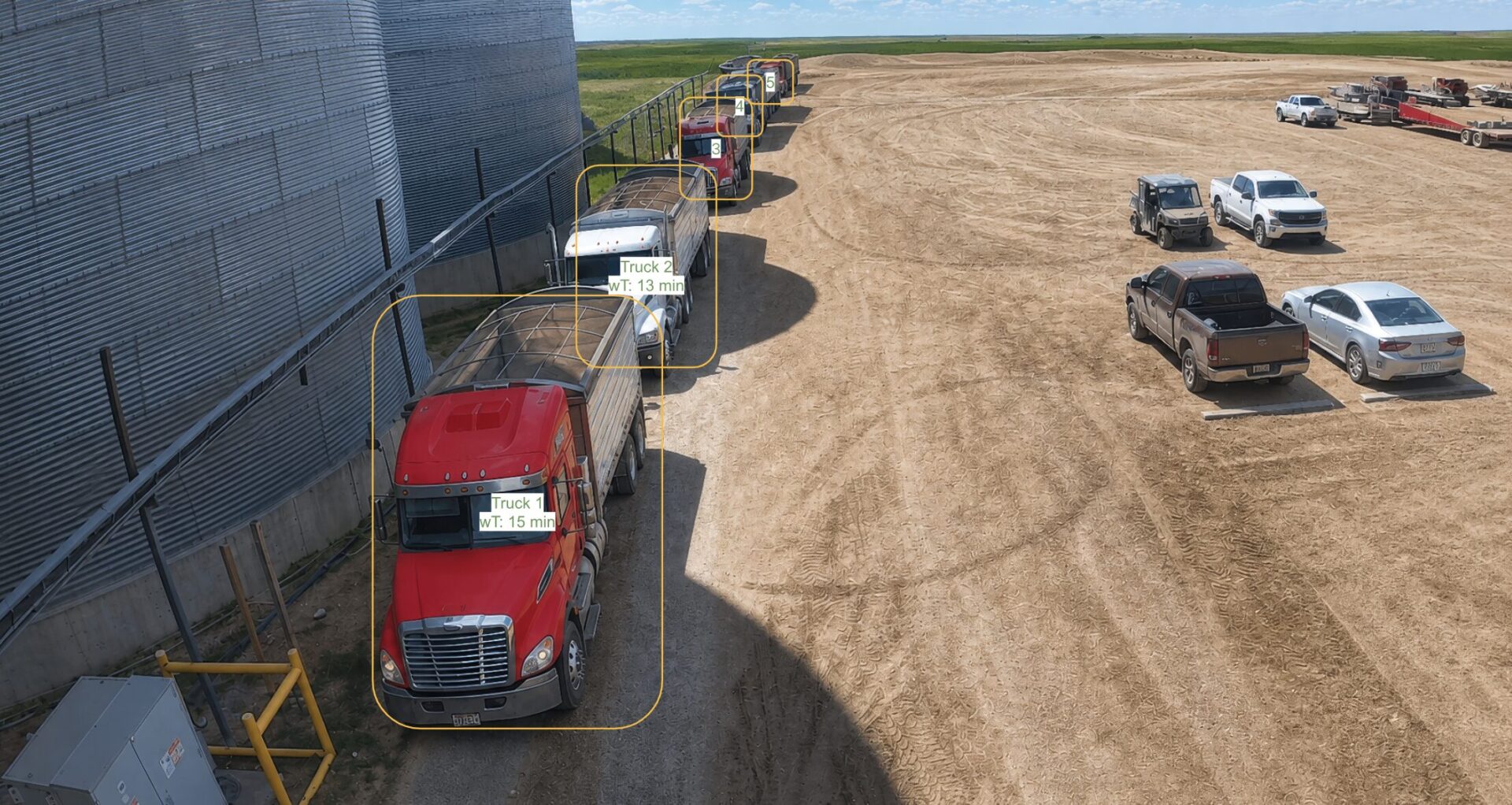
Its initial “wedge product” is a computer vision-based queue visibility system using cameras and edge AI to count trucks, estimate wait times, and present congestion data in real time.
A digital tool that allows farmers and truckers to book delivery time slots at a grain facility, GrainFlow replaces phone-based coordination with an online system and sets available capacity by hour and product type. Drivers reserve slots in advance. This reduces wait times, improves facility throughput, and eliminates the daily flood of phone calls.
Visibility is key, says Wattie, as anyone that has used Uber or Lyft can testify. If you know your Uber is coming in five minutes because you can watch its progress in real time on your screen, you can go to the pickup point just before it arrives. If you can see it’s delayed, you can do something useful while you wait. If you call a regular cab, you’re flying blind.
The longer term vision
Beyond simply serving as an online appointment booking system, GrainFlow can respond dynamically to the situation on the ground, detect growing congestion and automatically send rescheduling recommendations to spread arrivals more evenly, for example. Farmers might receive alerts suggesting they delay departure, stop for fuel or lunch along the way, or shift to a different time slot.
To those wondering why queuing at a grain elevator really matters that much, says Wattie, “Every truck that waits an extra hour in the morning is a truck that can’t make a second trip that afternoon. Multiply that across a fleet and you’re losing real loads, real revenue. Nobody’s short on capacity at 2pm. They’re drowning at 8am.”
But the broader vision extends to what Wattie describes as capacity-aware scheduling: integrating scheduling, contracts, inventory, delivery tracking, and predictive analytics to help facilities smooth inbound flows and reduce congestion and downtime.
Facilities can then set delivery targets based on outbound rail schedules, processing needs, or storage capacity, while farmers and truckers receive re-scheduling suggestions and alerts when delays occur.
GrainFlow is also exploring predictive maintenance applications such as identifying equipment issues like unstable probe arms (mechanical sampling devices used to collect grain samples from trucks before unloading) before failure occurs.
Certain crops such as canola or soybeans can also contain excess debris or poorly cleaned material, which may clog or partially obstruct elevator legs, augers, or unload systems, he says. Detecting declining throughput could pick up this problem before operators notice or before a complete shutdown occurs, allowing facilities to intervene proactively rather than reactively.
Pilot deployments
Commercially, GrainFlow is very early stage, says Wattie, who is planning a pre-seed round while participating in Saskatchewan’s Cultivator accelerator program.
However, it has already secured two pilot deployments with a major grain industry player covering two distinct facilities in Canada and the US: one scheduled end-user processing plant and one unscheduled grain elevator. Installations are expected before the harvest season.
Additional pilot sites are being added across the Canadian Prairies and the US Plains for harvest 2026 and spring 2027.
The ROI for the grain handlers comes from improved throughput, labor savings (no guy with a whiteboard taking 40 calls a day), and yard intelligence (savings from more predictive maintenance for example).
The addressable market
According to Wattie, any facility with unpredictable truck arrivals and limited unloading or loading capacity can benefit from GrainFlow, which could help coordinate canola supply into a crush plant or manage seasonal outbound shipping peaks at a fertilizer terminal.
While fertilizer production is dominated by a handful of global players such as Nutrien, Yara International and CF Industries, he says, most growers source inputs through local retail networks and fertilizer sheds, where bulk product is stored, blended into custom formulations and loaded for field application.
Here, the same problems emerge, creating periodic bottlenecks, with coordination often still handled via phone calls or informal systems, leaving farmers waiting in line during peak periods despite the scale and sophistication of production further up the chain, says Wattie.
While this might sound like the kind of task that conventional warehouse and third-party logistics scheduling systems could handle, “They tend to be designed for third party logistics providers, not farmers,” he claims. “They’re missing a bunch of the operational context.”
For example, OpenDock is dock scheduling for warehouses with no agricultural features, says Wattie. Bushel handles grain origination, contracts, and scale tickets, and serves as a complementary partner, not a competitor, to GrainFlow, he claims. Terminal Industries focuses on enterprise warehouse yard automation outside agriculture. “GrainFlow is the only platform combining inbound farmer scheduling, computer-vision yard monitoring, and commodity-aware capacity planning purpose-built for grain handling.”
He adds: “I’ve worked with computer vision models for the past 15,16 years and authored patents in that space, so I’m quite familiar with the state of the art. And I think this is a really novel application of it.”