
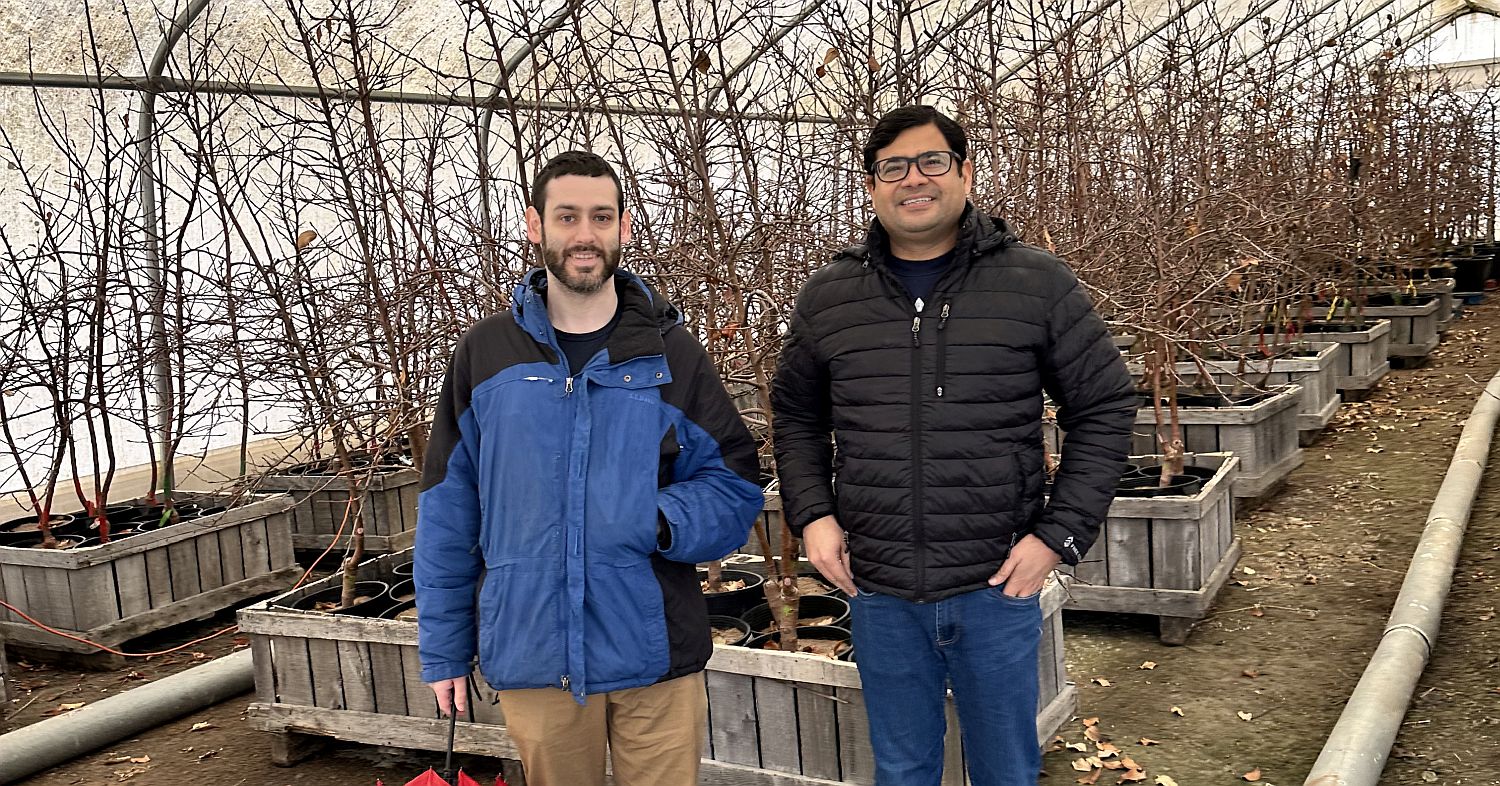
– New York-based CryoBio—which has developed a novel solution for frost protection in apples, grapes, and other high-value crops—has raised a $1.3 million pre-seed round to take its tech from the lab to the field.
– Investors in the pre-seed round include Marble, AgVenture Alliance, New York Ventures, Launch NY, FuzeHub, Klessig Trust and Jade Cove Partners.
– The capital will be used to expand operations in New York, with additional hires in biochemical engineering, biomanufacturing, and horticulture.
The cost of frost
Frost is a perennial problem for farmers. But thanks to climate change, it’s getting worse, with warmer winters and earlier springs causing crops to bud and flower earlier, leaving them more vulnerable when late cold snaps hit.
When frost hits, it can be devastating. First it starves plants of functional water and oxygen, and then ice crystals physically shred plant cells, says Murli Manohar PhD, who teamed up with biochemical engineer Abe Pressman last year to create CryoBio as a spin-out of the venture studio Marble.
“All you need is one night below freezing to destroy the whole crop. In 2024, frost and freeze events alone caused $854 million in US crop losses, with losses rising to up to $3 billion in a bad frost year.”
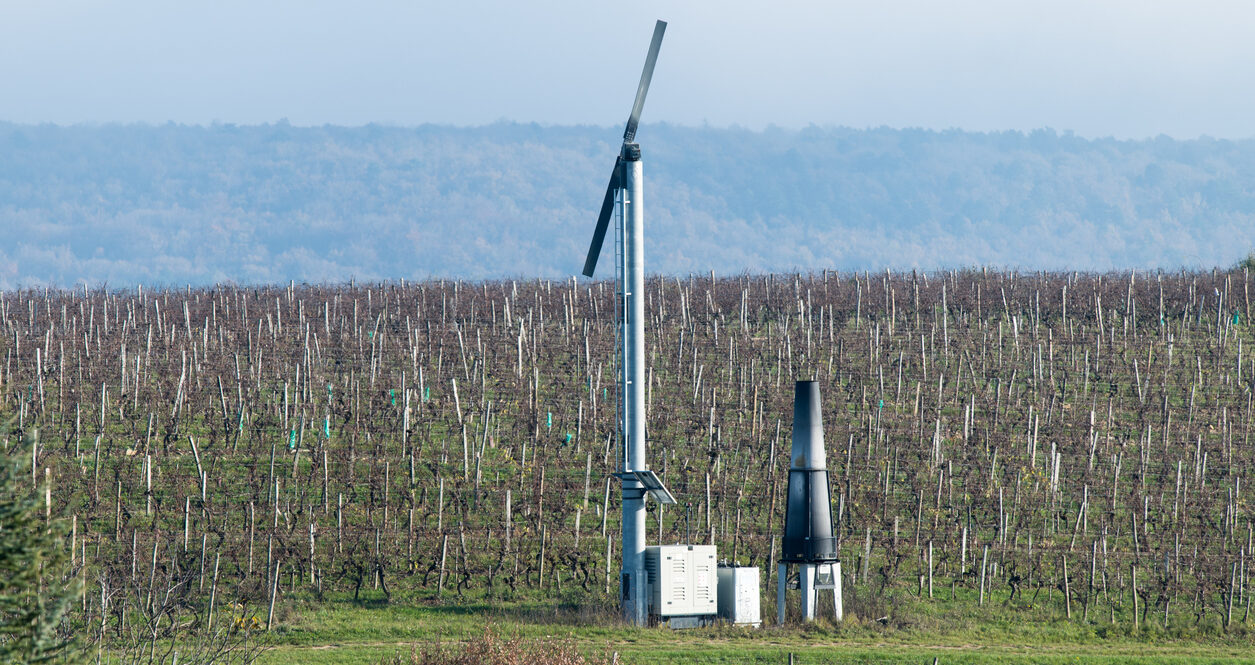
Yet the tools to counter the threat, he says, remain “prohibitively expensive” or “stuck in the past century,” from candles and insulation blankets to orchard fans that pull warmer air down and mix it with colder surface air.
Commercial frost protection products in turn mostly rely on nutrient sprays featuring potassium and calcium to very slightly lower the freezing point of water, or microbes claimed to delay ice formation.
But their effects are brief and inconsistent, claims Manohar, who is also the co-founder of Ascribe Bioscience, a startup behind crop protection products that activate plants’ immune systems to defend against fungal and bacterial diseases.
“We have spoken to hundreds of farmers and the general consensus is that these sprays don’t reliably work in real-world conditions and offer, at best, incremental improvements over traditional methods.”
“Vineyard owners still light thousands of candles between rows at 3am, burn hay bales, or hire helicopters to push warm air down onto vines. These methods are prohibitively expensive, inconvenient to operate, and are no match for severe frosts.” Murli Manohar, CEO, CryoBio
Inspired by animals, produced in a fermentation tank
CryoBio, in contrast, takes its inspiration from antifreeze proteins found in animals that have adapted to survive in subzero temperatures. It then engineers microbes to produce these molecules in a fermentation tank, extracts them, and supplies them to farmers as a powder that can be mixed with water and sprayed on crops just prior to a frost event using standard equipment.
The molecules bind to tiny ice crystals, preventing them from forming larger, more damaging, ice crystals.
“Think of animals in Alaska or Antarctica,” says Manohar. “When winter comes, some of these organisms go into winter dormancy. From the outside they may look dead, but they produce these molecules, which get into the blood and keep it liquid throughout the winter.”
Right now, CryoBio is making these molecules in bacteria, with plans to shift to yeast or fungi as the production microorganism for large-scale production.
In the short term, CryoBio is extracting and purifying the target molecules, but in future if it moves to a different microbial host, could save money on the downstream process by harvesting the entire microbe and supplying that as a product, says Manohar.
“We are looking into some of the beneficial microbes that are commonly used in agriculture. Can we have them produce [the antifreeze molecules] so instead of purifying the protein, can we deliver it via a [whole] microbe that’s symbiotic to the plant? That’s the path we may take eventually, although it will hit the regulatory wall in some countries as it’s a genetically modified organism.”
From the greenhouse to field trials
Farmers can apply the spray to crops at least four hours prior to anticipated frost, he says. “The molecule takes time to penetrate the plant.”
To date, CryoBio has tested the treatment in frost-simulated conditions in greenhouses, and is now gearing up for a flurry of field trials in New York, Washington, and Canada on apples and grapes.
“We have a freezing chamber where we control the temperature, wind, humidity, but our whole focus now is to get this field validation. Once we have that, we can better understand what the formulation [of a commercial product] is going to look like, what surfactant to add, what stabilizer to add, which polypeptide is the best, as we will be testing a few of them.”
Currently, CryoBio is producing its biomolecules at the gram scale, but should be at the kilogram scale when it launches with growers in New York, hopefully in 2027, says Manohar.
“The protein itself is very stable. Once we extract the molecule and freeze dry it, based on what we know, we think the shelf-life could easily be 2+ years.”
Regulatory pathway and scale up plans
As CryoBio’s products are naturally occurring molecules and don’t directly affect plant growth or act as a pest control agent, they shouldn’t fall under US EPA pesticide regulation, claims Manohar. Instead, the company plans to pursue state-level registration, which is faster and cheaper.
To streamline approval, CryoBio is considering positioning the product as an adjuvant, inert ingredient, nutrient supplement, biostimulant, or biofertilizer — even potentially blending it with nutrients such as zinc — whichever classification offers the least regulatory friction to reach farmers quickly, he says.
“We have fair bit of understanding of how it might play out in US. But for other markets such as New Zealand, Australia and Europe, we’re still exploring the pathway,” he adds.
CryoBio is partnering with several CDMOs to manufacture its product, he says. “Our goal is to have multiple manufacturing locations.”