
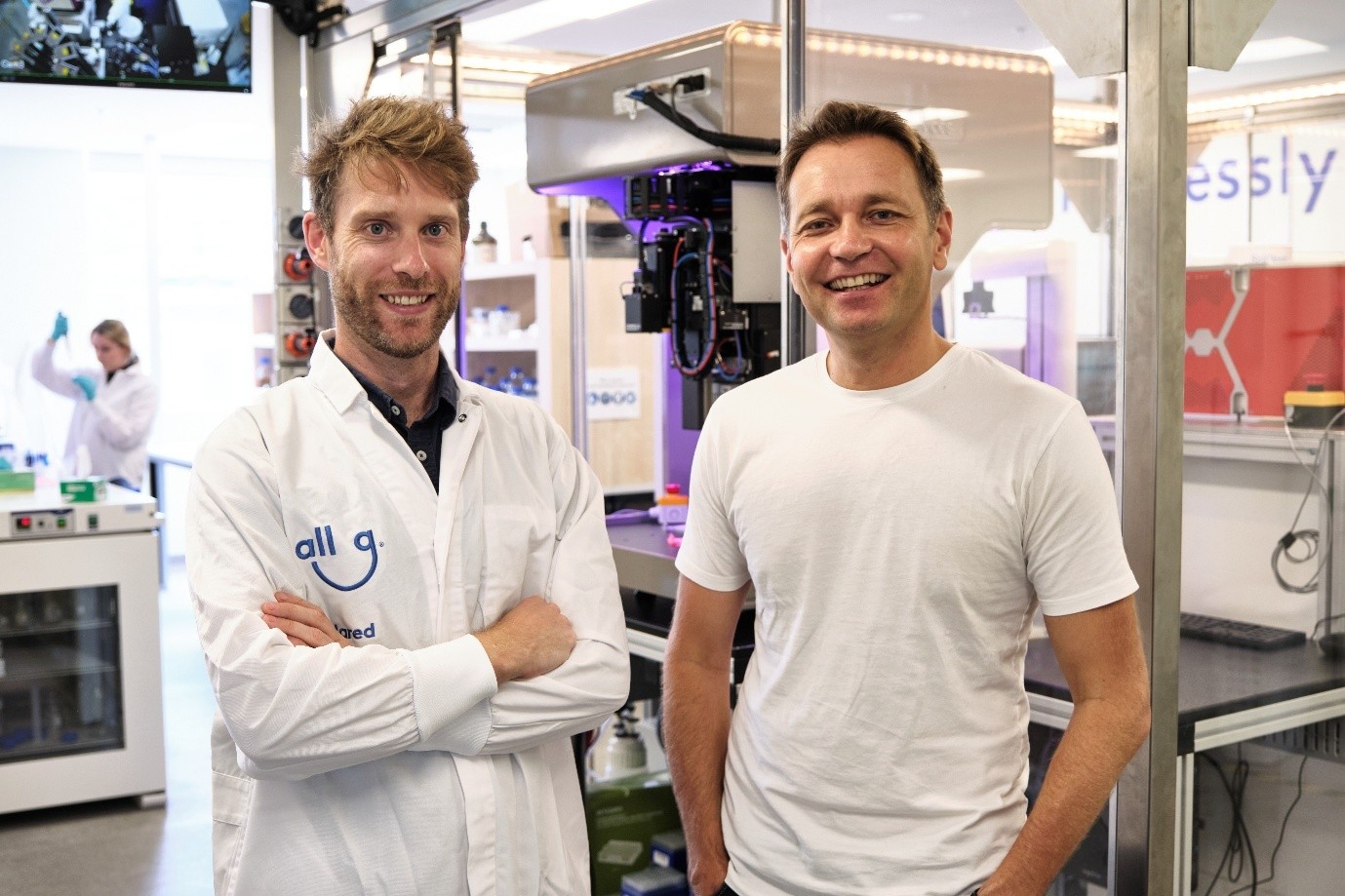
Australian startup All G has formed a joint venture with French dairy ingredients expert Armor Protéines to commercialize human and bovine lactoferrin made via precision fermentation.
The JV will combine All G’s expertise in recombinant proteins with Armor Protéines’ expertise in bioactive milk proteins including animal-sourced lactoferrin, said All G, which is gearing up to launch its first product—recombinant bovine lactoferrin—in Q1 2026. Human lactoferrin will follow later in the year.
All G, which has just raised A$10 million ($6.6 million) via a convertible note from new and existing investors including Agronomics and Döhler Ventures ahead of its Series B raise, aims to capitalize on Armor Protéines’ scientific expertise, distribution channels, and long-standing relationships with leading players in infant formula, adult nutrition, and supplements.
Why it matters
An iron-binding anti-microbial protein found in mammalian milk, lactoferrin has benefits across the lifespan in immune function, iron homeostasis, gastrointestinal, and dermatological health. However, it has historically only been available in small quantities owing to the costs and challenges of isolating it from milk (thousands of liters are required to make a single kilo).
By producing lactoferrin in fermentation tanks using genetically engineered microbes, several startups are seeking to unlock new markets in adult and infant nutrition, cosmetics and personal care.
However, progress has been constrained by technical barriers, “notably replicating native glycosylation patterns and achieving yields sufficient for commercial viability,” claims All G. “All G has overcome these hurdles, enabling the production of lactoferrin with high purity, consistent quality, scalable production, and ultimately greater global accessibility.”
Unlike some players in the alt protein space, meanwhile, All G is not trying to create entirely new markets from scratch, CEO Jan Pacas told AgFunderNews.
“Armor Protéines is owned by Savencia, which is one of the top three global producers of bovine lactoferrin. Demand exceeds supply so we can immediately help fill the pipeline. They already have an established market and customers who want to buy more of it in applications where we already have approval in China such as supplements, personal care and so on.”
He added: “Armor Protéines has a vast distribution network, a lot of credibility, and a lot of in house capability, so we see this as a means of getting to significant revenues very fast.”
Regulatory and scaleup plans
All G has secured self-GRAS (Generally Recognized as Safe) status in the US for adult nutrition sales and gained approval for sales in several categories in China, with further filings underway, said Pacas.
On the manufacturing front, All G has proven its tech at pilot scale with Döhler and now plans to scale up with a contract manufacturer in China and a second CMO in the US or Europe, he said. “We have already started the technology transfer for the CMO in China, which manufactures for some of the largest global pharmaceutical companies and has a lot of expertise in our organism.”
Next-gen infant formula
All G does not yet have approval to sell into the infant formula market but sees this as a significant opportunity for human lactoferrin, added Pacas, who noted that infant formula companies already incorporate human milk oligosaccharides (HMOS) made via precision fermentation into their products.
“I believe that in five to 10 years, human lactoferrin will become dominant in infant formula, which is a $35 billion market in China, where we’re working with one of the largest companies [in infant formula] to work through the regulatory process.”
All G has also developed expertise in recombinant casein production, but is currently prioritizing lactoferrin because it commands a higher price point, said Pacas.
“The market wants to see money and profits, positive unit economics. And the reality is, it is a lot easier to achieve with lactoferrin, although casein volumes are much much bigger. But when we do casein, we’ll prioritize human casein because we believe there’s going to be a big market for that in infant formula.
“For recombinant casein in other applications, there are significant sustainability benefits, but are there really clear consumer benefits like does it have a better nutritional profile or is it cheaper? To answer those questions is hard, right? However, if I give to you two options for infant formula: casein from cow’s milk or casein from human breast milk, it’s obvious that the human proteins are better for the baby.”
Further reading:
Alpine Bio debuts ‘insanely soluble’ soy protein isolate and iron-rich lactoferrin made in soybeans
10 million servings per run: Helaina scales human lactoferrin production
Vivici raises $34m to expand animal-free dairy operation, plans move into lactoferrin market
DeNovo Foodlabs and EFFV create JV to scale lactoferrin via precision fermentation