Neutralizing the “off switch” for starch production in plants could be the key to unlocking higher yields and boosting resilience across a vast swath of crops, says Israeli startup ClimateCrop.
Founded by Yehuda Borenstein, Erez Eliyahu and Vivekanand Tiwari in 2021, ClimateCrop builds on a discovery by researchers at Israel’s Weizmann Institute of a group of proteins that control the daily starch storage mechanism in plants.
During photosynthesis, plants use sunlight, water and carbon dioxide to make sugars. Some of the carbon fixed during this process is stored temporarily in leaves as starch, which can later be broken back down into sugars to fuel growth at night or during periods of stress such as drought.
One of the proteins involved in regulating this process helps apply the brakes to starch production as light declines, while also keeping starch synthesis partly in check during the day. By targeting this regulatory mechanism, ClimateCrop says it can increase daily starch accumulation by 10–15%.
This gives plants more stored energy to support growth and recovery from stress, potentially boosting yields and resilience.
And as its genetic target is found in all vascular plants, the approach could ultimately be applied across thousands of crops spanning food, animal feed, fiber and fuel, says cofounder and CEO Yehuda Borenstein.
AgFunderNews (AFN) caught up with Borenstein (YB) at the World Agri-Tech innovation summit in London to discuss the science behind the approach, progress so far, and the potential route to market.
AFN: What does ClimateCrop do?
YB: What we are doing is gene editing or other gene modification techniques that allow us to increase the amount of energy the plant is storing during the day and allowing the plant to handle stress situations in a better way than it does today.
AFN: Is this starch storage system in plants controlled by a single gene?
YB: It’s a complicated system, but we identified a very specific command that goes to one of the [signaling] proteins that tells the plant to stop producing starch. And once we neutralize that command, the plant made 10-15% more starch.
Now think about what 10-15% more starch will do to the plant every day because it’s a daily cycle. So every day I have more energy and I’m using it so I’m growing a little bit faster. So the roots [grow] a little bit faster; I get faster to the nutrients in the ground.
So you have an accelerated process that accumulates during the time and if there is stress, I can handle it a little bit better, and I can also recover a little bit better from the stress. So overall, you see a significant improvement in plant health, in the speed of growth, and potentially also in yield.
AFN: Is there an evolutionary reason why plants wouldn’t themselves perfect this process?
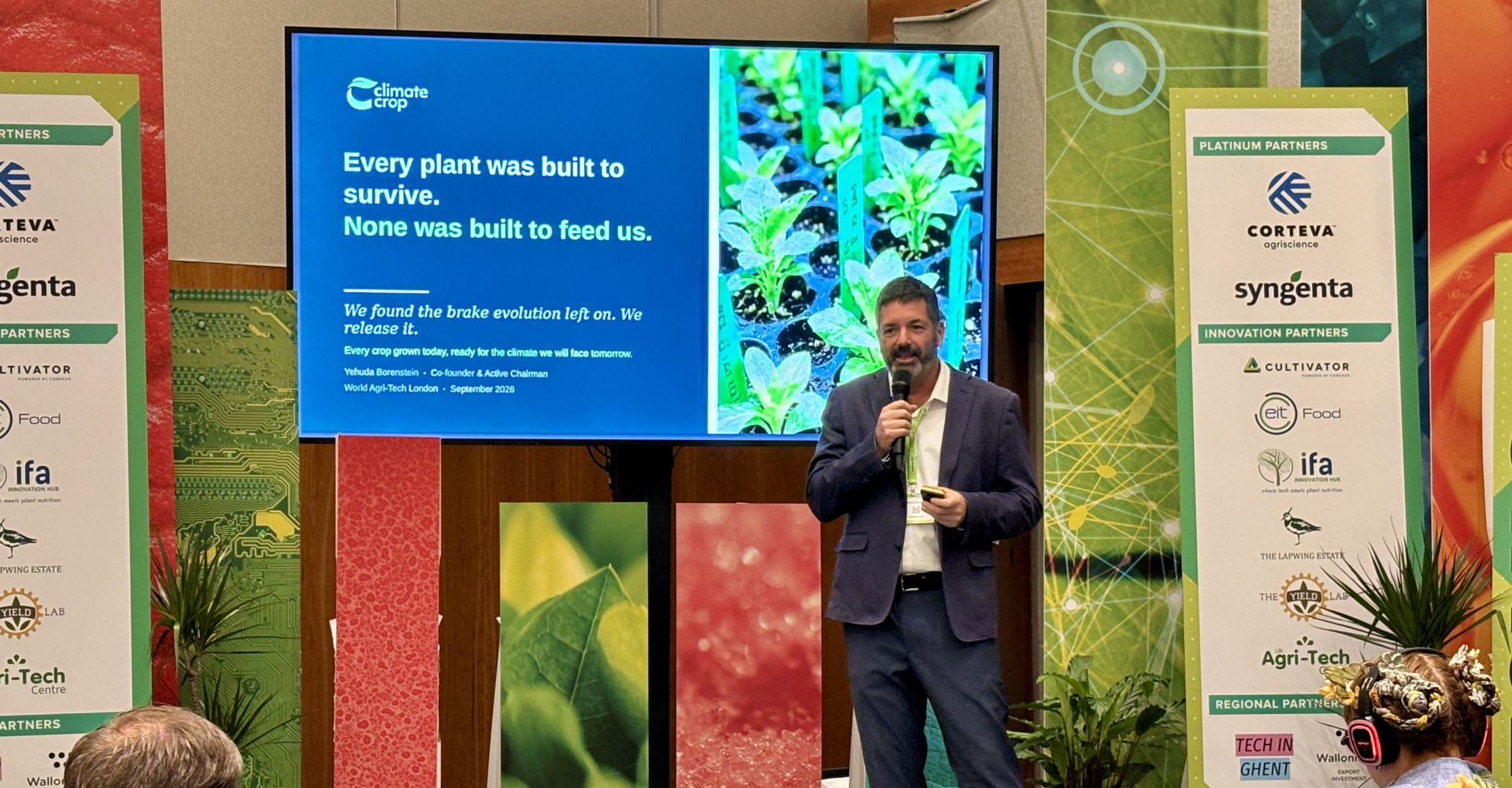
YB: One of the things we need to realize is that plants are not here for us. Their job is not to feed us. They just want to survive. And if you look 10,000 years back, before we started to improve plants using agricultural techniques, they were much smaller. The fruits were much smaller, and they looked completely different.
So plants are tuned to survive, not to give maximum yield. This mechanism is exactly what the plant needs because it’s for survival. The fact that we neutralized it is not something that nature should do.
AFN: In that case are there tradeoffs? If you start interfering with this mechanism, could there be unintended consequences?
YB: We didn’t see any, and also it makes sense there will not be any. If you look at the photosynthesis mechanism, it’s not working at its maximum capacity. That’s not the bottleneck in many cases.
AFN: Is this something that would work in all or most plants, or only certain crops?
YB: So we tested it on potato, tomato, canola, sorghum, and in all we saw a similar effect. Is it going to be different from plant to plant? Yes, definitely. And a few plants, probably the C4 plants [which use a more efficient carbon-concentrating form of photosynthesis] may have less effect than the C3 plants [which use the most common form of photosynthesis]. So we assume that there will be differences from plant to plant but there should be some effect.
AFN: Are other startups looking at this mechanism as a target in plant breeding?
YB: We know that few researchers are looking at this mechanism and things around it. We have a patent covering modifications to this specific gene.
AFN: This was tech developed at the Weizmann Institute of Science and licensed to your company?
YB: It’s been licensed to the company.
AFN: What’s the measure of success? As so many things can impact yield, is it hard to say it was this that did it?
YB: This is an important question. On yield you never win on the knockout. You win on points. It really depends on the territory, the land, the season, the conditions. So we expect that this is going to be different from season to season, from region to region, and it needs to be tested in a long period, not only over a short period.
AFN: Does that make the pitch more difficult because you can’t go in and say I can guarantee you 10% yield, for example?
YB: You’re right, it makes life a little bit more difficult but on the other hand there is something that really helps us called climate change… where things are getting worse and worse. People want to have some insurance and this is one of the ways to get some insurance.
AFN: What progress have you made so far?
YB: We have good results in bananas. We saw clear evidence that we have additional starch. We saw the same thing in potatoes and tomatoes and now we are teaming up with companies to license the technology, so they will take it to their varieties and to field trials.
AFN: What is your business model?
YB: It really depends on the type of customer, but we are teaming up with breeders that we can give them the variety, and they can backcross it into their varieties. We are teaming up with seed companies, and we are teaming up with growers of plants. So, with each one, we are trying to be flexible and to find the right path to a win-win situation.
AFN: So this would be an edit, or could you do this through conventional breeding?
YB: So, in many cases, it can be done by [an] edit [to a plant’s genome]. In some cases, if you have a library that is big enough, you may be able to find one mutation that happened in nature naturally. We did team up with a company that has access to big libraries, and in some of the crops, we found it naturally occurring.
AFN: Would you make the edits or would a partner do that?
YB: Usually, we prefer to find a partner because each crop has its own tricks on how you can do the gene edit. So we prefer to work with partners.
Further reading:
Exclusive: Plantik and Hudson River Biotechnology team up to de-risk heat-tolerant strawberries
‘Bring us your difficult trait problems’: Biographica, Hudson River partner on crop genome editing
Exclusive: Spearhead Bio lands oversubscribed seed round for faster, more precise gene editing tech