Stephen Wood is a senior scientist for agriculture & food systems at The Nature Conservancy, where he carries out science to help achieve TNC’s 2030 goals through the organization’s work on agriculture and food systems. His scientific work spans agroecology, climate change, land use change, biodiversity, and freshwater science.
Steve Rosenzweig is a principal scientist at General Mills, where he leads regenerative agriculture research and outreach programs. He works to accelerate farmer adoption of regenerative agriculture and measure the impacts on soil, water, biodiversity, climate, and farm economics in key ingredient sourcing regions.
The views expressed in this article are the author’s own and do not necessarily represent those of AgFunderNews.
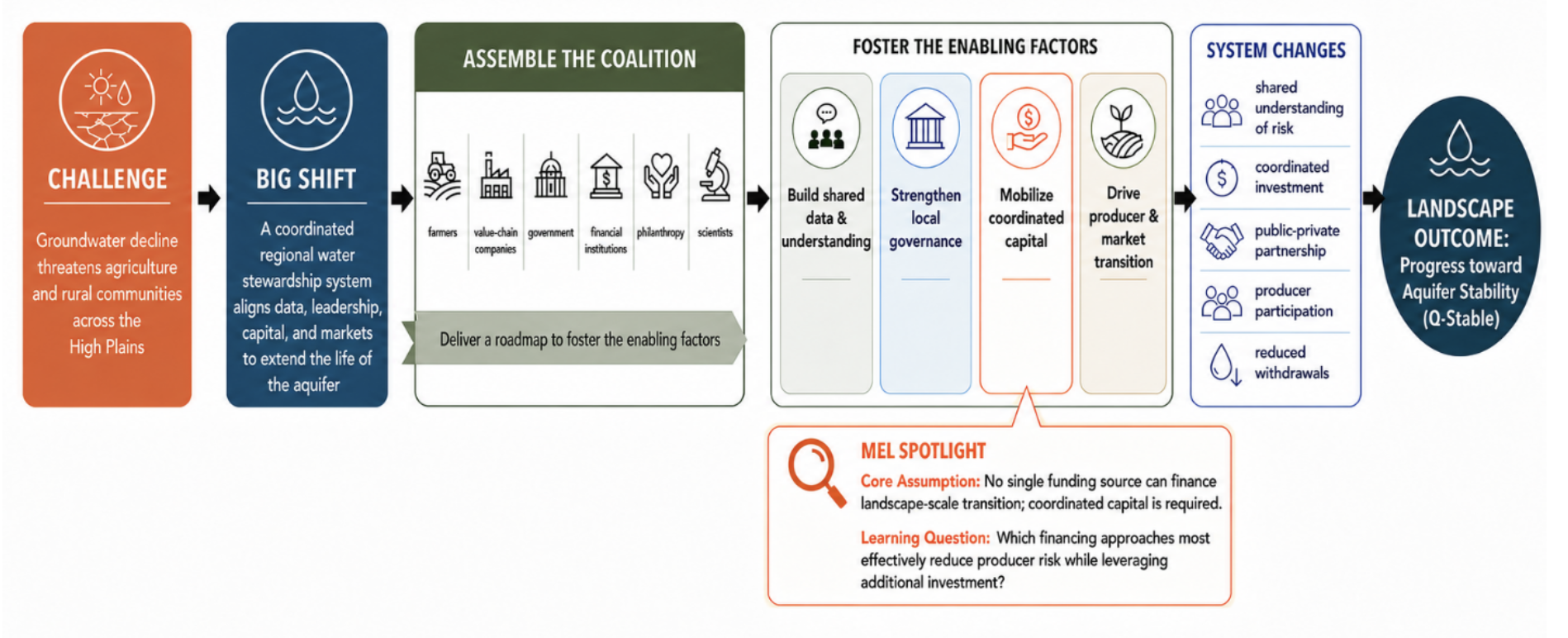
In western Kansas, the decline of groundwater within the Ogallala Aquifer threatens the long-term resilience of agriculture and rural communities. For companies working in that landscape, including General Mills, which sources wheat from the region, the challenge is not simply how to advance regenerative agriculture within one slice of the system, but what it will take to return the aquifer to a more stable state.
That example points to a broader challenge across regenerative agriculture. More than 100 major companies have committed to advancing regenerative agriculture across millions of acres by 2030, providing a north star for action. But acreage alone does not tell us what it will take to create durable environmental gains.
The most pressing environmental challenges in agriculture, from groundwater depletion to land-use change to soil degradation, are context-specific and driven by many forces. Addressing them requires looking beyond adoption of farm-level practices alone and asking what scale of regenerative agriculture, together with what other shifts, is needed to create lasting change in a given landscape.
Through years of collaboration, The Nature Conservancy (TNC) and General Mills have worked to adapt TNC’s approach to monitoring, evaluation, and learning (MEL) to General Mills’ regenerative agriculture strategy.
In practice, this landscape-scale, learning-centered approach starts by identifying the defining challenge in a place, then uses real-world evidence to strengthen and adapt strategy over time. This work has shown that deeper impact comes not only from expanding acreage but from understanding place-based needs and continuously learning which strategies are effective, where, and why.
Why landscapes matter
The defining challenges for agricultural landscapes vary widely. While groundwater decline is the defining challenge in western Kansas, nutrient runoff degrades water quality across the Upper Midwest. Different combinations of ecological, market, and institutional forces drive these challenges, so effective strategies must be tailored to each place.
That variation matters in part because regenerative agriculture can deliver many different benefits, from soil health, water outcomes, and biodiversity to economic resilience. But that breadth also creates a strategic problem. When strategies treat every possible outcome as equally central, it becomes unclear what to measure, what success looks like, and what the work is actually trying to achieve. Conversely, too often funders organize programs around a single universal benefit or prescribed set of practices, even when that outcome does not reflect the priorities of all the stakeholders needed to drive change.
A landscape-scale strategy solves that problem by bringing the defining challenge into focus. Framed well, a defining challenge creates a shared basis for action, helping stakeholders align around the outcome that integrates their most pressing needs and mobilizes both the farm-level changes and broader system shifts needed to achieve it.
In western Kansas, for example, the defining challenge is not simply how to expand regenerative agriculture but how to reduce pressure on the Ogallala Aquifer over time. That shift helps clarify what the strategy is trying to achieve and why it requires coordination beyond any one actor or value chain.
A learning-centered approach
Once the defining challenge is clear, the next step is to articulate the strategy. A learning-centered approach works by making a strategy’s core assumptions explicit and testable. Rather than starting with only a goal, there is a clear “theory of change”—a hypothesis for how change is expected to happen in a specific landscape. A learning-focused evaluation then tests those assumptions in practice, helping teams adapt strategy based on real-world evidence rather than relying on uniform approaches or trial and error.
In western Kansas, learning extends well beyond tracking acres enrolled or groundwater conserved. It asks whether the assumptions underlying the strategy are proving true. Is trusted groundwater information available and changing decision-making? Are financing mechanisms reducing producer risk? Are market signals sufficient to support lower-water production systems? Which combinations of governance, capital, and technical support lead to durable adoption?
A useful theory of change identifies not only the activities an organization will undertake, but also the enabling conditions that must exist for those activities to produce landscape-scale outcomes. These enabling conditions will determine whether conservation practices remain isolated demonstrations or become durable landscape transitions.
These are questions about how a system changes, not simply whether activities occurred. By testing these assumptions over time, organizations can refine their strategies, strengthen partnerships, and increase the likelihood of achieving lasting landscape outcomes.
Learning is not the same as measuring outcomes
A learning-centered approach complements outcome-tracking by helping teams test assumptions, interpret results, and adapt strategy in ways that increase the likelihood of achieving durable outcomes. Tracking outcomes, whether through internal company metrics or public initiatives like the Science Based Targets Initiative (SBTi), supports accountability and transparency. But outcome tracking alone cannot tell organizations whether their strategies are effectively addressing the landscape-level challenges they aim to solve.
In part, that is because many corporate reporting frameworks are set at the level of an individual company, while the most important environmental challenges in agriculture are defined at the level of the landscape. When reporting frameworks are designed to track high-level outcomes on a company-by-company basis, they reveal little about whether anyone is effectively addressing the critical, shared challenges of a place.
Additionally, in agriculture, outcomes are shaped by natural variability, market conditions, and other forces beyond the reach of any single intervention. As a result, high-level outcome metrics may show what changed without revealing why it changed or what adjustments are needed to improve results over time.
The path forward
As regenerative agriculture moves from early commitments to broader adoption, the next phase will depend less on scaling a single model and more on understanding how change unfolds in different places. For companies, this means complementing sustainability targets with stronger investment in learning infrastructure—the systems, partnerships, and evaluation capacity to understand what is working, where, and why.
The collaboration between The Nature Conservancy and General Mills demonstrates that this kind of learning-centered approach is not only possible but practical. It also points to an important next step for companies: building the capacity to learn, adapt, and coordinate around the defining challenges of the landscapes where they work. The most ambitious, impactful, and effective regenerative agriculture targets are not simply the ones that cover the most acres, but the ones best able to respond to the defining challenges and place-based needs of the landscapes where they are pursued.
Treating learning as a core strategic function offers a path to greater impact and more lasting outcomes for people and the landscapes they depend on.