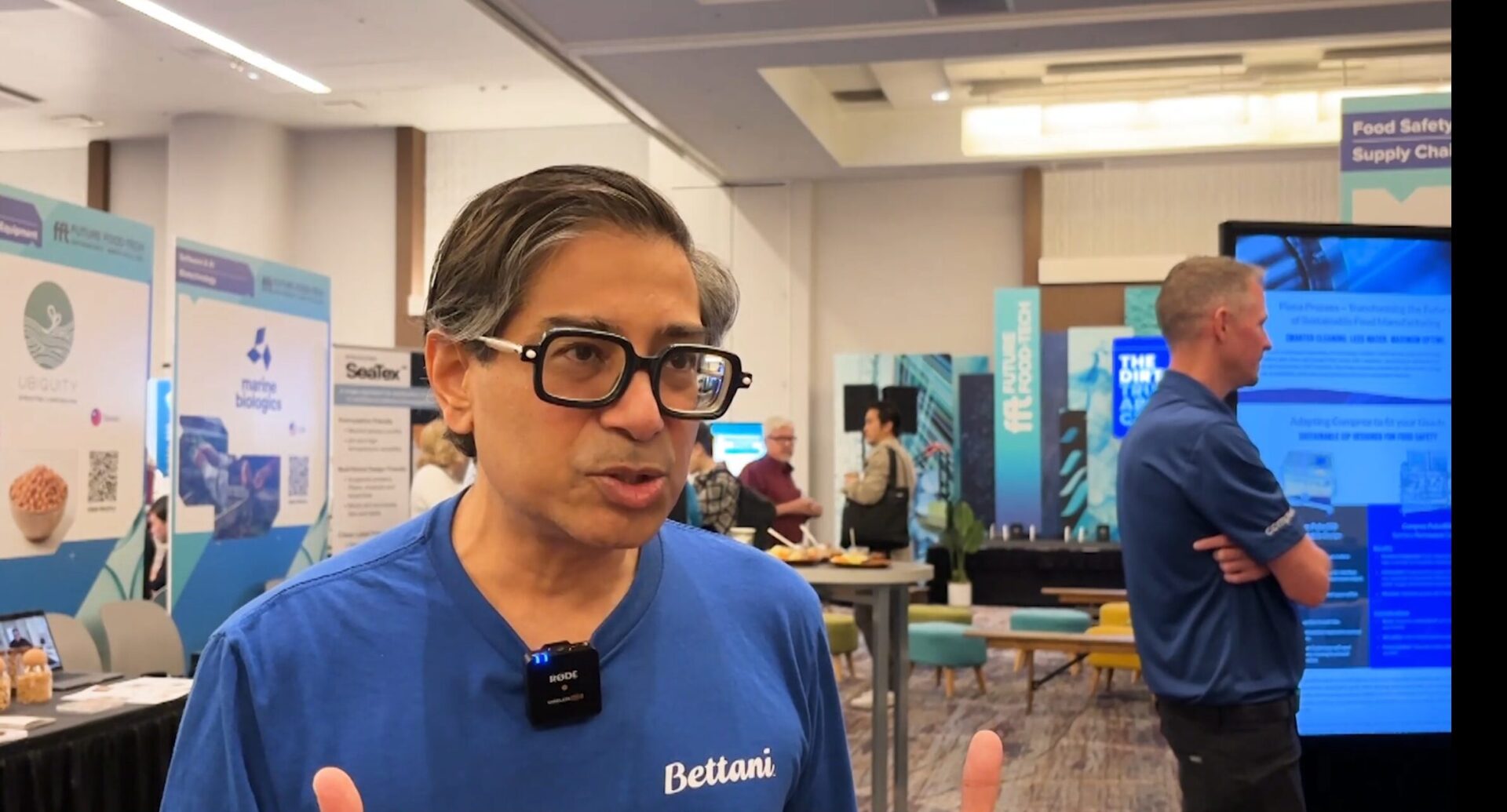
Like a lot of high-profile alt protein players, Climax Foods went through some challenging years, but regrouped in October 2025 with fresh funding, new leadership, and a new name: Bettani Farms.
AgFunderNews (AFN) caught up with CEO Sandeep Patel (SP) at Future Food-Tech in San Francisco to discuss the firm’s strategic pivot toward larger, more scalable cheese categories, the commercialization timeline for its casein-mimicking “Caseed” protein, and why it believes foodservice will be the key to unlocking the next wave of growth in plant-based dairy.
AFN: What key strategic decisions were made last year?
SP: One of the big things we did is take a step back and look at what are the biggest areas of the market that makes sense for us to focus on.
Our blue cheese was a phenomenal product our team developed, but there’s a fairly small market and it’s very difficult to make. So we decided let’s just go after the biggest prize, which is mozzarella. It’s 40% of the US cheese market, which is about 15 billion pounds, and that’s really where our proprietary protein, which we call Caseed, which mimics a lot of the functionality of [the dairy protein] casein, really shines.
We’ve also focused on other cheeses like cream cheese and feta that are big markets, more scalable, and also feature our proprietary protein.
We have three main approaches to go to market and two channels.
The first approach is go to foodservice directly, whether that’s pizzerias, salad chains, or bagel shops. So through some recent acquisitions, we’re already in the market with important customers such as Whole Foods and Apollo Bagels in New York City and pizza chains like &Pizza with a great set of products, and we’re well poised then to launch our next generation products into the away from home channel.
Channel number two is b2b for the CPG market. So essentially, any company that’s using cheese in a frozen pizza, frozen appetizer, any other food product, is our target customer, either for our proprietary protein, where they would use the protein and formulate products themselves, or for a cheese based on our proprietary protein that they would use as an ingredient.
AFN: What is the status of [your flagship ingredient] Caseed
SP: One, our US patent on the proprietary process to produce the ingredient was issued in March 2025 and is pending in many countries. Number two, we are nearly complete with our self-affirmed GRAS. And three, we are nearly there on scale up. So we’ve been working with high quality co-manufacturers on scaling up the protein. We’ve had successful commercial trials at scale, and our hope is to launch products using the ingredient within the next few months.
AFN: Caseed has been described as a storage protein. Is it in many different plants, and does it take expensive or bespoke equipment to functionalize it so that it will behave like casein?
SP: It is found in multiple different crops. We’ve narrowed our focus to a few very specifically that achieve optimal performance, but we think we’ll be able to expand that over time. The equipment we need is nothing very bespoke. There are a lot of facilities with this equipment.
One of the challenges, however, is that most facilities doing protein extraction and refinement are designed… or at least, the owners like to run one protein at very large scale, and not bring in other things. So that does narrow down the field of potential partners we can work with.
Having said that, we do have high quality partners that we’re working with, with a focus on the US in the first instance.
But importantly, the commodities we are using are grown all around the world. They are highly regenerative crops with very low water use. So we do think this is very much a global play from an agricultural standpoint, a manufacturing standpoint, and a demand standpoint.
AFN: Even if you can replicate the melt and stretch of dairy proteins, is the market for dairy free cheese actually that big of an opportunity?
SP: What if you told the companies that launched oat milk in 2018, Oh, the market for plant milk and coffee is only 10% penetration, so why are you bothering? Square recently released some data on the coffee transactions in its North American business and 50% of the coffee transactions in restaurants and cafes had plant milk associated with them, and the vast majority of that was oat milk. And this happened only in six years.
Our goal is to do for pizza, for bagels, for salad, anything that uses cheese, what oat milk has done for coffee. Our strategy is to go application by application, and say not just how can we create a great cheese, but how can we create a great product that performs really well in that application, so that it’s not about “I want the plant based version,” it’s just this is a great tasting product.
That’s exactly what’s happened with coffee, with oat milk. We believe Caseed is a total gamechanger and we think we can expand the market significantly.
AFN: Is it reasonable to compare oat milk with plant-based cheese?
SP: Comparing plant milk with cheese is very different than comparing plant milk with meat. First, they are both in the dairy category. Second, you have a lot of adjacent use cases. You go into a bagel shop, you ask for an oat latte and then you get dairy cream cheese on your bagel. But it would otherwise be a completely animal-free transaction.
The problem right now is that we don’t have very many great tasting dairy free cheese options. We did acquire a brand, Stockeld Dreamery, which has an amazing dairy free cheese as is, but we’re working on something that’s even better.
We’re also not just solving for taste. We’re solving for texture and nutrition.
AFN: US retail sales of plant-based cheese are declining. Is it your view that if the products are simply better, that the market opportunity is there?
SP: It’s not as simple as just having a better product, because then you have to convince people you should try this when there’s a lot of baggage people have. So you hear, “Oh, dairy-free cheese. I tried it once. It can’t be good, right?” That’s one of the reasons we’re focusing on foodservice and not retail in the first instance.
For retail, we want to partner with existing CPG brands that have marketing muscle and brand trust.
AFN: If the best you can say is we can match a [dairy] product that you’re already happy with, you might say, why wouldn’t you switch [to plant-based]? But you could also say why would you switch?
SP: Let’s go back to the oat milk and coffee example. So plant penetration in coffee was maybe 10-15% before oat milk came along, right? Why did another 35% of transactions go to oat milk? Was it because all those people are vegan? No. It’s because it tastes great.
People have different reasons for trying things, but lactose intolerance is a trend that’s only growing. Allergen-free is a trend that’s also growing. In fact, there was a study that Acosta presented at a conference in Minnesota last year showing that the second most searched for term for allergen sensitive consumers after gluten free was dairy free.
So it’s totally different than [alt] meat. I think lactose intolerance [is a big issue], particularly with Gen Z, and for consumers outside of the United States, particularly in Asia and Latin America, there are massive rates of lactose intolerance. So [if they can have lactose-free options] they will feel better, they’ll feel lighter, with fewer digestive issues.
AFN: You recently acquired three brands: Hungry Planet [plant based meat, foodservice], Numu [plant-based mozzarella, foodservice] and Stockeld Dreamery [plant-based cheese, mostly foodservice]. What value can you add to them or vice versa?
SP: The strategy was these are companies with great products using existing technology. Again, our technology, we think [enables] a whole new level of products. Second, they have a great set of customers. Third, they have distribution.
And when we put all three companies together, it was very synergistic, both from a distribution standpoint to unlock growth as well as from a cost and infrastructure standpoint.
And that gives us a foundation. In foodservice, it’s very difficult to start from zero, because I can go to the pizzeria down in the street, or the bagel shop, and they might say your cream cheese is great, your pizza cheese is great. But I can only order a case a week, and then their distributor needs to bring a whole pallet in, so you have a massive cold start issue.
[Through these acquisitions, Bettani Farms now has] foodservice distribution with an existing base of sales and great partners like Dot Foods. So that’s a huge unlock, and it gives us a huge head start to launch our next generation of products.
Further reading:
Standing Ovation nets $34m, gears up for US launch of casein via precision fermentation

Sign up for our weekly newsletter.