Bruce Friedrich’s core thesis—laid out in his new book MEAT—will be familiar to anyone who has followed the Good Food Institute over the years: using vast quantities of crops to feed animals, rather than people directly, is an inefficient and environmentally damaging way to produce food.
But he’s also pretty clear-eyed about the challenge facing meat alternatives: right now they are more expensive and not as appealing as meat. This makes for a less than compelling value proposition to most consumers, who are pretty hooked on meat even if they’re not in love with industrialized animal slaughter.
Consumers will only change their behavior en masse, says Friedrich, if and when alt meat products achieve taste and price parity with their animal-based counterpart, at which point market forces will kick in.
But what’s the roadmap for getting there? And at a time when sales in many markets are going backwards and funding is drying up, what gives him the confidence that we’ll hit such a tipping point any time soon?
In our conversation (transcribed below), AgFunderNews also quizzed Friedrich on the new US dietary guidelines, whether alt meat is losing the war of perception around what counts as “real food,” and whether Beyond Meat’s move into the beverage aisle is a smart strategic move or an admission of defeat.
The transcript below has been lightly edited for clarity:
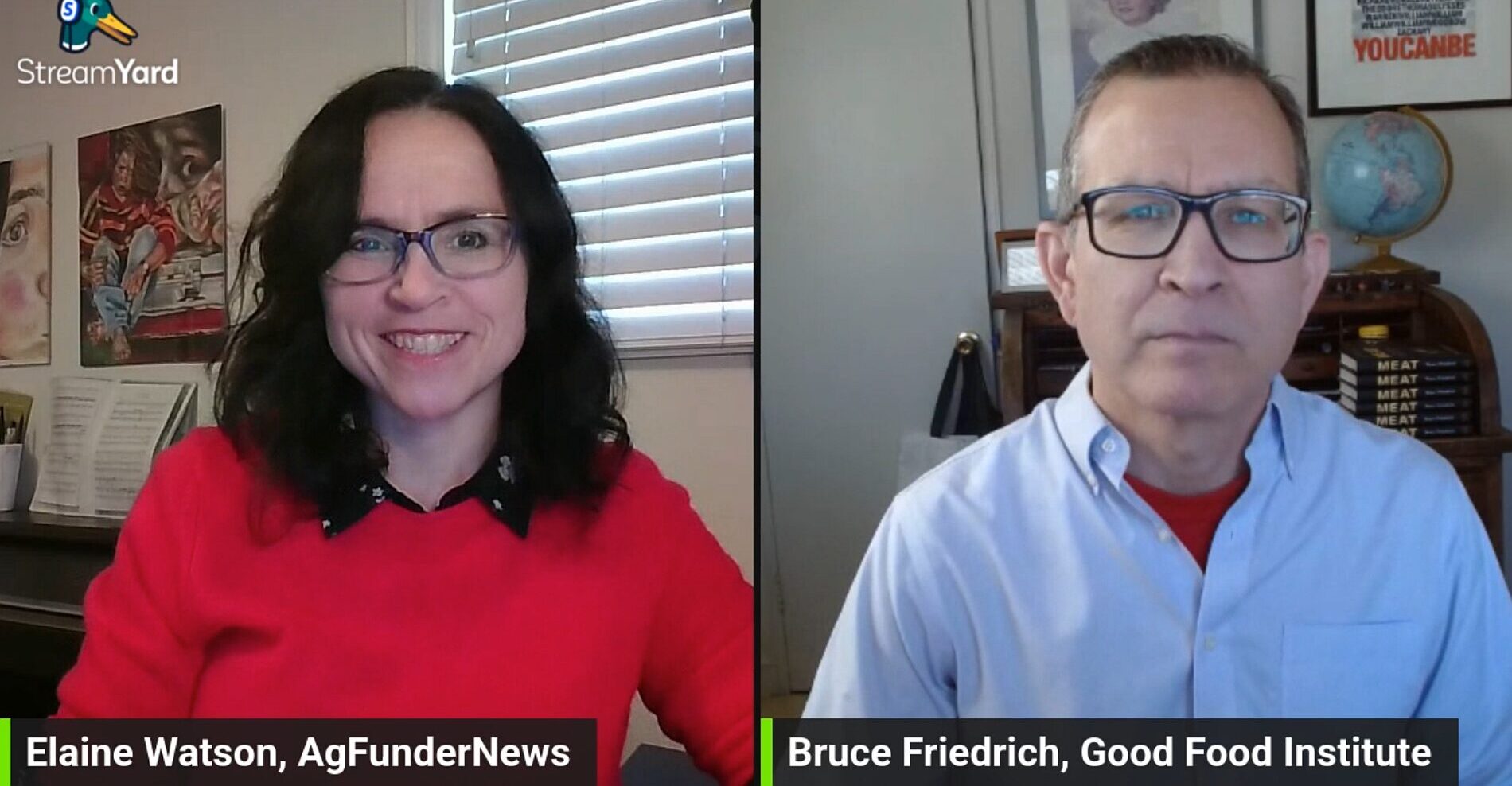
Elaine Watson: Hello and welcome, I’m Elaine Watson with AgFunderNews and I’m delighted to be joined by Bruce Friedrich, founder and president of the Good Food Institute.
We’re here to talk about your new book: MEAT, which is now available on Amazon, Barnes & Noble, or wherever you buy books. You can also find out more at MeatBook.org.
Now your book makes a compelling case that animal agriculture is inefficient [at converting feed calories to human food], and bad for the environment.
But you’re also clear-eyed about the fact that simply trying to persuade consumers to eat less meat or switch to alternatives hasn’t proved a very effective strategy.
Your argument has always been that people might love meat, but they don’t necessarily love industrialized animal slaughter, and that a tipping point will inevitably come for meat alternatives if and when they can reach taste and price parity.
But my question is, what’s the roadmap for getting there? Before any challenger brands have the scale to compete with a mature industry on price, don’t they have to offer something better in the short term such that they can charge a premium until they build economies of scale?
What’s the compelling case that these brands can make to consumers in the near term?
Bruce Friedrich: I think we’re on the path to that tipping point now, and it’s been interesting to see some very creative solutions recently, but it is still the case that globally, sales of plant-based meat, they’re not rising as much as they were, but they’re rising as the products get better.
And I think we will continue to see that happen as the products get better and better. It’s also the case that Impossible Foods is continuing to introduce new products. So it’s interesting to me to think about the fact that just three or four years ago, when Food System Innovations, which rolled out its Nectar project, when they did analysis of all of the top plant based meats, the only one that satisfied meat eaters was the Impossible Burger. Then second place was the Beyond Burger. And on a scale of zero to 1 which is to say 1 means the meat eater liked it as much as conventional meat, the best chicken could do was about 0.6. The best that a hot dog could do was about 0.4.
We now have… more [plant-based] products that people who enjoy meat really like, and about 14, I think, that most people who like meat, like as much, or almost as much, as their [animal-based] counterparts. So I think the strategy is continue to lean in on the health benefits of the products, continue to lean in on the other the secondary drivers, and continue to make more delicious products.
When people are asked, ‘Why have you not tried plant-based meat yet?’ the two reasons are, ‘I don’t think they’re going to taste good’ and ‘They’re too expensive.’ And when the people who have tried them and stopped eating them are asked why did you stop, the top two reasons are, ‘They don’t taste good enough’ and ‘They’re too expensive.’
Well on cost, Mosa Meat just announced that the cost of their burger is down 99.999% in cost [vs the cost of a prototype unveiled by founder Dr. Mark Post in 2013]. So I think things are moving in the right direction.
Elaine: You talked about how Impossible and Beyond scored pretty well in those consumer surveys. But isn’t the fact that Impossible is now partnering with Equii on high protein pastas and breads and Beyond Meat is now launching into the beverage aisle a sign that maybe they don’t see displacing animal meat as the path to commercial success?
In the current climate, doesn’t it seem more like an acknowledgement that Americans might want more protein, but not necessarily in the form of plant-based meat?
Bruce: I see Impossible going into other high protein foods, and Beyond going into beverages and UPSIDE Foods spinning out a b2b cell culture media company [Lucius Labs] and [Australian cultivated meat startup] Vow marketing pharmaceuticals, I see all that as a really good sign.
The goal is to bring down prices, and you bring down prices by ramping up volume. So if Impossible, and Beyond and UPSIDE and Vow can market other things that are higher value in order to ramp up volume and bring down prices for their core product, for plant based meats and the cultivated meats, I see that as a fantastic sign.
Elaine: Going back to where how we’re going to get to this tipping point. You talked about building volumes, economies of scale and you’ve also talked advances in the cultivated meat space that are going to bring costs down. But could a tipping point ultimately come from higher meat prices driven by, who knows, a new pandemic, zoonotic diseases or other factors that might push up prices?
Or is it unhelpful to sort of hope that something external like that is going to happen to change the equation?
Bruce: Well, I definitely would not hope for higher [meat] prices [for] consumers. I’m also not a big fan of hope [as a strategy], as I will say that for 30 years, people in meat reduction advocacy have been claiming that the world cannot produce more meat… I remember in 2006 the FAO report ‘Livestock’s Long Shadow’ came out, and said that animal agriculture is one of the top three causes of all of the worst environmental harms… Well we’re now producing 40% more meat than we were 20 years ago.
So you look at something like the World Resources Institute report [from late 2018], what they say is that in 2050 on our current trajectory, unless we have significant crop productivity gains, there will be no forests or savannas left. That is what meat demand and markets lead to.
Sure, the food supply is incredibly fragile, but my goodness, we made it through COVID. We made it through the shock, the initial shock of grain production in Ukraine suddenly being off of global markets. So global agriculture continues to make it through.
But you know, maybe not….my entire chapter four [of the new book, MEAT] is about the possibility of a significantly more impactful pandemic that could happen. Chapters nine and 10 talk about the fragility of the current supply chain, all of the extra stages of production, all of the other dependencies. So sure those things could create shocks that make alternative proteins more competitive as conventional proteins go up in price. But I don’t think we can count on that.
Elaine: You talk in the book about how government funding has helped lots of industries, whether it’s space exploration, renewable energy, EVs and so on. But what evidence do you have that the Trump administration has any interest in funding an alt meat moonshot?
Bruce: In 2019 it had been about 15 years since there had been a significant government investment in cultivated meat. The last one was, I think, 2005 or 2007, when the Dutch government [helped fund the cultivated meat research that led to] that burger that Mark Post made [in 2013], paid for by [Google cofounder] Sergey Brin [who personally invested in the innovation]. And that then became the company Mosa Meat.
The National Science Foundation under Donald Trump put more than $3 million into a cultivated meat project at UC Davis. Also at about the same time, it was Donald Trump’s Secretary of Agriculture, Sonny Perdue, and Donald Trump’s FDA commissioner Dr. Scott Gottlieb, that created the regulatory path that allowed the United States to be the second country in the history of the world to approve cultivated meat for sale.
Interestingly, during the Biden administration, there were two companies that had new products approved over the course of four years whereas in about 90 days, the second Trump administration had already crashed through that in terms of approvals.
Similarly, if you look at something like the bipartisan biotechnology commission, which involves Senator Todd Young from Indiana on the Republican side, Representative Stephanie Bice from Oklahoma on the Republican side, and then Ro Khanna and Alex Padilla on The Democratic side, and it includes alternative proteins explicitly. So I’m not sure it’s a top priority for the Trump administration but…
Elaine: But some regulatory approvals and a small bit of money here and there, that doesn’t really amount to pumping tens of millions or billions of dollars into a moonshot, does it?
Bruce: It doesn’t, which is one of the reasons that it’s very exciting to see Korea, Japan, Israel, Singapore, the UK, Germany, Brazil, India, lots of other countries around the world taking the opportunity of alternative protein super seriously, and organizations like the Center for Strategic and International Studies (CSIS), they released a 4,500 word report on the opportunity of alternative proteins and framed it in terms of economic competitiveness and national security.
They say the US government should prioritize alternative proteins alongside things like advanced chips for AI and biopharma. And of course, CSIS is one of the most renowned think tanks in the world for national security and is extraordinarily bipartisan. My first choice for the person to write the foreword for my book was Caitlin Welsh, who is the director of global food and water security over there at CSIS. She was about five years, I think, in the Obama administration, and then for all of the first Trump administration she was at the National Security Council, and I’m incredibly gratified that she did rate the book.
So, you know, we’ll see, but we continue to be optimistic about working with the Trump administration on alternative proteins, and we have a lot of Republican as well as Democratic supporters for what it is that we’re trying to do, including the conventional meat industry.
Elaine: Can I ask you about that, because a few years ago, all of the big meat companies were investing heavily in alternative proteins, whether it was pumping money into some of the cultivated meat companies, setting up creating their own ranges of plant based meat products.
And they were positioning themselves as protein companies or protein agnostic. They just want to make money, right; they’re not necessarily concerned about what the protein source is. The same thing with big oil companies a few years ago, investing in algae, biofuels and so on. But many of these companies have now pulled back because it isn’t paying off. What is going to change their minds?
Bruce: I mean, all of the companies have protected their equity in the cultivated meat companies that they’ve invested in and I’m not aware of any company that has actually pulled back.
Elaine: JBS set up a separate plant-based meats division [called Planterra Foods], and then pulled [the plug on] that pretty abruptly because it wasn’t making any money…
Bruce: And then they bought Vegetarian Butcher [via JBS’ Vivera subsidiary], which I think is the most widely distributed plant-based meat company in Europe and performs the best in taste tests. And they have ramped up production of their plant-based meat product in Brazil, supplying all of the grocery stores in Brazil, supplying Burger King in Brazil.
You can’t expect companies to make decisions that are bad business decisions, obviously. But, I mean, it was 2024 so not that long ago, that Tyson board member John Randall Tyson spoke at the Concordia Summit and said we see alternative proteins as the next frontier.
I don’t expect them to do things that are bad decisions for their bottom line. But at the end of the day, the inefficiencies of cycling crops through animals that make them so environmentally problematic, that drive hunger and malnutrition, are also a massive business opportunity.
You know, we’ve been doing [animal ag] for 12,000 years. It makes no sense. It’s inefficient. If we can update it, it’s going to be a more profitable way to make meat.
Companies are not going out of their way to make something happen that is difficult, but they are certainly continuing to be supportive, to invest and to see [alt meat] as a real opportunity, because it is one.
Elaine: At the GFI, you place a lot of faith in science for solving the alt meat taste and texture problem. So looking at the plant based space, we can now genetically engineer microbes to produce animal proteins, things like [meat protein] myoglobin, animal fats, or animal-like fats that you can then add to extruded plant proteins to create a more “meaty” product and so on.
But the closer you get to animal meat, the more processed some of these products might appear. And isn’t that a kind of challenge in the current environment when we’ve got new dietary guidelines that explicitly talk about highly processed foods?
We’ve also got a federal definition of ultra processed foods coming, which may result in, who knows, warning labels or rankings, or some kind of front of pack labeling.
Bruce: Yes, in the United States and to some degree in Europe, not really anywhere else in the rest of the world, there’s the ultra-processed…. grouping of all of the [alt meat] products together. I guess the first thing to say about that is that all of the science indicates that plant-based meats are healthier than the products they’re replacing.
They have less fat, they have less saturated fat, they have no cholesterol. They have more fiber. They have more protein across all of the plant-based products in that Nectar study that I was mentioning. The Impossible hot dog has three times as much protein as a beef hot dog, and all of the products have more of those essential nutrients.
When you look at what the things are about ultra processing that make them problematic, it tends to be sugar and fat and caloric density. That’s what Dr. Kevin Hall, formerly from NIH, said in his formative study. It’s caloric density, and plant-based meats are less calorically dense. There was also a peer reviewed study from Stanford Medical School by a guy named Dr. Christopher Gardner, and he fed people Beyond Meat’s pork, beef and chicken and organic [regular] pork, beef and chicken, and found that predictably… if you feed somebody something that’s lower in saturated fat and cholesterol and higher in fiber and protein, you’re going to have better outcomes.
Elaine: I’m not making the argument there’s anything wrong with these [processed alt meat] products, but this is the war of perception, isn’t it? And at the moment, I think the industry is probably losing it?
But let’s go to the new guidelines, which recommend a near doubling of protein intakes. Is that good news for the alt meat industry, or potentially bad news, because at least in terms of the [new inverted pyramid] graphics, where you’ve got a big slab of meat at the top, meat and dairy proteins are at the fore.
Bruce: Well, I do want to just take a step back and say it is still true that all of the polls that have been done ever of why people are not eating plant based meat, or why they stopped eating plant based meat, the top two causes are still taste and price. They didn’t like them and they’re too expensive. Processing has inched up [as a concern], but it’s still a big gap between those two things [taste and price] and processing.
Elaine: I agree with you. And obviously there are many products that we eat every single day that are ultra processed, but if people like them, they taste good and they’re delivering a benefit that people perceive, then absolutely they’ll buy them. I’m just thinking more about if we get for example, front of pack labeling around processed foods. How are meat alternative products going to be positioned?
Anyway, let’s talk about money. So since you wrote your book, Believer Meats has become insolvent, Meatable has called it quits, GOOD Meat seems to have hit pause as [parent company Eat Just] is focusing more on its Just Egg business. And UPSIDE Foods has kind of retrenched a little bit.
Many of the companies I cover are I would say, effectively in hibernation mode, if they haven’t gone bust already. I agree, media costs are coming down and we’ve got some interesting technologies around new bioreactors and sterilization techniques. But private sector funding has almost dried up.
You say that in some markets, people are recognizing that this technology could be important for food security and so on, but, but right now, the money has almost dried up. What’s going to bring it back?
Bruce: I think we are seeing it start to come back. So Better Meat Company [mycoprotein] just raised, I think, $30 million, BlueNalu (cultivated tuna] raised over $11 million Mosa Meat more than $17 million.
We have seen government support go up literally every single year since governments started funding in this space. And I think it’s worth thinking about… that this is what an innovation ecosystem looks like. Flashback to the early dates of the automobile, and you had in the first 10 years, 500 car companies go out of business. It wasn’t an indictment of automobiles. It was the fact that running a business is hard, or you look at something like the dotcom bubble when it burst, NASDAQ lost 80% of its value and went from $113 a share to less than $6.
But companies that came out on the other side, they grew in size and penetration and success. So it’s certainly true that it’s a tough time at the moment, but companies are incredibly undervalued, like these companies that are worth investing in, investments in The Better Meat Company, and those in BlueNalu, those are really good investments for the investors, and there are a lot of other bargain basement prices for these companies. You know, Impossible is privately held, but it seems to be thriving. Vegetarian Butcher is owned by JBS and they seem to be thriving. And I’m really excited to see Impossible and Beyond and UPSIDE and Vow looking at other ways to get add money to the revenue line.
Elaine: Some people would argue that the GFI has underestimated the role of food culture around animal meat… that it’s not just a case of once we get to taste and price parity, there’ll be this inevitable tipping point, but that it’s more complicated than that, that animal meat is a key part of food culture and it’s really hard to shift entrenched consumer habits.
I mean, I kind of agree with that, but I’m also seeing evidence every day that eating habits can shift quite fundamentally. I mean, we’re all eating, hummus and sushi now in the US when maybe we weren’t 20 years ago. So where do you see that argument around culture, because we’re also seeing alt meat has gotten embroiled in the culture wars.
Bruce: I think the concept of alt meat in the culture wars is overblown. I mean, it’s gotten caught up a little bit, I suppose, in Europe and a little bit in the US. But you know, the most prominent Republican to take a stand against alternative meats is Ron DeSantis. He’s not, you know, exactly a pinnacle.
And the entire conservative establishment, from The Cato Institute to National Review to The Dispatch, they’re all like, this is entrepreneurship, this is small business, this is consumer choice, this is innovation. So I think, I think oftentimes, especially the media might be looking to play up the culture war angle, but I’m not sure that’s really here.
Elaine: Well there’s definitely been legislation across a bunch of states, and proposed legislation trying to restrict everything from the way you market plant based meats to permitting cultivated meat. I mean, that’s just a fact, isn’t it? And similarly, I’m not really feeling the love [for alt meat] from the current administration, RFK Jr or JD Vance, I mean, don’t they use terms like fake meat and so on?
Bruce: I haven’t heard either of them say that. The media say that they have said that, and maybe they have, but I will just say the National Cattleman’s Beef Association and the American Meat Institute are not against cultivated meat…
Elaine: I’m loving the relentless optimism, but just going back to the situation in the US. I get [US retail] data every month from Circana that says meat alternative sales are going down, and we’re now back at 2019 levels or something like that. I appreciate you’re saying the growth curve is not necessarily going to going up like a hockey stick the way people were predicting a few years ago. But I’m not even seeing a kind of steady increase, at least in the US market.
It feels like we’re actually going in the opposite direction at the moment. I mean, take the event you were at recently at Tufts. Mike Messersmith at [foodtech startup] Lasso was saying, If you pick up the phone and say, Hey, I’m a plant-based meat company trying to raise money, the investor is going to say “delete”, just as a reflexive response these days. So I’m just wondering where this optimism is kind of coming from, at least in the US market?
Bruce: Well, I do want to take a step back and say that the book is not relentlessly optimistic.
Elaine: I’m still not really, personally seeing that we’re on this great trajectory, that we’re somehow inevitably going to get to this taste and price parity…
Bruce: Well, I mean, I don’t think it’s inevitable. The book attempts to be a roadmap for how we get there, and sort of level set what’s true. So if you’re reading chapter 11, which addresses the question about when are we going to have taste and price parity, I say pretty explicitly that we might not. But the science is sufficient. So is this going to be an innovation that dies because of pessimism instead of scientific impossibility?
I want to have the conversation that we’re having, but I point out that [sales in] 2019 were still, I think, more than twice the sales of 2016 for plant-based meat. I’m not saying it that it’s not a problem that sales are down from their heyday. But it’s also not quite the crisis that some people might think it is.
And then the other thing… some people thought I was unreasonably mean in chapter seven, where I pointed out that after Impossible and Beyond, there were something like 35 plant-based meat companies that claimed they were the next Impossible or the next Beyond, and they have products to market in six to eight months [that didn’t deliver]. But it took tens of millions of dollars in research and development from both Beyond and Impossible to get their products to where they are, and it’s still the case that three out of the four products that do the best [in blind taste tests] are Impossible products.
I think the early optimism assumed products would continue to get better, but most of the products that were introduced were not any better; they were the next Garden Burger.
Elaine: But if as you say, it takes all that time and money to develop the best innovations, the money, at least, doesn’t seem to be there at the moment for companies that do want to make [better products]?
Bruce: In 2019 the amount of funding from governments for research and development scaling outside of the United States was about $650,000 in India. It’s now hundreds of millions of dollars a year.
10 years ago, there was literally no scientist on the planet who was getting government money to do protein research. Now it’s thousands. The pure science papers in this area, were I think four in all of history, 10 years ago, and in cultivated meat, there were 160 in 2024 alone.
10 years ago, there was no Impossible Burger or Beyond Burger. So we’re making a lot of progress, even in the face of the headwinds. We’ve still got a long way to go. I mean, you know, with cultivated meat, it’s [costs are] down 99.999% but that’s still 2x the cost of production for an [animal-derived beef] burger. And chicken, pork and fish are even less expensive than that.
But the basic first principles analysis is that it is far more efficient to produce plant-based meat or cultivated meat than to produce conventional meat. So I’m optimistic… but I wouldn’t have written the book if I thought that [reaching taste and price parity for alt meat] was inevitable.
The point of the book is to say, this is the harm we’re solving for and these are the opportunities, and I have a global outlook. So even if you’re pessimistic in the US, look at what’s happening China. Look at what’s happening in Korea and Israel and Singapore, in the UK and Switzerland, in the EU… there’s a lot of scientific activity. And you don’t change any industry overnight.
Elaine: I want to ask about the term “alternative protein.” Was it in retrospect a mistake to use that term by kind of making animal protein seem like the default or the benchmark, or is it just a case of, well we’ve got to call it something, right?
Bruce: Yeah. And I try to say plant-based and cultivated meat as much as possible. There has been a lot of pushback on alternative proteins. It’s just, you know, then people come up with [terms such as ] green protein… and we do need to call them something. But I’m very open to other alternatives. I think complementary proteins is good. Novel proteins is good… But I don’t think that any of our struggles are nomenclature-based.
Elaine: If you and I are back here in five years’ time, what do you think our conversation will be about?
Bruce: The conclusion of the book is really focused on saying we’re now seeing governments lean in because of food security, food systems, resilience, economic competitiveness, especially countries like China, Korea, Japan. Their food self-sufficiency numbers are very bad, and they are incredibly tech forward.
I was in an event in Korea maybe six weeks ago, and all [of the speakers] were very on fire for alternative proteins and food tech writ large. And the person who ran AI was saying Korea is not going to compete with China and the US on AI writ large, but we can absolutely dominate in food technology. So it does feel to me like we’re at a critical time for decision making.
We still don’t have the level of support across the multinationals, across the cause based people. But things are moving in the right direction, and if we continue on the upward trajectory of support, understanding, government support, etc. I think we can make a tremendous amount of progress in five years.
I think we could be at taste parity with a lot of plant-based products. I think we can see the cultivated meat cost of production really falling and I think we could see production infrastructure across both technologies scaling up.
But that’s all going to require a lot more people being involved and enthusiastic, and the positive upward trajectory that we’ve seen from governments continuing to trend upward. So that’s what all of us at GFI are trying to support and make happen. But it’s not self-executing. So I really do try in the book to be both cautious and optimistic.
👉 Learn more about Bruce’s book at MeatBook.org

Sign up for our weekly newsletter.