

The global biostimulant market has hit $4.47 billion as it shifts from “opportunistic” growth to “more science-based market development,” according to research firm DunhamTrimmer’s 2025 Global Biostimulant Market Report.
Projected CAGR through 2030 reached 9.9%, marking the first time growth in the biostimulants industry dipped below double digits.
But: The sector isn’t slowing—it’s scaling, says Dunham Trimmer. As markets get bigger, percentage growth naturally moderates. The global biostimulants industry is still adding more than $500 million in real-dollar growth every year through 2030.
Why it matters:
While still just a drop in the overall fertilizer bucket, biostimulants offer promise when it comes to improving plant yield and resiliency while simultaneously checking the “sustainable farming” box. These substances activate processes already naturally present in the plant to improve nutrient uptake and efficiency, stress tolerance, and yield.
DunhamTrimmer’s latest numbers suggest a maturing market where “critical mass has increased substantially,” according to Manel Cervera, managing partner and COO at the firm.
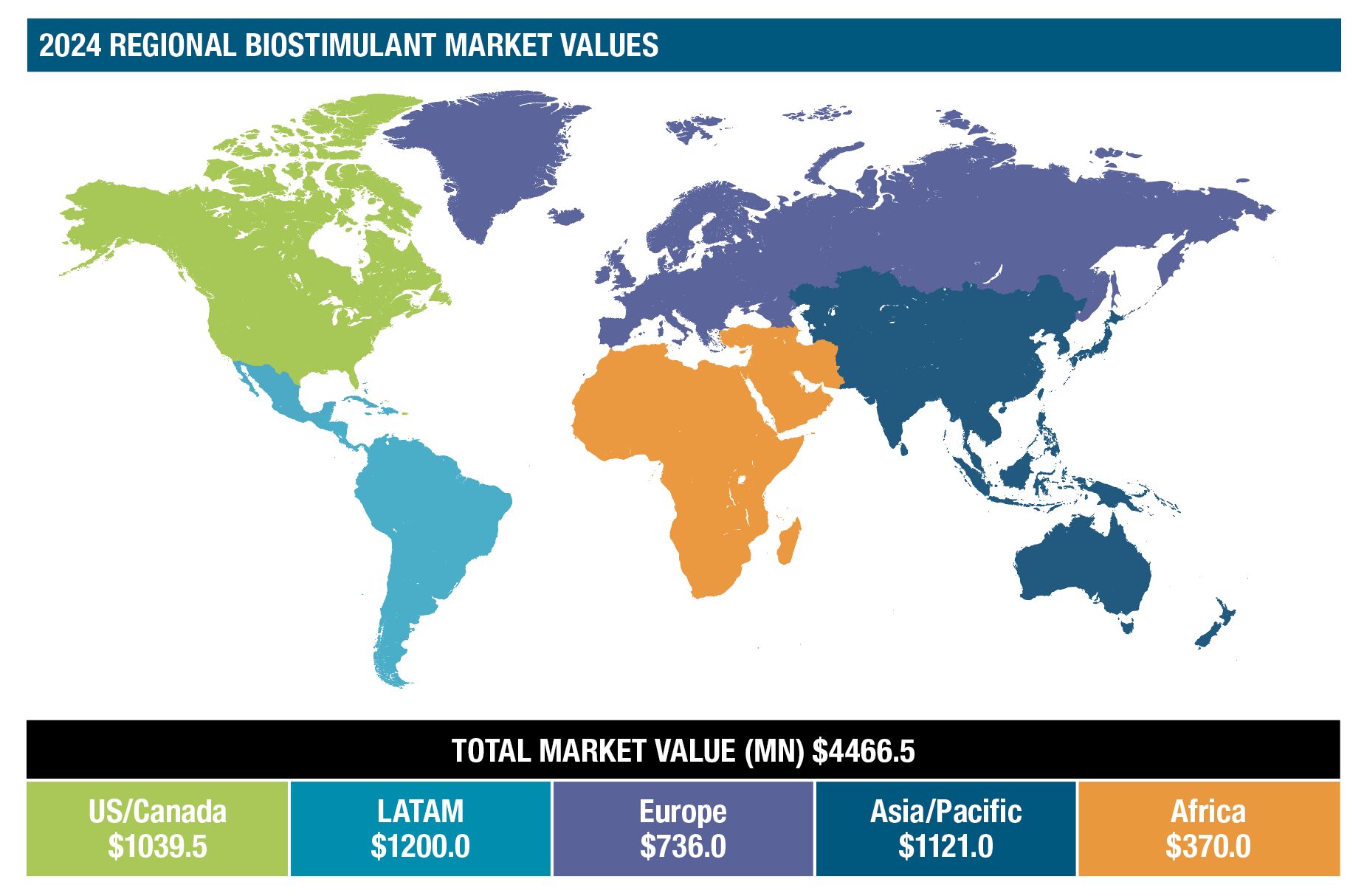
Regional views:
🇧🇷 Latin America leads the global biostimulant market in both value and growth, with Brazil driving 50% of the region’s revenue.
🇺🇸 The United States remains the largest single-country market, powered by distributors evolving into formulation leaders.
🇪🇺 Europe lags in fourth place and “has not reached critical mass to elevate overall trajectories”; growing interest in CE certification interest could reignite growth.
Africa remains a small-but-promising market, with long-term potential as commercial channels improve.
What’s selling:
Amino acids are still the top category for biostimulant substances, thanks to their formulation versatility and “strong alignment with circularity principles.”
Algae extracts remain the second-largest segment.
Humic/fulvic acids are also relevant in 2025, especially across irrigated acreage.
The emerging standout: Single biostimulant molecules (SBMs) are high-specificity products offering more consistent efficacy and the potential to crack row crops and cereals at scale.
Fruit and vegetable crops are still the biggest use cases, driving over 50% of demand for biostimulants.
Row crops and cereals are growing fastest, and poised to become the next major demand driver.
The lowdown:
Despite inflation, supply-chain turbulence, and regulatory shifts, biostimulants have shown remarkable resilience. DunhamTrimmer concludes that future growth will rely on deeper science, more product differentiation, and greater adoption.