Impossible Foods CEO Peter McGuiness is stepping down from the plant-based foods company after almost four years at the helm.
AgFunderNews understands that he will be wrapping up day-to-day involvement over the next couple of weeks although he will continue to serve as a member of the San Francisco-based company’s board.
His responsibilities will be shared by chief legal and operating officer Jason Gao, chief demand officer Meredith Madden, and chief supply officer Robert Haas. A spokesperson did not say if the firm plans to recruit a new CEO down the road.
As a private company, Impossible Foods has not faced the same level of public scrutiny as beleaguered rival Beyond Meat. But given the jaw-dropping sums (almost $2 billion) pumped into the startup over the past 15 years, the pressure to deliver a return for investors is intense.
‘He has done a great job at trying to steer the ship in a very difficult market’
According to a press release, Impossible is “announcing the transition from a position of strength.” Under McGuinness’s leadership, it says, “the company outperformed the broader plant-based category through innovation, demand creation and critical distribution gains – besting the competition and commanding the #2 position in terms of US market share [behind Morningstar Farms].”
A spokesperson shared that the company has continued to nurture strategic customer relationships across retail and foodservice and has long-standing partnerships with Burger King and Starbucks, but would not share any figures.
Industry sources we spoke to on Friday said McGuinness had made significant strides to move Impossible Foods from a foodtech company into a tech-enabled CPG company, putting R&D projects on seafood, and eggs, and milk on the backburner to focus on expanding options in beef, chicken and pork, introducing new bold red packaging, and focusing messaging on taste and health rather than displacing animal agriculture.
Most recently, the firm teamed up with Equii, a startup fermenting grains to create breads and pastas with higher protein content.
Speaking to AgFunderNews in fall 2023, McGuinness said: “We will innovate like a tech company, but we’re going to operate like a food company.”
However, he has faced increasing headwinds with weakening category sales at retail, negative media and investor sentiment, and inflationary pressures over the past couple of years.
‘No one is doing well in this category’
One alt protein industry source told us: “I think he has done a great job at trying to steer the ship in arguably a very difficult market. But recall Impossible raised tons of capital like Beyond at nose bleed valuations, none of which will ever hold water as a public company [that once exposed to public-market scrutiny, valuations would compress sharply].
“He could hold on longer because they are private and numbers aren’t public, but I surmise he was given a period of time to get to the valuation investors we’re looking for (higher than where they invested) or he was given a package that had valuation milestones linked to it, none of which are achievable.”
Another source told us: “No one is doing well in this category, or not well enough to make ends meet with the massive expectations and expense structure design to be a billions of dollars company.”
Building a global footprint
Unlike Beyond Meat, which spent a large sum entering into the Chinese market, but recently suspended operations there, Impossible has focused largely on the US market, although it has some sales in Canada, Australia, New Zealand, Singapore, the UAE, Hong Kong, and Macau.
In the UK, it is still waiting for the Food Standards Agency to approve the use of its star ingredient heme protein but has been selling alt-chicken products that do not contain heme there since 2022. The timeline for EU market entry is still unclear, although it has made significant progress on the regulatory front over the past year or two.
Plant-based meat in US retail
For a time, it looked as if putting refrigerated products in the meat case next to conventional meat would be the key to unlocking growth for meat alternatives at retail by putting them squarely in front of meat eaters. Beyond Meat debuted there in 2016, with Impossible Foods following in 2019 after a successful debut in the foodservice market.
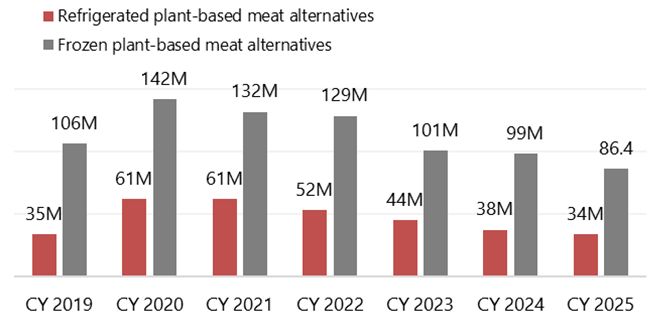
However, sales of refrigerated meat alternatives have been going backwards since Q3, 2021, with dollar sales falling from $490 million in 2021 to $276 million in 2025 in conventional multi-outlet channels (grocery, mass/supercenter and club), according to Circana data crunched by 210 Analytics. This brings sales back to about where they were in 2019.
Sales in the frozen case—accounting for 68% of retail sales in December 2025—have also fallen, albeit slightly less sharply, says 210 Analytics.