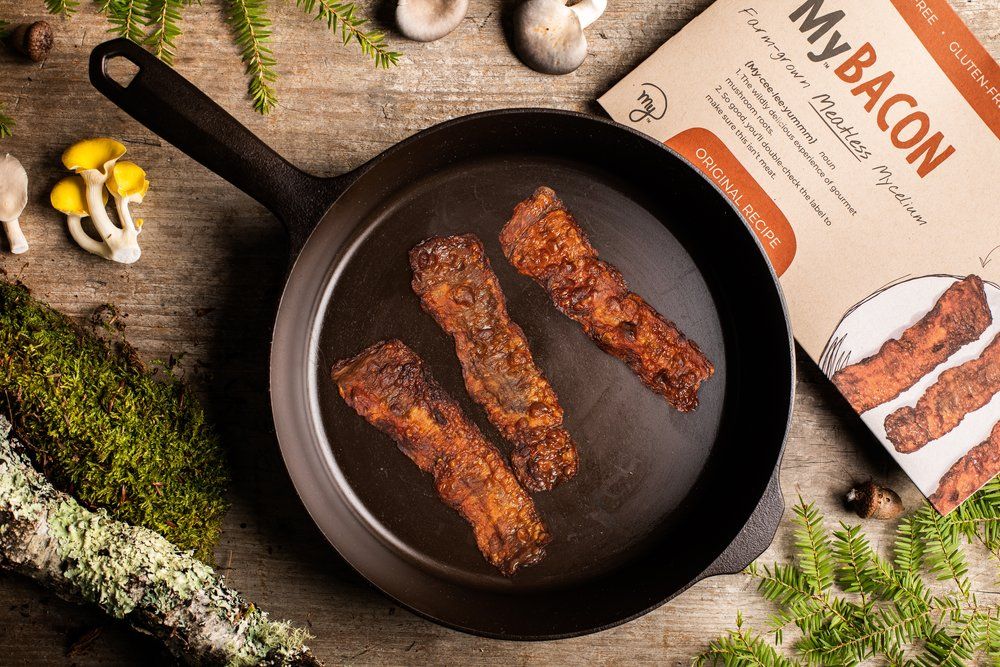
New York-based MyForest Foods, which grows mycelium-based bacon (MyBacon) and pulled pork (MyPulledPork) using solid state fermentation, has rolled out nationwide with Whole Foods Market in the US, increasing its footprint to 2,500+ locations.
The news was announced as Circana data crunched by 210 Analytics showed US retail sales of meat alternatives fell 10.2% year over year to $70 million in September 2025, with average assortment numbers in the refrigerated case falling from 14 in 2021 to 9.3 today.
While many alt meat brands are “seeing slower velocity and reduced shelf space,” MyForest Foods “continues to grow, helping keep the category afloat with products that deliver real satisfaction in flavor and texture,” cofounder Eben Bayer told AgFunderNews.
“We are finally de-bottle-necking on supply, and growing like crazy. We are seeing strong repeat purchase and accelerating velocity, currently averaging 5.7 units per store per week in the natural channel and more than 10 units per store per week in Whole Foods.
‘Farmed not fake’
In-store demos and “Farmed, not fake” signage have been particularly effective at increasing awareness and sales of the products, which perform best when merchandised in the refrigerated plant-based breakfast section, he said.
“People are responding to the honesty and simplicity of real, farm-grown food. All of our nutrition comes directly from oyster mushroom mycelium, which allows us to keep our ingredient list to five simple, recognizable components. Much of our growth still comes organically through word of mouth and enthusiastic repeat customers.”
MyForest, which initially focused on the retail market, is now “ready for foodservice partnerships to build on that momentum,” said Bayer.
“Our focus in food service is MyPulledPork as a center of plate option, which has performed exceptionally well in early tastings and trials. Chefs and operators are responding to how well it performs across a range of menu applications, from sandwiches and sliders to tacos and bowls.”
Gross margin positive now, aims to be EBITDA positive H1, 2027
Many startups that grow mycelium use submerged biomass fermentation, which has high capex and operational costs. MyForest, by contrast, deploys a patented solid state fermentation process that is less capital intensive with simple downstream processing, says Bayer.
“The cultivation system we use has a bunch of benefits. The first is the mycelium has an incredible texture that is preserved when you harvest it, so you don’t have a lot of downstream processing costs.The second is that the mushroom farms we partner with [to grow mycelium using MyForest’s proprietary process] are already really scaled in North America and Europe.”
The firm’s latest partner, Pietro Farms in Pennsylvania, “has been our fastest activation to date, moving from setup to product in market in just three months,” he said.
“The MyForest Foods Farm network is operating above plan in terms of yield and capacity. This quarter we turned direct [gross] margin positive. Like any form of agriculture, there is still week-to-week variation, but our four-week averages are becoming increasingly consistent. This demonstrates strong predictability and quality control across our growing systems.
“It really is like a new crop. In the lab we have been breeding the next generation of strains and are excited to roll those out to our network.”
The hope is that the company will be operationally profitable in 2027, he said: “MyForest Foods is already gross-margin positive, and we are targeting EBITDA-positive in the first half of 2027. We are scaling efficiently while maintaining both quality and brand.”
Tough times for mycelium-based textiles
The Forager side of Bayer’s Ecovative business, which makes mycelium-based textiles and other materials, has faced challenges, he acknowledged: “This sector has had a hard go with a slug of companies shutting down or restructuring recently (click here and here). Worse even than plant-based.
“With that said, we continue to make meaningful progress with Forager, our mycelium textiles division. We are booking revenue there but still upstream in development; it’s an important area of ongoing research, though not the only thing we are working on outside of food.
“We do have some great stuff cooking and will bring it to mass market when the time is right. Importantly the work we do now in scaling the MyForest Foods farm network lays the groundwork to quickly bring mycelium leather to scale around the world.”
In a LinkedIn post this afternoon, Bayer added: “The real trap is thinking mycelium solves everything. It doesn’t. It solves specific problems when you nail fundamentals—alignment to culture, the problem customers need solving, fundamental capabilities of mycelium. Nail an intersection, customers show up. When they don’t, no amount mushroom mysticism saves you.”