

While investor sentiment has soured on cultivated meat, UK-based startup Meatly has set out to prove—on a shoestring—that the unit economics can add up, and that petfood, rather than human food, is the place to start.
Dogs aren’t overly concerned about what their food looks like, the regulatory pathway is simpler and shorter, and pet owners and brands are surprisingly open to trying new things, says CEO Owen Ensor, who founded Meatly in 2021 with Dr. Helder Cruz (CSO).
Unlike some firms that burned through large piles of cash before it became clear that the tech to make filets and steaks at industrial scale was not ready for prime time, Meatly approached the market with “pragmatism” from the outset, claims Ensor.
“I came at this from a traditional startup background, which is get something out as fast as possible and get some feedback.”
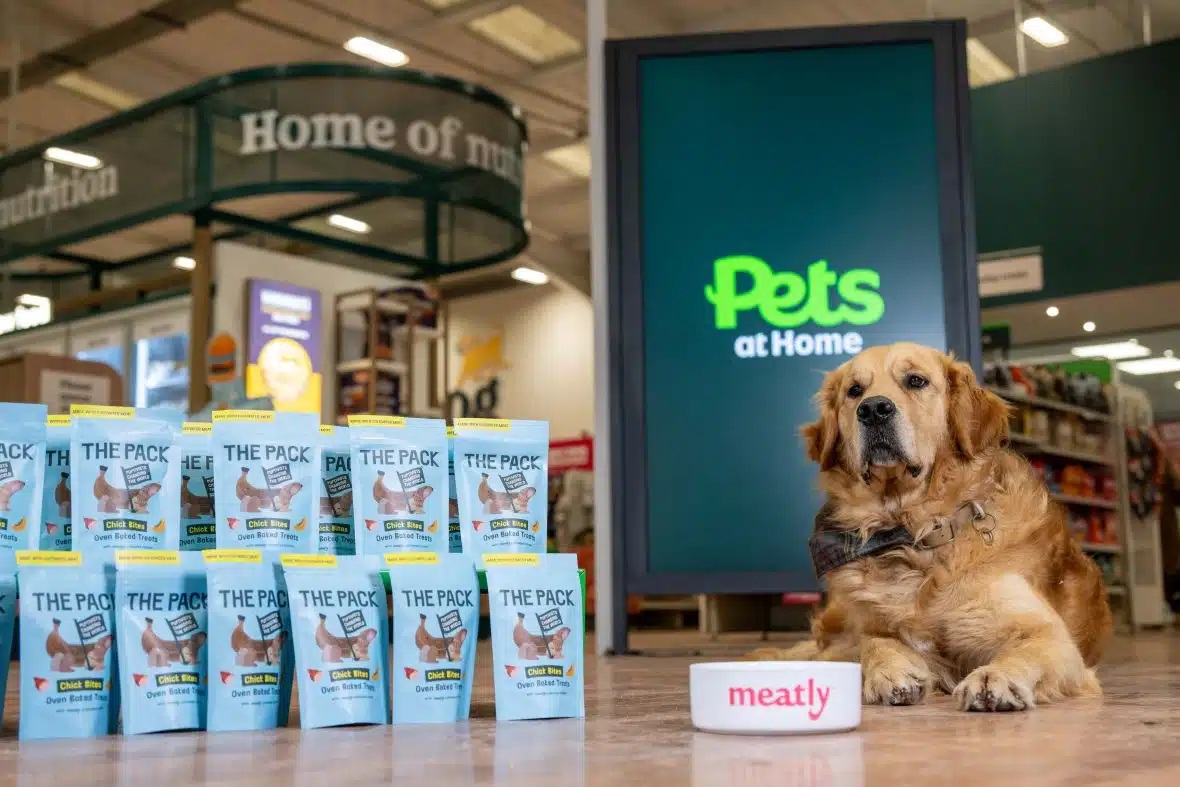
The firm has been as good as its word, securing regulatory approval in the UK in July 2024 and launching a limited edition product at the UK’s largest pet care retailer Pets at Home in February 2025. The “Chick Bites,” launched in collaboration with dog food brand The Pack, combined plant-based meat and a small amount of cultivated chicken.
“Our approach has always been that we’re incredibly excited for the day when we make the perfect cultivated steak,” says Ensor. “But there are interim steps between here and there, and that means unstructured, undifferentiated products first because we have to prove this can be done in a commercially viable way. It’s not about the perfect steak; it’s about hitting under £10 ($13) a kilo.”
Low-cost bioreactors, cheaper media, robust cell lines
Meatly has developed a patent-pending low-cost bioreactor in-house (its pilot plant currently houses a 310-liter vessel Ensor claims cost just £12,500/$16,800) and brought media costs down to 22p/liter, a number he claims could get down to just 2p/L with economies of scale.
“We really focused on replacing expensive media components with much cheaper food-safe components that are more readily available and replace the function of albumin, transferrin, insulin, and growth factors,” he says. “It’s been an iterative process and we’ve got over 200 doublings now with our in-house, chemically-defined media formulation.”
Ensor reckons the economics are viable at 20,000-liters, with a commercial-scale facility ultimately containing around 15x 20,000-L vessels.
“We think with one bioreactor [of that size], you could reach profitability at a premium price point, which is probably £7-10/kilo ($9-13), which is a high premium ingredient in pet food, although not unheard of,” he says. “But we want to reach the mass market, where you’re talking about £5 ($6.7) a kilo, where you would be looking at an industrial facility with 15x 20,000-L bioreactors.”
The immediate focus is raising sufficient funds to prove out the tech at 20,000-L, he says. “We’re fundraising at the moment, and hopefully we’ll close that in next couple of months. We’ve raised £7 million ($9.4 million) to date, and we’re now raising about £15 million ($20 million) to scale up.”
Should the tech work well at 20,000-liters, there are then three options to build an industrial facility, he says.
“The first is debt financing or project financing to build infrastructure ourselves based on offtake agreements. The second is we partner with a meat processor or petfood manufacturer that provides the capex and the sales and distribution, while we run and operate the facility. The third is we license our technology to existing fermentation companies, other cultivated meat companies or pet food manufacturers.”
As for cell lines, “We’re just doing chicken with a very robust cell line that we don’t need to genetically engineer to immortalize [keep dividing indefinitely],” says Ensor. “We’ve looked at fish and other stuff, but it has been a case of let’s just make chicken work so it has everything that our customers need, which is great nutrition and great taste with a chicken pate-like consistency. We licensed the cell line so we’re not doing in-house cell line development.”
The market opportunity
But is there a market for cultivated pet food?
According to Ensor, who previously helped scale an insect protein business in Nairobi, pet food companies are “more innovative than many human food companies. There’s cold pressed, baked, freeze dried products, plus they are always testing different ingredients; there’s a lot more experimentation. So when we started in 2021, 2022, a lot of companies had tried insect-based and plant-based ingredients but there were challenges around palatability and nutritional availability.
“With our cultivated chicken, we’re matching the amino acid profile of a chicken breast, there’s complete traceability, no contaminants, and the promise of a consistent supply and price. There’s a lot of price volatility in the meat markets and prices in the UK and numerous other markets have increased significantly in the last six months.
“And there’s the European chicken commitment, a commitment from chicken companies to high welfare, low density stocking of chickens, which is estimated to increase chicken prices by 40% over the next five years. So we’re expecting continued volatility and increased prices in traditional meat markets, while we’re aiming to continually bring costs down. When those two figures cross, I think there’ll be huge interest in cultivated meat products.”
As for messaging to consumers, he says, “We know that health is number one; people want to make sure what they’re feeding their pets is the healthiest, safest product. And then sustainability and welfare can come into play.”
Funding cultivated petfood
To date, Meatly has been funded by a mix of VC and strategic funding, says Ensor. “Agronomics provided funding early on alongside some other small VCs and private investors, and then we were very fortunate to bring Pets at Home on board as a key investor. In the last round, we also brought on DSM-Firmenich.
“We see strategics being critically important, as we see our role as providing a solution for industry to help it provide more sustainable, healthy and kind solutions. We also want to work with meat processors, pet food manufacturers, with everyone in that food chain to help create that solution.”
He adds: “I think there was some initial hesitancy about doing cultivated meat for pet food, but I think what that underplays is how much people care about their pets and view them as a core part of their family.”
Given the simpler regulatory path, there are also more approvals in the petfood space, he says, with Meatly securing the green light in the UK in July 2024, Biocraft getting the go-ahead to sell its wares in the EU in March 2025, and Friends & Family Pet Food Company securing approval in Singapore last month.
While cultivated meat has become embroiled in the culture wars in the US with several states pre-emptively banning it, attitudes in the UK and many other markets are more enlightened, says Ensor.
“What we know is that it’s going to be a bumpy ride with ups and downs, and it’s going to take time. If you look at any food trend, it’s not ChatGPT, it’s not going to reach half the population in two years. But I do think the tide is turning.”
Further reading:
Believer Meats secures FDA ‘no questions’ letter for cultivated meat, completes NC facility
Clever Carnivore’s pragmatic path to cultivated meat profitability, starting with $0.07/liter media