The world’s most critical challenges—from food security and the energy transition to human health and climate resilience—are accelerating rapidly. The R&D methods tasked with solving them are not. They remain locked in the slow, less efficient processes of the last century, making it more difficult to combat the ecological, social, and economical hurdles ahead.
In the race to find the next fuel cell, sugar alternative, herbicide, or packaging material, the traditional R&D process is a decades-long endeavor with abysmally low success rates. With the success of entire industries now reliant on delivering new, resilient solutions at scale and speed, this costly, slow-moving paradigm is finally starting to fade into obsolescence.
Simultaneously, a mix of AI, robotics, and partnership models is building a new paradigm, ushering in new opportunities for major industries, agrifood included, in the process.
The fast lane to scientific discovery
“Scientists spend roughly 80% of their time optimizing things, so there is no creation, no creativity, just fine-tuning,” says Atinary CTO Loïc Roch. “Scientists should spend 80% of their time thinking about what to tackle, why this problem, and let a machine take care of the rest.” [Disclosure: AgFunderNews’ parent company is an investor in Atinary.]
A scientist himself, Roch understands first-hand the paradox today’s chemists, biologists, and others face: they’re naturally curious and want to find new solutions and methods, yet most of their time is spent on rote, manual optimization—or in Roch’s words, with ”tools from the last century.”
That means finding the next fertilizer, food ingredient, or packaging material could take 20 years of trial and error by scientists as they painstakingly run experiments that rely heavily on manual input.
Atinary is among a handful of startups employing AI and automation to change this.
Behind Atinary’s platform is a simple idea: an automated lab that learns from itself. It designs its own experiments, runs them, analyzes the results and updates its understanding of the problem based on those results. Rinse and repeat 24/7, 365 days per year.
There are potentially millions of formulas, ingredients, temperatures, and conditions to test. Falcon AI, Atinary’s proprietary optimization algorithm, uses Bayesian Optimization to map out experiments that have already run, what’s working, and, based on that information, what experiment to run next. The idea is for scientists to leverage the tool to find the best results in as few experiments as possible.
Critically, scientists don’t need a degree in machine learning to use Atinary’s tools, which were designed with a “no code” approach in mind.
A reduced timeline here is striking. Developments that historically took years can be compressed into a few months.
Atinary, for example, worked with ETH Zurich’s SwissCat+ initiative to identify the best catalyst for converting carbon dioxide into methanol.
“Typically, to do this conversion the regular way would take roughly 100 years of research,” says Roch. Atinary accomplished it in six weeks.
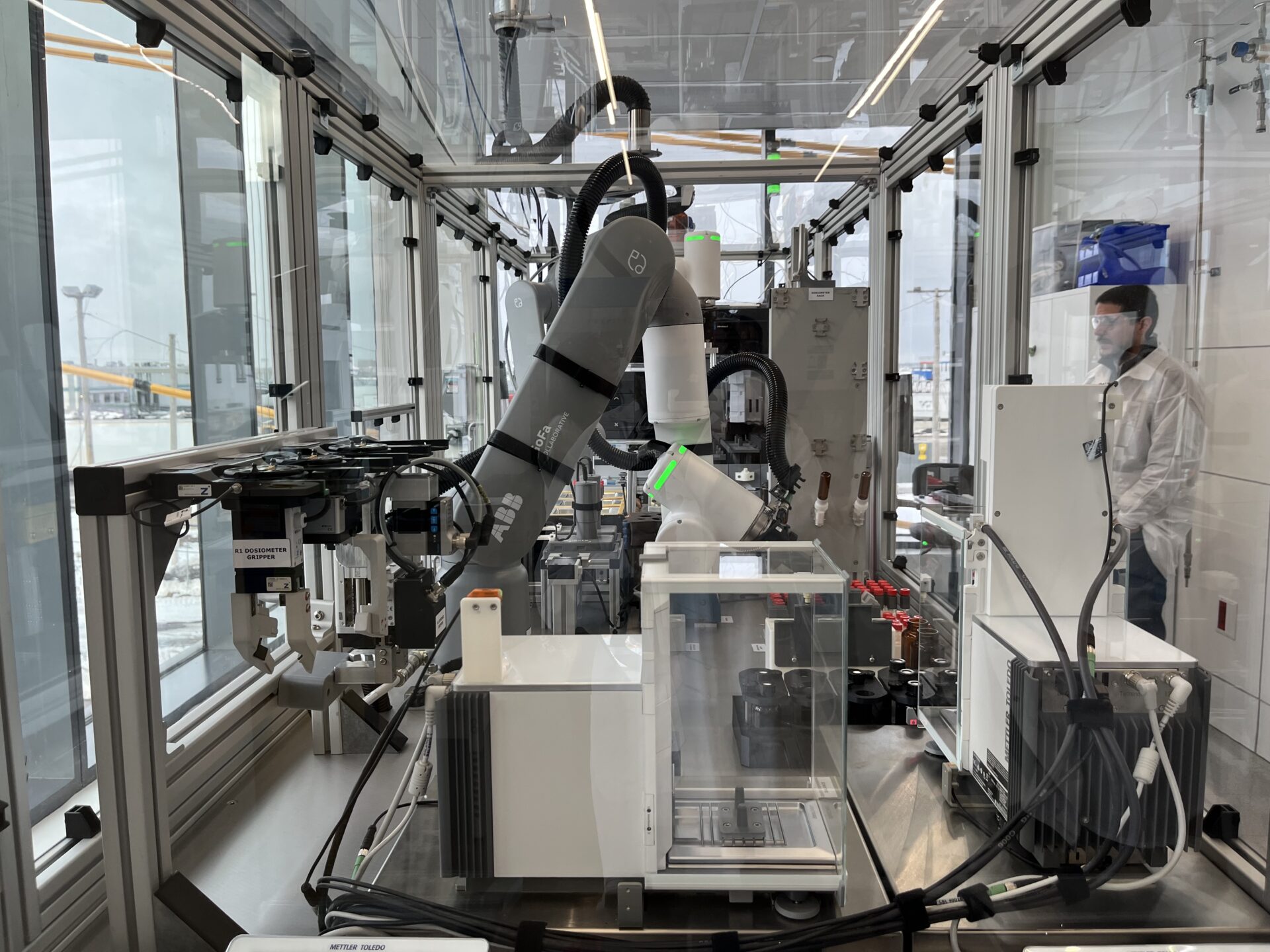
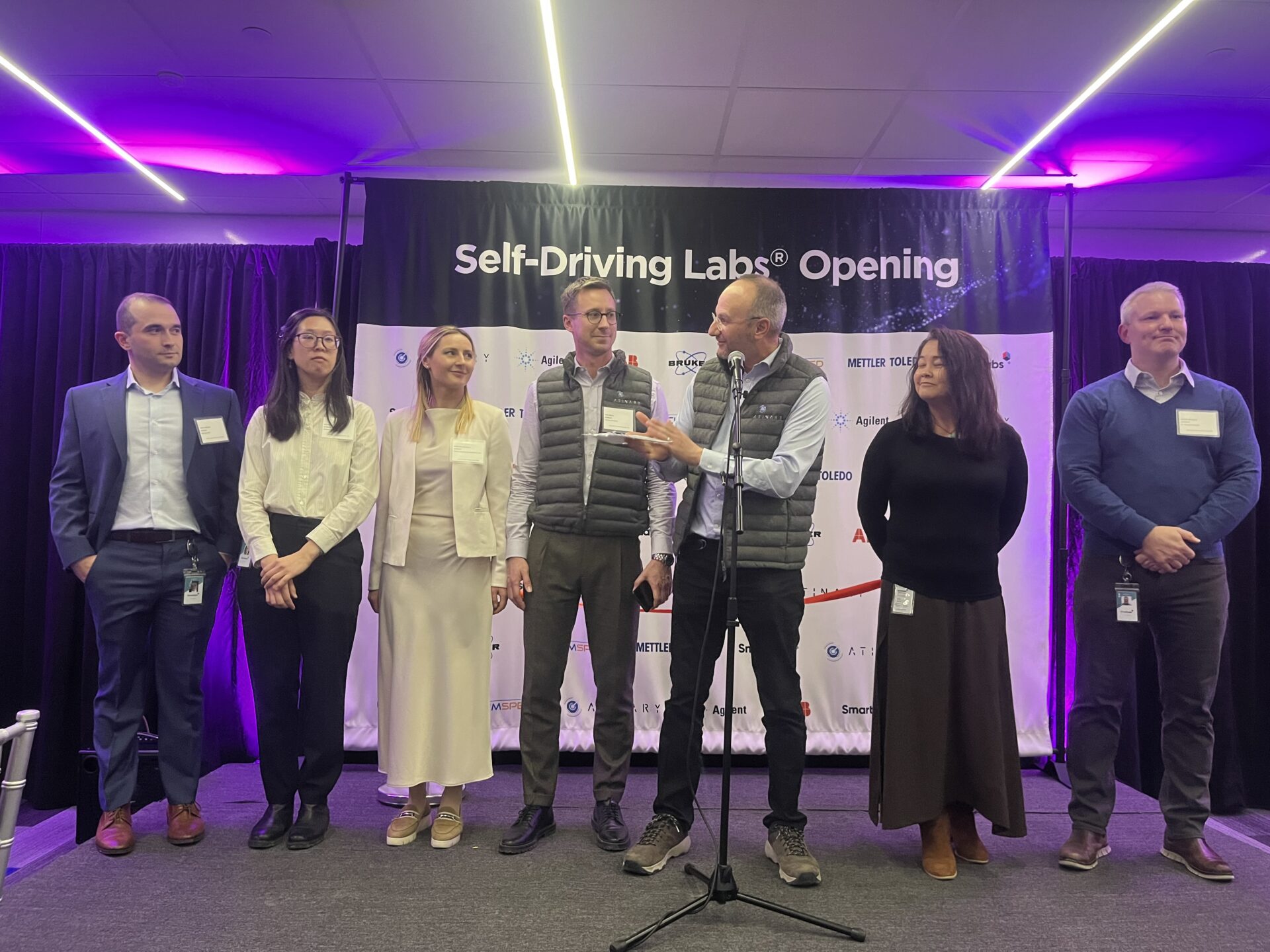
More recently Atinary worked with ABB Robotics and others to build a fully autonomous Self Driving Lab (SDL), which it unveiled this month in Boston, Massachusetts.
Robotics in the lab isn’t a new concept. However, combining Atinary’s software with robotics (along with contributions from Mettler-Toledo and Agilent, both key players in lab technology) turns experiments into fully autonomous, closed-loop cycles, with AI deciding what to test and robots physically carrying the work out.
Roch says Atinary’s SDL can run between 200 and 400 experiments per day, generating more data than a PhD student would churn out over the course of a typical five-year degree program.
The goal of this collaboration is not to replace the scientist, Roch stresses. It’s about helping them spend 80% of their time deciding which problem to solve and not on every last detail of how to do it.

A new blueprint for corporate R&D
In agriculture, new product development has long needed an R&D makeover. Drought-resistant corn, cleaner alternatives to Red Dye No. 5, better routes to biofuels are in demand. But these and other innovations require years-long development cycles and quite a bit of money.
In response, large agribusinesses are now leveraging AI and other tools in an effort to speed up new product discovery and synthesis, and work with younger, more agile startups to implement new ideas.
“We’re seeing the strongest impact where complexity, uncertainty and scale intersect,” says Renee Boerefijn, senior director for R&D at Cargill, tells AgFunderNews.
Cargill’s product portfolio includes everything from beef to biofuels to asphalt modifiers.
Across the portfolio, ingredient formulation and sensory optimization are key areas in need of R&D innovation, says Boerefijn. Here, predictive modeling helps teams understand ingredient behavior across multiple applications.
“By integrating sensory science with AI and ingredient and component models, we can predict preference, reduce reformulation cycles, and work on innovations that help meet expectations around taste, texture, and familiarity—which is critical for repeat purchase.”
Like Atinary, Cargill says it is using AI in R&D to augment rather than replace human input.
“AI shortens feedback loops—but human expertise remains central to interpreting results and making decisions,” explains Boerefijn. “Speed does not come from automation alone, but from better selection, stronger data foundations, and closer collaboration between customers and Cargill.”
For example, Cargill has partnered with Voyage Foods to develop chocolate alternative NextCoa.

Voyage provides technology to turn upcycled ingredients into “cocoa-like flavors and textures,” while Cargill applies predictive sensory science, formulation expertise, and application know-how.
“Digital tools and AI-driven sensory modelling help both teams assess consumer acceptance and optimize performance much earlier, faster, and more accurately than traditional trial-and-error R&D,” says Boerefijn.
Cargill, of course, is one of the world’s largest agribusinesses, with over 150,000 employees and customers in more than 100 countries.
Its sheer size means the company should set the example for others when it comes to using AI in R&D, suggests Boerefijn.
“Cargill’s role is to show how innovation can be accelerated and scaled without sacrificing trust, safety or long-term impact. That means embedding AI and digital tools into everyday operations, from consumer insight to factory floors, while maintaining strong governance through our Responsible AI Program.”
“By acting as a connector between startups, scientists, customers, and supply chains, we aim to help turn promising ideas into solutions that work at scale—and ultimately contribute to a more resilient, affordable and sustainable food system.”
While large corporate efforts like Cargill’s drive internal innovation, external partners are also playing a crucial role in accelerating specialized R&D.
CDMOs: Localizing R&D for global success
Even when a company has strong R&D capabilities in-house, pursuing open innovation is worthwhile, as it adds to possible capabilities, solutions, and products, says Gilson Manfio, PhD, head of R&D and innovation at IdeeLab.
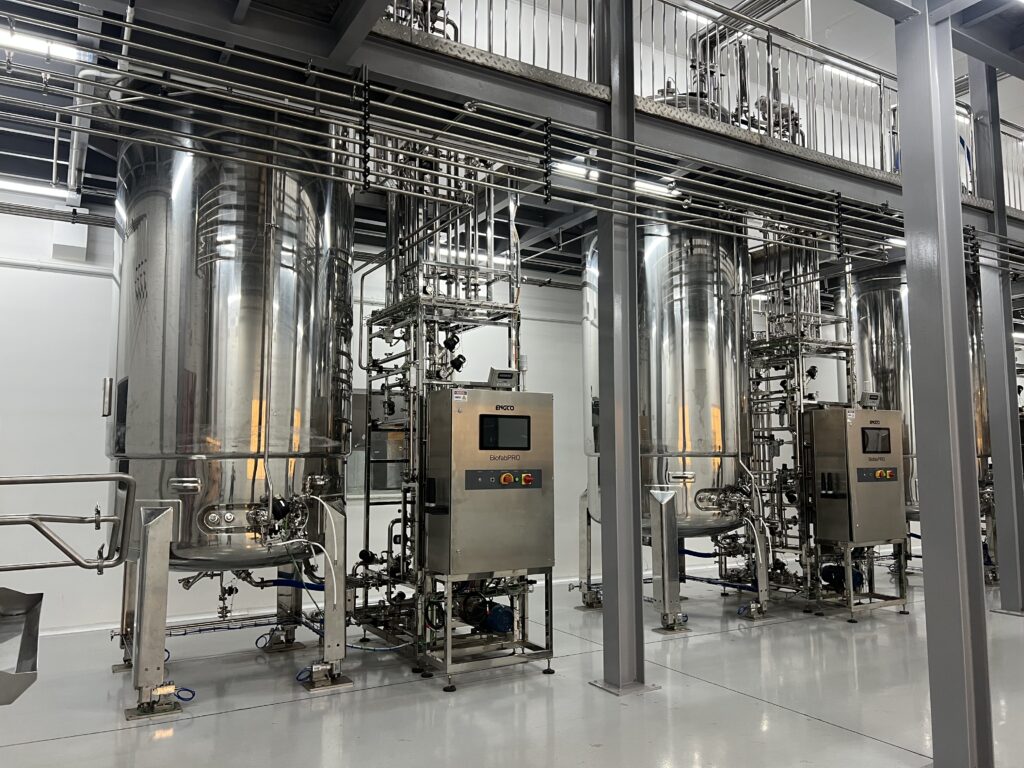
As a full-service contract development and manufacturing organization (CDMO), IdeeLab, supports other companies in their scientific discovery and production processes.
CDMOs can provide everything from infrastructure (e.g., fermentation tanks) to expertise on regulatory requirements to tools for process optimization and analytical testing. The concept is well known in Pharma and biotech and is now making its way into agriculture, too. IdeeLab, for example, focuses specifically on the discovery and production of biological crop protection products.
“The development of biological products via CDMOs is much faster and cheaper,” Manfio tells AgFunderNews, adding that major benefits of CDMOs can include “a more effective product scope and overall agility in the process.”
Right now, IdeeLab works with companies—multinational agribusinesses as well as startups—on projects such as the development of metabolite- and peptide-based biologicals.
“We provide solutions from live cell products (live microorganisms or a mixture of different organisms in a product), to next-generation products based on microbial metabolites and effector proteins/peptides, the latter triggering physiological responses in the plant itself, such as defense response and stress response modulation,” notes Manfio.
The company is headquartered in Brazil and focuses its efforts there; its particular CDMO model could be replicated elsewhere in the world in the future, he adds.
One major benefit of CDMOs in discovery and development is the ability to account for the necessary biogeographical context—the recognition that crop protection products developed for a temperate environment like the US or Europe won’t likely perform the same way when deployed in the tropics. If an R&D team is based in Switzerland, it needs a local partner in the region in which it intends to sell its products.
“Many companies bring technologies from abroad and launch them in the country, and they don’t perform as well as they did in the original country,” says Manfio.
“We have big agricultural players looking for a local developer so they can [develop and test] with a local developer that can do it faster and more reliably. This brings agility and the possibility of running specific tests with diseases and pests that would not be possible at the client’s R&D laboratory located in the US or Europe.”
Thus, development can be much more efficient if carried out in the region/context where the product will be used.
A new R&D paradigm
While a self-driving lab, R&D at a major agribusiness, and a CDMO for biologicals are distinct from one another, each is a response to the same problem: the tools science has relied on for the past century are no longer sufficient to address the challenges ahead.
Nor is it only a matter of solving today’s problems. As Roch notes, the transformation of R&D through these new technologies could lead to discoveries the scientific community has yet to even consider.
“With time compression like this, think of the discoveries we can make every month, every quarter, every year,” he says.
“We’re at a stage where we have all these technologies. Now we need to make them converge so we can move to the next paradigm, what the next 100 years will look like.”

Sign up for our weekly newsletter.