
Gustavo Mamao co-founded an agricultural biocontrol company two decades ago, which was acquired by Stoller 10 years later. He serves as an international partnerships advisor for IdeeLab, a leading Brazilian ag biological CDMO. He writes about ag biological investment and impact, and is involved in other ag biological innovation ecosystem initiatives.
The views expressed in this article are the author’s own and do not necessarily represent those of AgFunderNews.
There is a lot in the ag biological market to celebrate. What was once a peripheral field in agriculture is increasingly becoming a mainstream practice in some crops and regions around the world, sustaining double-digit growth, according to DunhamTrimmer.
However, greater consistency of ag biological products is increasingly required.
Biologicals are inherently less stable than their synthetic chemical counterparts, and there is always a risk that biological activity present at the factory door may be lost by the time of application in the field if the product is not managed properly.
Furthermore, how biological products fit within integrated crop and pest management systems can lead to actual field performance falling short of promised benefits. Without consistency, demonstrating efficacy and achieving better yields alongside other agronomic outcomes can become a significant challenge.
On the business front, unhealthy market competition is driving down prices for some of the most commoditized products. These are often products that have not shown critical differentiation and that tens (or even hundreds) of companies can produce, making growers’ purchasing decisions relationship-based and, in most cases, driven by who can offer the lowest price.
In this context, a wave of innovative products has been making the headlines in recent years. Metabolites, proteins and peptides, genetically modified microorganisms, and RNAi-based solutions are among the technologies behind these innovations.
These emerging platforms offer various potential advantages: greater consistency and efficacy, more targeted modes of action, and easier integration into established agricultural-input systems.
Some of these technologies may also fit more naturally within existing manufacturing, formulation, logistics, and distribution systems, potentially transforming not just product performance, but how easily biological innovations can be scaled.
If you are running or investing in a company exposed to agricultural biological inputs, you may be asking a simple question: Is it time to step on the gas or the brake?
The answer likely depends less on whether biologicals will grow, and more on which technologies will actually perform and which ones the existing agricultural-input system can absorb and scale.

A scenario-planning exercise
We cannot predict the future, but business leaders can work with scenarios that make it possible to anticipate decisions or prepare triggers upon seeing strong warning signals, as the methodology of scenario planning suggests.
As part of a scenario-planning exercise, I established a key focal issue: How might increasing commoditization and emerging innovation reshape the agricultural biological-input industry across leading agricultural markets over the next 10 years, and what do different futures mean for where and how fast companies should invest?
The next step was mapping the variables that influence the market and ranking them by impact and uncertainty. As a result, I identified two high-impact driving forces with a high degree of uncertainty.
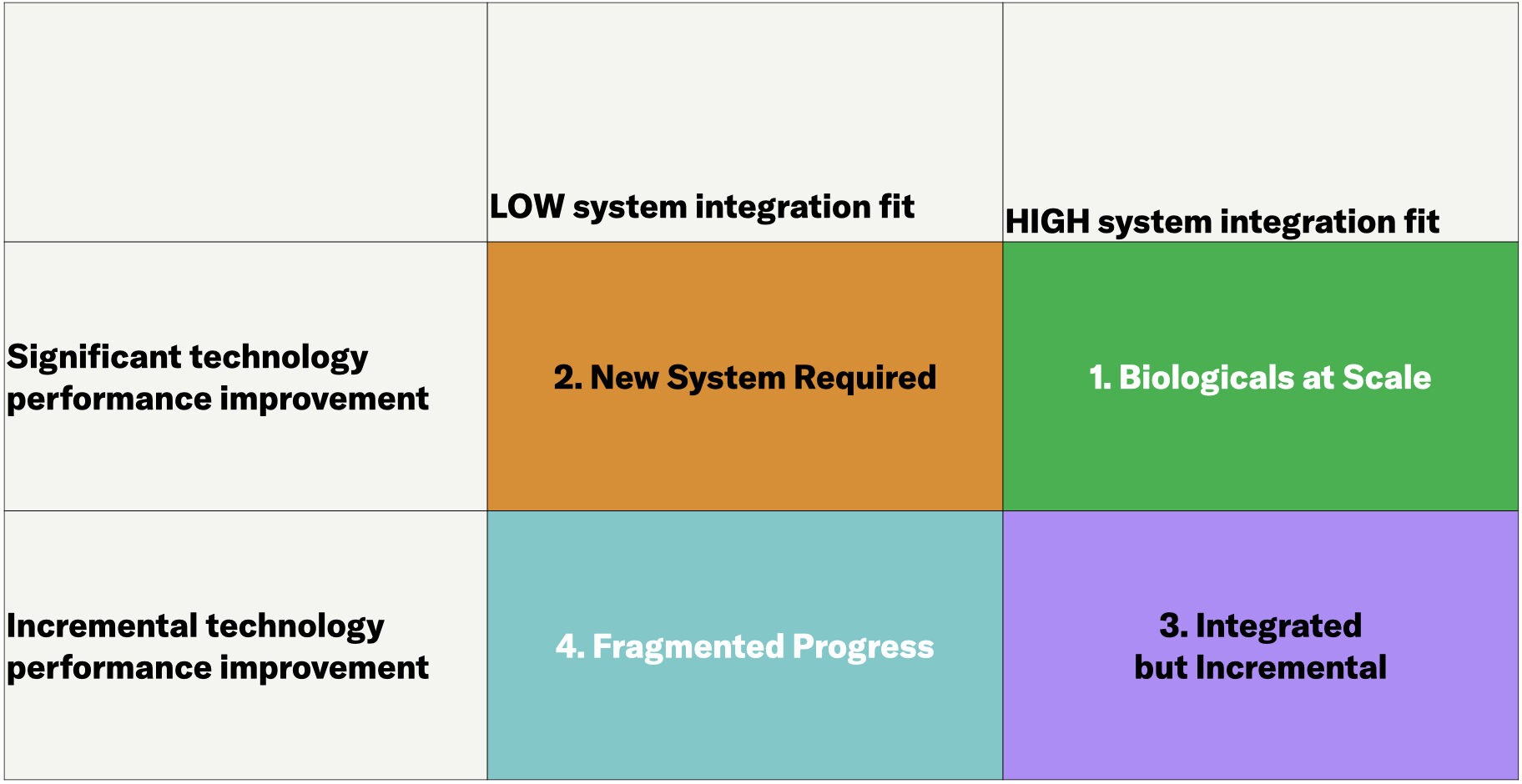
The first is “Ag biological technological performance”—how these new innovation platforms will actually perform and whether they can deliver greater product consistency. The second is “Corporate/channel system integration fit,” which is how well agricultural-input companies can integrate these technologies into existing portfolios and move them through established distribution channels.
The following four potential scenarios emerge from combining the opposite ends of the spectrum for these two key driving forces:
Scenario narratives
On picturing those four possible futures of this specific simulation, a narrative focusing on how to answer the key focal issue, in a 10-year timeline, is possible to be described as the following:
1. Biologicals at scale
Significant tech performance improvement + high system integration fit
- The technology delivers. A new generation of biologicals brings significant improvements in efficacy, consistency and predictability, building confidence among growers and the broader industry.
- The system is ready for it. New technologies increasingly fit existing manufacturing, distribution, and application systems, allowing ag input traditional players to scale them faster.
- Innovation moves into the mainstream. Commoditized biological categories remain, but differentiated technologies create new sources of value and take a larger role in crop-input portfolios.
- Scale becomes the name of the game. Companies able to combine differentiated technology with existing market reach are well positioned, and biologicals become much more integrated into mainstream crop protection and nutrition.
2. New system required
Significant tech performance improvement + low system integration fit
- The technology delivers. A new generation of biologicals brings significant improvements in efficacy, consistency and predictability. The old “but does it really work in my case?” conversation starts losing steam.
- But the old system wasn’t built for it. Some of the most promising technologies don’t fit neatly into existing manufacturing, distribution, and application systems, facing bottlenecks on the road to scale.
- Two biological markets emerge. Established categories continue their march toward commoditization and price competition, while differentiated technologies open new pools of value.
- The “bridge builders” win more territory. Specialized manufacturers, formulation players, technology partners and new business models emerge to connect promising innovation with the agricultural market.
3. Integrated but incremental
Incremental tech performance improvement + high system integration fit
- The technology gets better, but doesn’t transform the game. Biologicals improve steadily, yet consistency and performance remain challenging in some applications.
- The system learns to work with what it has. Manufacturing, distribution, and application systems become increasingly capable of integrating biological products into established portfolios.
- Biologicals grow, but commoditization follows. With fewer major technological barriers and limited differentiation in many categories, competition increasingly shifts toward price, brand, distribution capability, and bundled solutions.
- Portfolio players gain ground. Biologicals become common complements to conventional inputs, favoring companies that can integrate them into broader crop-management offerings rather than relying on biological innovation alone.
4. Fragmented process
Incremental tech performance improvement + low system integration fit
- The technology keeps promising more than it consistently delivers. Improvements continue, but variability in efficacy and predictability prevents a broad step-change in the farmer value proposition.
- The system remains difficult to navigate. Manufacturing, distribution, and application challenges continue to make commercialization and scale expensive and complex.
- Commoditization meets fragmentation. Established products face increasing price pressure, while new innovations struggle to create sufficiently differentiated and scalable markets.
- Niches survive, and some thrive. Successful products and companies emerge around particular crops, geographies and problems, but biologicals remain a collection of fragmented opportunities rather than a broadly transformed input industry.

Implications
While scenario implications should be assessed by each organization, there are some clear messages for different groups of companies in this specific exercise:
Incumbents: Integration is the name of the game. This means they can scale products more efficiently while continuing to rely on legacy systems, especially for distribution and application. If biologicals can closely resemble chemical molecules in product stability, shelf-life, and application conditions, incumbents can leverage their existing capabilities and overcome some of their current hesitations.
However, these incumbents must still invest in educating growers on modes of action and how to maximize the value of integrated crop-pest management.
New entrants/specialized biological companies: While it is unclear whether additional new entrants will enter the ag biological market at its current level of maturity, the companies already challenging incumbents (with over $20 million in revenue) continue to push boundaries. They bring specialized capabilities to the table, ranging from fermentation companies with large manufacturing capacity to those with dedicated distribution and sales forces capable of handling diverse biological products and finding the optimal path to plants. They don’t need integration with legacy systems, as they were born to challenge them.
That said, this group will need to take the lead in driving innovation to avoid falling into the commoditization trap.
Startups: These players promise enhanced product performance, and time will tell which ones will deliver. They are racing to prove that new innovation platforms can deliver superior solutions while operating in an environment of scarcer capital and intense competition.
Beyond product performance, they may benefit from finding ways to integrate with incumbent systems or leveraging the strengths of specialized biological companies. For instance, certain peptide and protein-based technologies can leverage outside precise fermentation manufacturing capabilities to achieve competitive pricing levels.

Final considerations
There are many nuances to what a “system integration” fit might mean for different organizations looking to incorporate these new platform innovations. I encourage any company intending to play a long-term role in this market to conduct scenario planning simulations around how new innovation platforms might match their capabilities, while accounting for the wide range of technologies available.
When running this exercise within your organization, you can uncover ways to detect early signals of which scenario is unfolding. These should include metrics related to product line commoditization, startups innovation pipelines, the scale and economics of these new solutions, and their performance validation, when turned into available data.
My 20-year perspective on what has been happening in this industry also leads me to challenge what incumbents have accomplished so far, including their historical hesitation and inconsistency in pushing ag biologicals forward. The fact that those incumbents share the market with medium-sized specialized ag biological players in the $200-500 million range shows they have not maximized their infrastructure to grow in this space.
I am also unconvinced whether incumbents have unlocked the full potential of their past acquisitions—sometimes, they turn their attention to other growth levers while failing to embrace the full complexity of ag biologicals. Even today, they still seem unready to adopt the right mindset for biologicals, thereby fueling the growth of new entrants who are competing with them head-to-head.
It is a fact that the ag inputs industry moves slower compared to other industries where innovation appears to be happening at every moment. That said, the time between taking action and seeing expected results also takes a few years. Ultimately, in a very competitive environment, how well companies navigate this window comes down to whether they will become the hunter or the prey.
Appendix
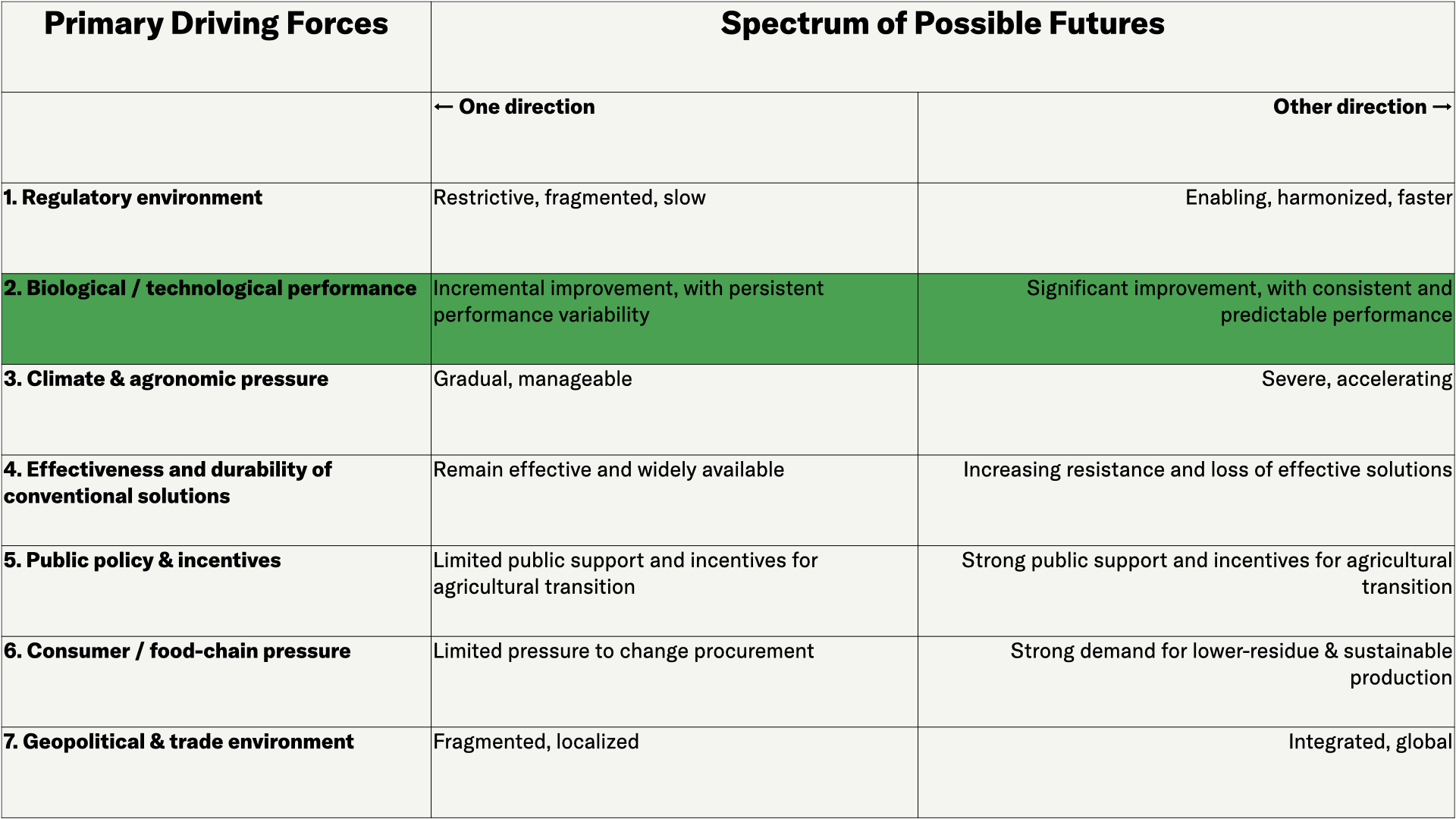
Primary Driving Forces (Macro-level): External environmental forces that define the operational landscape of the industry.
Secondary Driving Forces (Industry-level): Internal industry dynamics that dictate how market players adapt, compete, and evolve.
Simply put, Primary Driving Forces define the field of play, while Secondary Driving Forces determine how the game unfolds.
Below are the evaluated Primary Driving Forces along with their potential future trajectories.
Below are the evaluated Secondary Driving Forces along with their potential future trajectories:
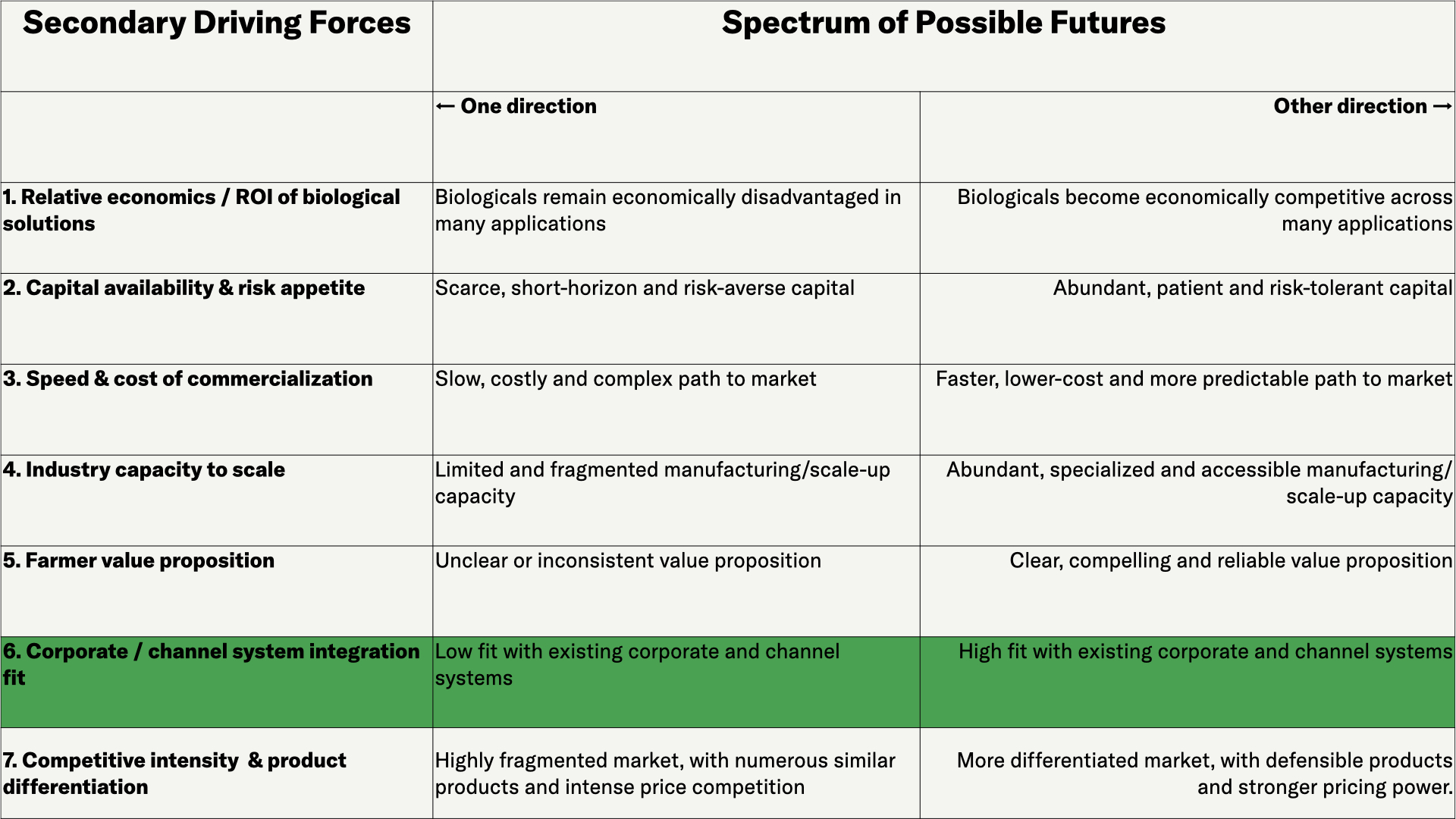
NOTE: Highlighted are the two driving forces chosen (high impact, and high uncertainty) to frame the four potential scenarios.