
Editor’s Note: Matilda Ho is founder and managing director at Bits x Bites, China’s leading agrifoodtech venture capital firm with technology investments across the globe, ranging from gene editing and drone-based imagery to biosynthesized ingredients and alternative proteins.
The views expressed in this guest article are the author’s own and do not necessarily represent those of AFN.
Global agrifoodtech investment may have hit the breaks, but a walk through China tells a different story—the country is alive with activity.
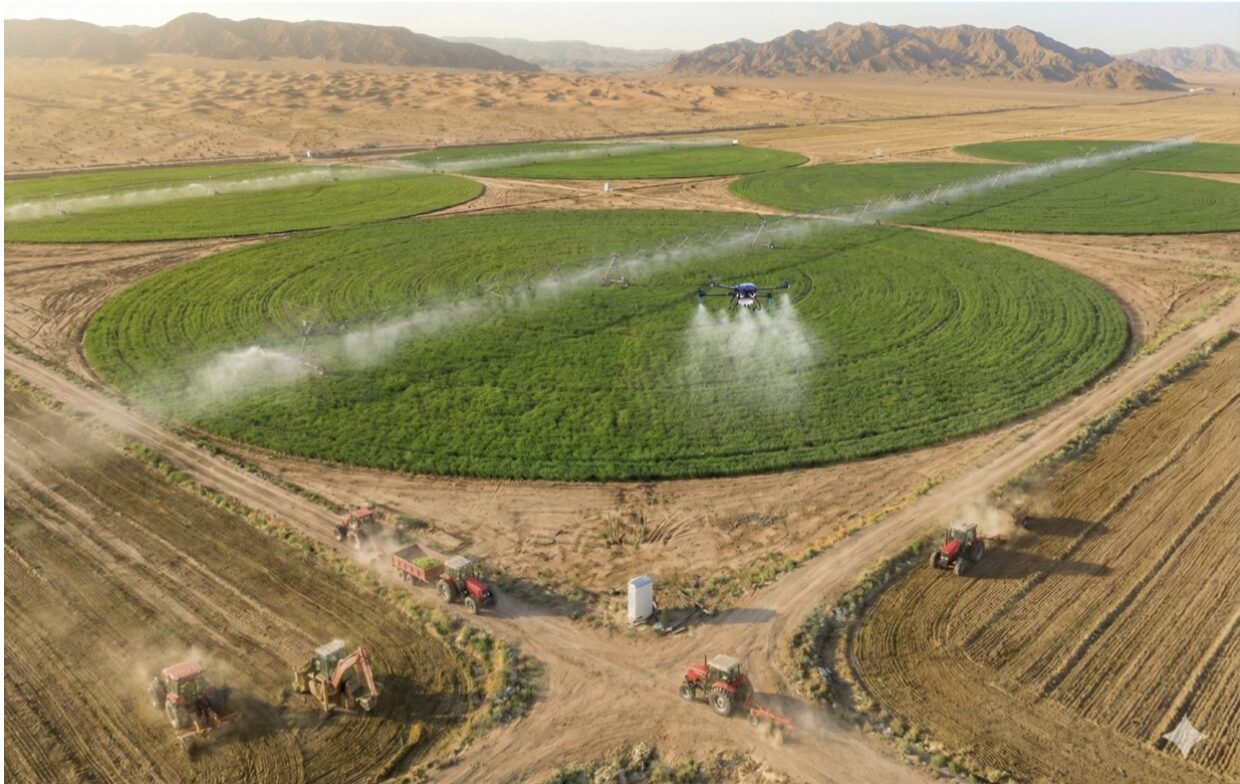
In Inner Mongolia, smart irrigation is turning desert into farmland. In industrial heartlands like Shandong and Jiangsu, biomanufacturing clusters are springing up seemingly overnight.
This is the “visible hand” at work: state strategy driving infrastructure, policy, and capital, and paving the way for private investors to redefine how billions of people eat.
As dedicated agrifoodtech investors with both global insight and local boots on the ground, we see a clear signal: while the world hesitates, China is forging ahead, providing us a unique opportunity to shape and capitalize on this transformation journey.
How national priorities drive innovation at scale
In today’s geopolitical landscape, China has made self-reliance in critical resources and core technologies non-negotiable. This shift has rewritten the investment playbook. Technological novelty alone is no longer enough. The premium now lies in a company’s ability to solve strategic chokepoints in priority industries.
Nowhere is this more evident than in agritech, a sector underpinned by the supreme mandate of food security. For years, China has poured hundreds of billions of renminbi into developing high-standard farmland with enhanced productivity, which now covers over 1 billion mu (67 million hectares). This is a continent-sized testbed for innovation, not just infrastructure.
With policy-backed upgrades in place, farming is moving from experience-based practices to data-driven systems like precision irrigation and autonomous field operations.
Our portfolio company, EAVision, grew up in exactly this environment. After validating its technology across China’s diverse terrain, it successfully expanded globally, establishing itself as one of the world’s leading agricultural drone manufacturers.
The same principle applies to China’s biomanufacturing sector, which is now a world-class engine for the bio-economy. Globally, many synthetic biology leaders stall at the “valley of death,” unable to scale production affordably. Here, China offers a structural advantage: over 70% of global fermentation capacity, integrated supply chains, deep industrial scale-up know-how, and a rich talent pool. This is the edge on which our portfolio Cataya Bio is built.
Today, Cataya is building a commercial-scale facility in Jiangsu, leveraging the region’s dedicated synbio industrial park with supportive policies and resources to fast-track innovation from lab to market.
Liquidity returns: China’s innovation engine is back in motion
Innovation needs more than just a compass; it needs fuel. After two years of tight liquidity, China’s capital markets are accelerating. Decisive government actions—injecting trillions of renminbi through stimulus measures and local debt resolution—have restored market confidence and emboldened investors to take risks again.
The revival is most visible in public markets. From 2025, investor sentiment has snapped back, driven by policy tailwinds and domestic breakthroughs—from the “DeepSeek moment” in AI to the landmark listings of Zhipu AI and MiniMax. This surge propelled A-share market capitalization past the historic RMB 100 trillion threshold and saw the Hong Kong stock exchange (HKEX) reclaim its global IPO crown.
Most critically, the risk appetite for high tech is back. Regulatory reforms opening the STAR Market and HKEX Chapter 18C to pre-profit firms have unlocked listings for companies like Healthgen and Dobot Robotics, whose market caps surged 109%-175% by early January. We are actively seizing this window to guide our mature portfolios toward their own debuts.
Yet the story goes beyond IPOs. For growth-stage companies facing the global funding gap, government-backed funds are stepping in as market makers. They provide the capital to scale while creating immediate liquidity for early investors.
Take our exit from Changing Bio. After validating the technology as the earliest investor, we passed the baton to a provincial government-backed investor at the Series B stage. We achieved a full exit while they took over the capital intensive scale-up, aligning the company’s growth with China’s bioeconomy ambitions.
This pattern repeats across our portfolio. For example, EAVision secured two growth rounds in 2025 alone supported by four government funds.
Simultaneously, M&A channels are widening. China’s latest “Six Measures for M&A Reform” is spurring listed companies to acquire quality assets or pursue industrial upgrades via reverse mergers. In 2025, the Shanghai Stock Exchange saw over 1,000 M&A deals, with major restructurings up 138%.
Agrifood is riding the wave too: Syngenta’s China National Seed Group acquired Huanong Weiye to strengthen its corn breeding, while Sunner Development fully took over Sun Valley Foods (formerly Cargill’s protein business in China) to reinforce its chicken supply chain.

Public-private partnerships: public capital, private execution
Beyond providing liquidity, the government is evolving from a subsidy provider to an ecosystem catalyst.
Through a fund-of-funds model, the state partners with professional GPs to channel capital toward strategic priorities, with a timeline that aligns with the development cycle of deep tech.
Since mid-2024, momentum has been striking. Shanghai set the tone with a RMB100 billion Industrial Guidance Fund, followed by Jiangsu’s RMB50 billion Strategic Emerging Industries Fund. A further signal came at the end of 2025, when the central government launched the RMB100 billion National Guidance Fund with a 20-year horizon—underscoring a multi-decade commitment to frontier technologies, such as biomanufacturing.
For investors, the edge lies in patience and specialization. At Bits x Bites, we are preparing our first RMB fund, backed by these strategically aligned LPs, to shape China’s agrifood future. This structure gives us long duration capital to nurture breakthroughs, combining the stability of the state with the agility of private venture execution.
The next China is China: innovation in a time of crisis
The world is watching China again, but through a new lens. We are no longer looking at a “me too” economy, but a specialized industrial machine reshaping energy, AI, and agrifood systems. The visible hand of state strategy and the invisible hand of the market have clasped together to build the next era of industrial growth.
The message is quiet but unmistakable: Where others see chaos, we see opportunities rooted in the nation’s superpowers, the speed to invent and the power to scale. For those willing to look past the headlines and into the heartlands, the opportunity isn’t just to witness this transformation—it is to be part of the engine that
drives it.