What does a restaurant operator with 2,300 locations know about foodtech investing that a conventional VC firm might not?
Quite a lot, argues Martin Davalos, partner at London-based McWin Capital Partners, which combines investments in restaurant chains with bets on technologies ranging from precision fermentation and agricultural robotics to AI-driven ingredient discovery.
With around €900 million ($990 million) in annual food expenditure across its restaurant operations, McWin has a direct window into the problems facing foodservice businesses—and potentially a ready-made customer base for technologies that can solve them.
AgFunderNews (AFN) caught up with Davalos (MD) to discuss the firm’s plans for a second dedicated foodtech fund, why it avoided plant-based meat but backed cultivated meat, where it sees opportunities in food and ag innovation, and what separates an interesting technology from an investable business.
AFN: Give us the lowdown on McWin…
MD: We invest in two verticals. The first is foodservice, where we are quite well known in Europe. We have about 2,300 restaurants, international brands and local brands. And then the other is food innovation/foodtech, and there are obvious synergies between the two.
AFN: What funds do you have?
MD: We launched our first fund, the McWin Food Ecosystem fund, in 2021. It is 70% invested in restaurants, where we have pretty much a private equity strategy, and then 30% in foodtech, which is more venture.
You normally don’t mix the two but we wanted to validate the thesis that there are so many potential synergies. For instance, we invested in the Burger King master franchise platform of Germany, and then on the foodtech side, we invested in Footprint, which does packaging solutions, with foodservice as one of the biggest consumers.
Since then we’ve launched a dedicated €525 million ($577 million) restaurant fund and a dedicated €250 million ($275 million) foodtech fund. But the point is, it doesn’t matter which fund you’re invested in, you benefit from the entire platform.
If you aggregate all of our restaurant expenditure in terms of food last year, it was close to €900 million ($990 million), so that gives us a lot of leverage when negotiating with food companies and allows us to plug and play technologies, services, and so on.
We manage about €1.3-1.4 billion ($1.4-1.5 billion) in terms of assets under management, so we have three funds and six co-investment opportunities.
We’re now launching our fourth fund, which is a dedicated restaurant fund called McWin Foodservice Fund, which is targeting lower mid-market restaurant brands in Europe.
And then next year we’ll be launching McWin Foodtech Fund II.
AFN: Are you still deploying funds now?
MD: The McWin Foodtech Fund I is approximately 50% invested and we’re still deploying out of that fund. With that, we made two investments this year in a firm called Incapto, and we invested in a company based in the [San Francisco] Bay area called Cut+Dry, which is a foodservice supply chain AI company.
And then as we speak, we’re working on three deals that we hope to close before the year end. So overall, that will likely be five deals this year.
As a rule of thumb, once a fund is over 70% invested, you can start thinking about the next fund. So we will probably reach that target for Foodtech Fund I by Q1 or Q2 of 2027, so that will unlock the opportunity to raise the second foodtech fund.
AFN: What kind of companies are you looking at in the foodtech space at what stage?
MD: We invest from farm to fork, so we look at agtech, ingredients, personalized nutrition, digital platforms, robotics in agriculture, food, and restaurants, and health and wellness around food. Our sweet spot is Series A/Series B. And if you’re an asset-heavy company, probably a Series C/Series D.
The way I like to describe it is, we normally invest once the technology hurdle has been overcome, and companies need capital, expertise, and a network effect for scaling. So we invest later than most of the typical food technology funds. It’s all about helping companies scale.
AFN: Is the current financing model for agrifoodtech fit for purpose?
MD: I think it does fit, but you have to resize return expectations. In food, you’re not going to get 100x returns. You have regulatory challenges, scaling problems, infrastructure problems. But given the cleanup in the industry, I still think you can get venture capital returns.
The headwind that venture is facing is the lack of capital, higher interest rates, and so on. Now that’s actually positive for professional investors like us as we’re able to invest in very good companies at lower valuations and better deal terms, plus we can concentrate and spend a lot more time helping portfolio companies to scale.
AFN: Now the sector has had to recalibrate expectations, are LPs still willing to invest in your funds?
MD: We need to have exits. We need to have a few wins under our belt. DPI [distributed to paid-in capital, a measure of how much cash a fund has returned to investors relative to the amount invested] is very important, but because of the nature of McWin, we can show where we have added value in portfolio companies.
Raising capital is a challenge, but the good news in Europe is that we have entities like the European Investment Fund (EIF), and then each country has its own sovereign funds, although you have to raise private capital to match the funding.
AFN: What key problems are you trying to solve across your verticals?
MD: Inflation… so higher input costs, labor issues, and health and wellness. Take ag robotics. The obvious problem you’re solving there is labor and the cost of inputs [such as fertilizer and pesticides]. We’re also looking at functional beverages, supplements, nutrients, and peptides around the health trend. Food safety has always been an area that we like, but we haven’t seen so many interesting deals in that space.
In the ag robotics space, we invested in [precision sprayer] Ecorobotix and what we like about it is the immediate payback; the benefits are tangible. You’re not saying to the farmer you might get an increase in yield over many years. You’re saying here is the immediate cost saving on inputs and labor. It’s capex heavy but we’re comfortable with that because the payback is quite good.

AFN: In food, it looks like you dodged some alt protein bullets?
MD: We never invested in plant-based companies because we have a whole bunch of restaurants and we understood that this could be a nice business, but it’s never going to be a venture-backed business.
We did invest in The EVERY Company [egg proteins via precision fermentation] because the foodservice industry uses tremendous amounts of eggs. And if we have a technology or product that solves that dependency, that’s something we could invest heavily in.
It’s about the value you’re providing and the problem you are solving for the customer. Price is part of that, but so are performance and security of supply.
The egg market is very localized as eggs don’t travel well. At the moment, we have low prices in the US, but high prices in Europe and Australia. Just imagine if you could arbitrage that [by having a precision-fermented product that can be made anywhere and travel]. At the moment, we can’t, because eggs don’t travel.
It’s also about having a platform technology. At the moment we’re focused on eggs, but the technology [developed by The EVERY Company] can produce other proteins.
AFN: What are you looking at in the health & wellness space?
MD: A good example is [McWin portfolio company] Nuritas, which has an AI-driven discovery engine helping it to identify naturally occurring peptides. One of its products, PeptiStrong, helps you synthesize protein. Another is PeptiSleep, which helps you reduce cortisol [a hormone that keeps you alert]. Of course, I think the holy grail will be a natural GLP-1 equivalent. But it has to be backed by rigorous clinical studies.
I like the supplements market. We’re looking at two supplement companies at the moment and I think that whole health, food is medicine, and nutrition area is really interesting.
We have also invested in Cook Unity, which provides ready-to-eat meals. What if you could cross over the information from your wearable into the platform, and an app will suggest what you need to eat based on your macros, or maybe a GLP-1 companion type meal? I think there’s a huge opportunity around things like this, as long as you can do it at a price point where it’s affordable.
AFN: You’re looking at alt fats & oils?
MD: We started looking at that because the price of oils. The price of olive oil hit record highs in Spain last year, which affects the overall restaurant industry. So that piqued our interest. Our restaurant friends were saying we’re paying so much for oil. If you guys find something that performs the same way, we’ll be all over it.
On costs, the tech [for alt fats and oils produced via fermentation] still needs more time to mature, but as it scales, costs will come down for sure.

AFN: What’s your take on cultivated meat? You’ve invested in UPSIDE Foods and Clever Carnivore…
MD: With cultivated meat you’ve got the taste and texture and if you can scale, you will get to price parity. That was the initial thesis. Now the reality is that it’s taking much longer than expected to develop some of these companies, but I still think it’s a technology that’s very interesting and I am still hopeful that it will work out.
We like Clever Carnivore as it has a completely different approach to scaling with smaller reactors and its media costs are extremely low, so that’s why we feel it has a very good chance of winning in this market.
If you have the right product at the right price, you will have a market.
AFN: We read that you were enthusiastic about gene editing?
MD: We have looked at a few companies in the gene editing space although it’s an area that will take a little bit more time to mature. We are coming to the later stages of our investment in Food Tech Fund I, we are 50% [deployed]. But hopefully by Q1, we will be at 70%. So out of Food Tech Fund I we’re now looking at deals that [will require] less time. But for Fund II, that’s an area we would explore for sure.
AFN: What about vertical farming?
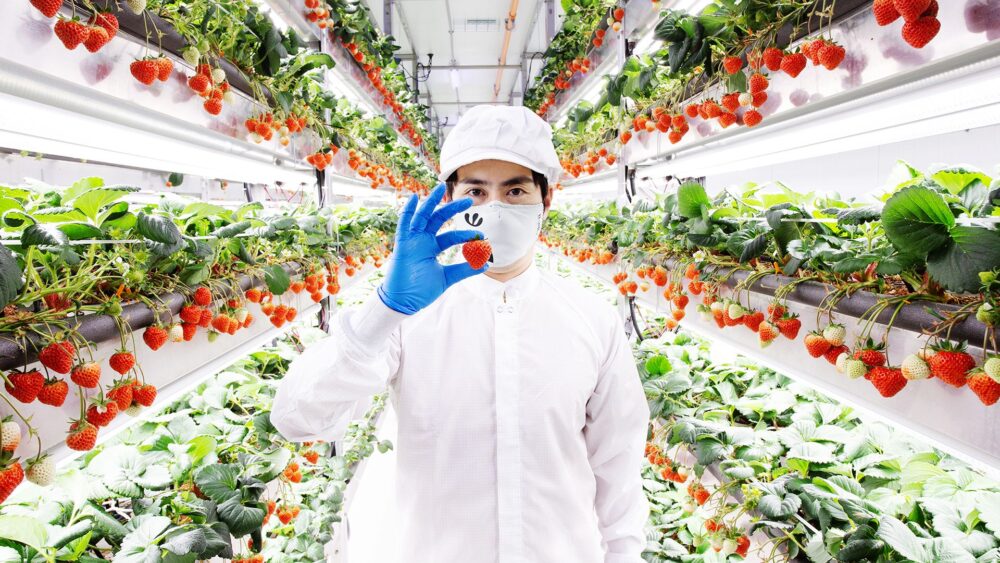
MD: We spent a lot of time in the vertical farming space and quickly realized that it’s very difficult to make money producing leafy greens and aromatic herbs. If you’re paying $2 for a lettuce, you need to sell a whole bunch of lettuces [to ensure a return]. But [portfolio company] Oishii inverted the model.
It’s really hard to produce a strawberry in a vertical farming environment 24:7, 12 months of the year because it’s a flowering crop, so this is the first part of the company’s moat. Their first strawberries were quite expensive, but now we’ve got really good prices after developing technologies around production in a very interesting low capex way. Instead of using fancy robotics, they are using gravity as a tool.
They are also producing a very premium product with real taste differentiation. The fact they were able to raise quite a lot of money in an industry which is being hit pretty hard speaks volumes for the team and for the technology.
AFN: How do you judge firms using AI in your space?
MD: The questions is what is the moat around AI? Take Nuritas. It’s a peptide company but you could also say it’s an AI company. What it really builds on are the billions and billions of tests and data it has been able to produce around peptides. Then you have peptides that have good efficacy, and then you back that with rigorous clinical studies. You start building layers of defensibility.
[Ag robotics firm] Ecorobotix is also an AI company as the robot needs to distinguish between the crop and the weeds and the only way to do that is through years of training in different countries, climates, and environments during the night and during the day. That is the moat.
AFN: What’s a red flag for you when you’re doing due diligence on a company?
MD: Whenever we do diligence at a company, the first thing we do is go to the car park. If we see any flashy cars, that’s the first red flag. Then we talk to the founders. The more frugal, the better. If they start talking about expensive skiing holidays… that’s another red flag! In an environment where cash is very tight, you really need to look at every angle and make sure that the money being raised is being spent wisely.
AFN: What do you look for in founders and companies more generally?
MD: We like companies that have multiple layers of defensibility. That’s really important because you’re giving somebody money for about 10 years and you’re investing in a very risky asset class.
The other piece where we spend a lot of time is around the team and team dynamics. We do external diligence checks, external HR, 360s on our founders. We normally engage an external firm to evaluate the leadership in the team and we share this information with the founding team as well, so it actually it helps them a lot, because you’re investing in a person, you’re investing in a team. You’re giving them money for 10 years so it’s really, really important to understand who you are investing in.
Then you need a credible path towards profitability, and companies that are solving real problems, not just launching a nice product.
AFN: How often do you pass on an opportunity because of the team?
MD: This happens all the time. The quality of the founder and CEO is really important, but also the second layer of management.
AFN: If unicorns are not so likely in food and ag, what are more realistic return expectations that still fit a VC model and make sense for LPs?
MD: You need to offer at least a 5x return, which depending on how many years [you hold the investment], translates to double-digit IRR [over a typical 7–10-year VC investment horizon]. I think that is still achievable in food and agri-tech.
Further reading:
Beware ‘pilots to nowhere’: Aleph Eins Capital on avoiding corporate agtech traps
🎥 Where are foodtech investors looking next after the boom and bust?
🎥 What is agrihealth—and can it become an investable category? The First Thirty makes the case