A new player offering US-made ag spray drones is entering the market.
Exedy Drones—one of a series of players attempting to build a US drone capability following the FCC’s bombshell decision to ban sales of new models of foreign made drones in the US—has opened reservations for its Ayre CX model. The first deliveries are targeted for spring 2027.
“A reservation holds a numbered place in the production line through one of our authorized dealers,” says the firm, which is based in Michigan and owned by EXEDY Globalparts Corporation, part of EXEDY Corp, a Japanese manufacturer of automotive drivetrain components.
Exedy is taking $1,000 reservations for the first 500 aircraft, with $750 refundable until customers convert to a purchase deposit, Scott Binder, VP engineering, operations, and technology, told AgFunderNews.
“We’re not putting a delivery date on it, which you can read more about on the website. The aircraft moves forward as it passes a series of milestones, from field validation to spray validation to a production build, and we’ll publish each one as it’s met so customers can follow along. Customers see the results before they convert to a purchase.”
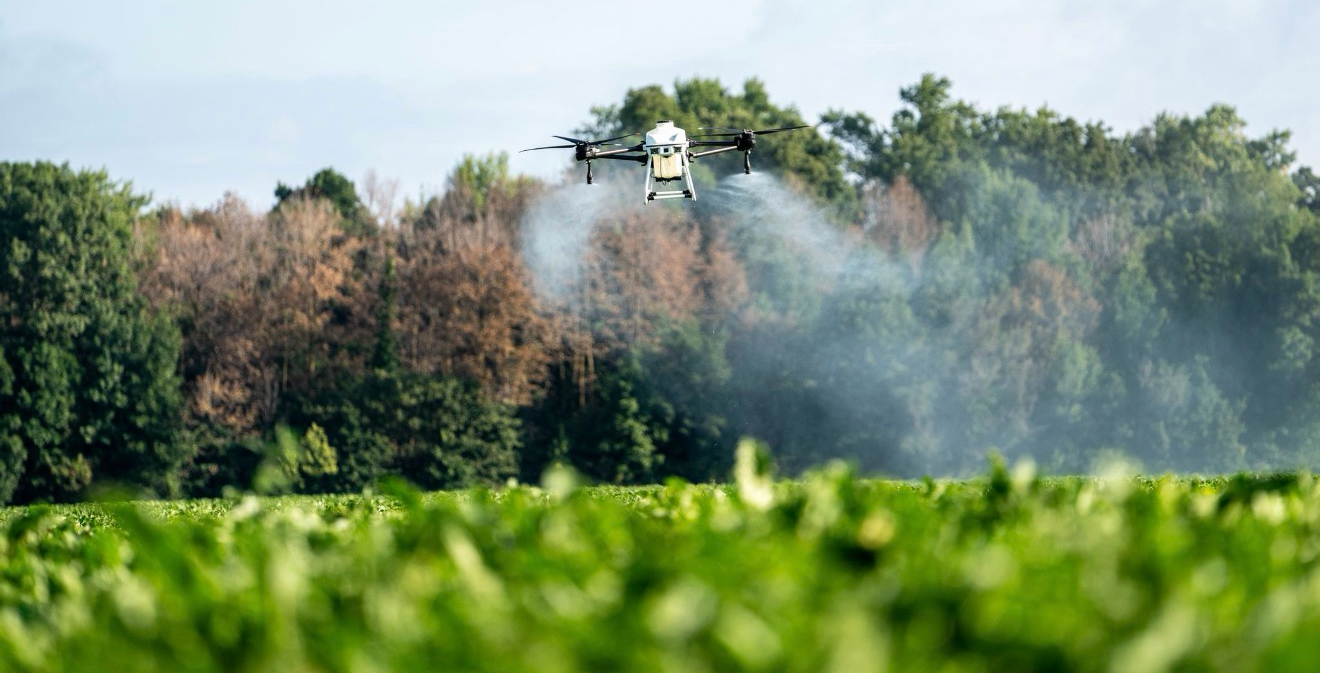
The Ayre CX aircraft, which has a 50-liter tank, utilizes locally and globally sourced components, with software coded in the US and data on US servers. It is assembled on a production line in Southeast Michigan, said Binder. “For the first phase, we’re bringing on about 20 dealer groups from roughly 30 locations. The network will grow with production, not ahead of it.”

The road to a 100% US-made drone
The announcement comes at a challenging time for the US drone market as manufacturers, dealers, drone operators and farmers attempt to navigate the rapidly evolving landscape.
The FCC ban announced in December 2025 applies to new models of foreign-made drones and critical components, such that firms are still permitted to import foreign-made products that have already been approved. The FCC has also granted a series of exemptions for new equipment from several overseas firms following national-security reviews by the Department of War.
However, there is still a lot of confusion, said Binder. “There is definitely a lot of uncertainty. Spray drones went from a novelty to essential equipment very quickly, and many operators built their businesses on aircraft whose supply they don’t control. Downtime is the most expensive thing on the farm. For an operator covering 250 acres a day at, say, $15 an acre, a week on the ground waiting on a part could be roughly $26,000 in lost work.”
According to Binder, drone users want three things. “Reliability: an aircraft supported by people they can reach, with parts that show up when needed. Accessibility: an aircraft and parts they can actually get. Compliance: an aircraft that’s cleared to be sold and flown here, so they aren’t buying a question mark.”
Right now, although the bulk of the parts to make its drones are sourced from the US, Exedy still sources some parts from overseas, he said.
“On what’s allowed, we wanted a clear answer for our customers. The Ayre CX received FCC Conditional Approval in July (DA 26-768), which means all components can be imported, sold and operated in the US. But there’s a lot of confusion between that approval and NDAA [National Defense Authorization Act] compliance; they’re two different things.”
Conditional approval is granted after a Department of War review of the aircraft, its bill of materials and its supply chain, and it covers the critical components on the aircraft, he explained. NDAA rules, in turn, govern what federal agencies, and projects paid for with federal money, can buy.
‘Our goal is that our initial release has as much US content in it as possible’
Exedy has recently increased its US content “by a large percentage,” said Binder. “This puts us ahead of the onshoring schedule we initially communicated to the FCC.
“Our goal is that our initial release has as much US content in it as possible. This includes 100% US based software in terms of both the flight controller firmware and the GCS. On cost, it’s a real challenge, and an American drone will cost more up front. But we’d rather have that conversation on return on investment than on sticker price, because downtime is what really costs operators.”
“The US still leads in innovation. What’s missing is manufacturing scale, and clear policy is what justifies building it here.”
He did not share numbers but said: “We’re careful not to price the aircraft out of reach. We’d rather be honest about where we are today and improve step by step than promise something we can’t deliver.”
‘There’s no one size fits all spray drone’
According to Binder: “There’s really no one size fits all spray drone. Smaller aircraft fit spot treatments, edges, tight obstacle-heavy fields and specific use cases. Large aircraft are built to cover big, open blocks in short windows. In between is the mid-size class, which handles a mix of field sizes over a season with lighter support. That’s where many operations land, and it’s where the Ayre CX sits. Its 13 gallon [50-L] tank puts it right in line with the other mid-size spray drones on the market today. As for future plans, we are actively developing both larger and smaller payload options.”
Spray drones have become “essential equipment for American agriculture in a very short time,” added Binder. “But the supply behind them can change overnight, from policy decisions here or from export decisions overseas, and the operators who depend on those aircraft have very little control over it.
“We think US agriculture needs a spray drone that’s engineered, built and supported here, by a company that will still be standing behind it years from now. That’s what Exedy Drones is building in Michigan.”
Navigating a market in flux
The US ag spray drone market is “very much in flux” following the FCC’s recent crackdown, according to the American Spray Drone Coalition (ASDC)
The challenge has been compounded by a recent FCC proposal to crack down on foreign-made “military grade” drones that could effectively ban sales of existing foreign-made models from top Chinese players such as DJI that have already been approved.
The changes follow a turbulent couple of years in a market that has already been roiled by import restrictions on shipments from DJI that have been periodically blocked by US Customs and Border Protection (CBP) on the grounds that DJI may be using forced labor. DJI says these claims are “categorically false.”
While other Chinese companies such as XAG, EAVision and Talos were able to pick up some of DJI’s slack, and US firms are beginning to build domestic manufacturing operations alone or in partnership with overseas firms, demand still exceeds supply, ASDC president Eric Ringer told AgFunderNews.
Largely thanks to CBP’s interventions with DJI shipments, sales of new spray drones in the US fell by 60% in 2025, he said. “We went from 8,950 spray drones sold in 2024 to 3,711 in 2025. That was not because of a lack of demand. That was because of a lack of supply.”
Further reading:
US spray drone market “very much in flux” as firms attempt to navigate evolving landscape, says ASDC
New FCC proposal could ‘retroactively ban’ some existing ag spray drones, warns DJI
USA Drone Motors emerges from stealth to target gap in domestic drone supply chain
DJI: FCC action could wipe out $1.5bn in US drone sales in 2026