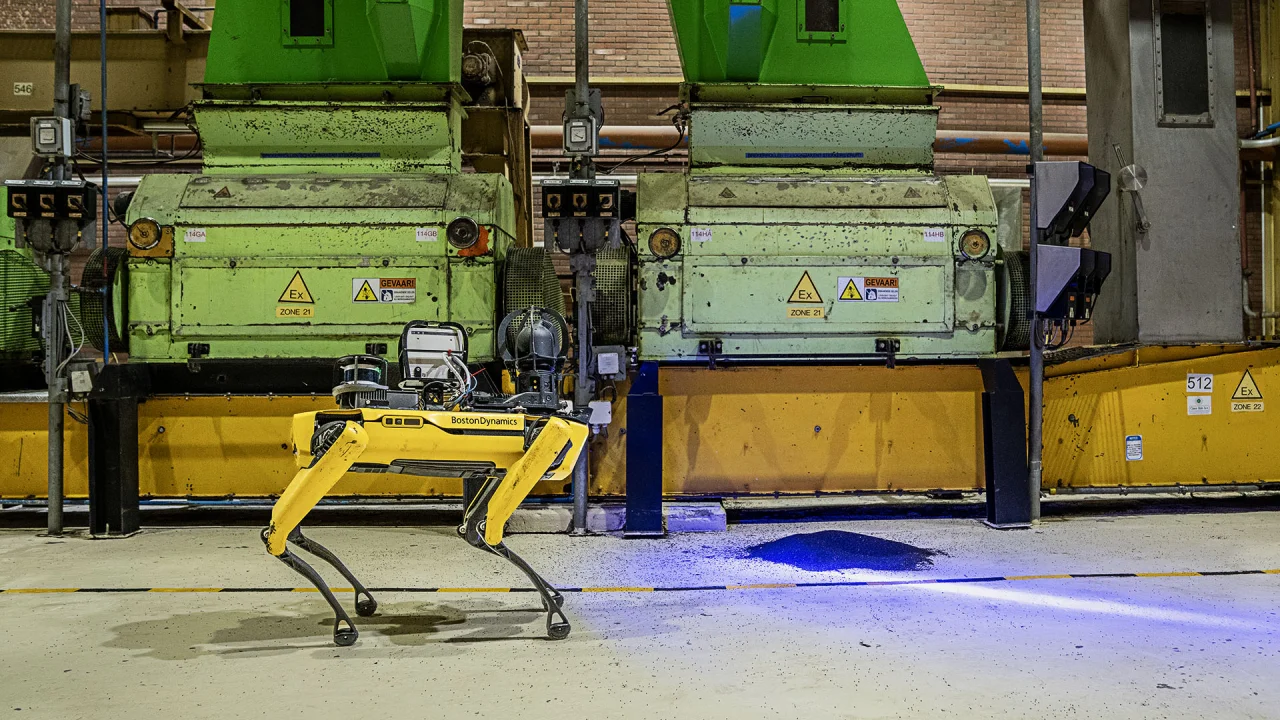
Last month, agribusiness giant Cargill introduced a four-legged robot named Spot to its crush and refinery plant in Amsterdam.
Developed by robotics company Boston Dynamics, Spot is already known around manufacturing, construction, and public safety circles, where it can do everything from site surveying to inspecting suspicious packages.
In an agribusiness setting such as a crush facility, Spot is “an extra set of eyes and ears” that can inspect operations and catch potential hazards (like equipment overheating) before they become actual dangers, says Chris Kassios, smart manufacturing process lead at Cargill.
“Ultimately, this is as much about people as it is about technology. By automating repetitive inspections, we’re helping employees gain new skills in robotics, programming, and data interpretation — shaping a workplace that’s both safer and more future-focused.”
Spot is also one step on a much larger evolution into an AI-centric business, according to Kassios. In an interview with AgFunderNews, he discussed the bigger-picture benefits of Spot as well as future AI/automation plans for the company.
AgFunderNews (AFN): How did this partnership with Boston Dynamics come about, and what motivated Cargill to explore this technology?
Chris Kassios (CK): At Cargill, we’re constantly looking for ways to apply emerging technologies that enhance safety, reliability, and operational excellence.
Our collaboration with Boston Dynamics is part of a broader strategy to responsibly integrate artificial intelligence and automation into our facilities where they can make a measurable difference.
The motivation was simple but powerful — we wanted to improve how we detect and respond to risks in real time, while freeing up our teams to focus on higher-value work. Spot helps us do that by acting as an extra set of eyes and ears in the plant, conducting autonomous inspections, collecting real-time data, and alerting operators before issues arise.
It’s about building the digital foundation for the next generation of manufacturing — one where people and technology work seamlessly together.
AFN: What are the biggest benefits Spot brings — both at the Amsterdam plant level and for Cargill globally?
CK: At our Amsterdam multi-seed crush and refinery plant, Spot performs around 10,000 autonomous inspections every week. It identifies issues like equipment overheating, leaks, or ventilation faults long before they become production or safety risks. That kind of predictive capability reduces downtime, improves safety, and gives our teams peace of mind.
For Cargill more broadly, Spot represents how AI can transform our operations — making them smarter, faster, and more resilient. Across our business, we’re already applying AI to optimize port logistics, food formulation, and even customer service.
The success of Spot connects directly to that vision: using data and digital tools to improve how we make and move food safely and efficiently.
Ultimately, this is as much about people as it is about technology. By automating repetitive inspections, we’re helping employees gain new skills in robotics, programming, and data interpretation — shaping a workplace that’s both safer and more future-focused.
AFN: Are there plans to expand Spot’s use to other Cargill facilities?
CK: Following successful testing and training at the Amsterdam site, we’re now assessing how this technology could scale across other European operations. Each facility has unique needs, so we’re evaluating where autonomous inspection can add the greatest value.
Any future rollouts will follow Cargill’s Responsible AI principles — ensuring that automation supports our employees and enhances safety, not just efficiency. As we scale, we’re also focused on upskilling our teams to manage and interpret AI-driven insights effectively.
We see this as the start of a broader digital transformation journey. Robotics and AI are helping us build manufacturing systems that are not only more efficient, but also more resilient, sustainable, and human-centric.
AFN: How does this fit into Cargill’s wider use of AI and digital innovation?
CK: Spot is one part of a much larger shift at Cargill. We’re using AI across multiple parts of the business — from inventory and logistics planning to ingredient formulation and customer insights. Our goal is to use AI to enhance productivity and innovation while improving safety and sustainability across the food system.
We’ve established strong governance through our Responsible AI Program to ensure that every use of AI aligns with our values and long-term mission to nourish the world safely, responsibly, and sustainably.
Spot brings that commitment to life on the factory floor. It’s a tangible example of how we’re leveraging technology to empower people, strengthen operations, and lead the next wave of food industry innovation.