

Japanese agtech startup Culta is looking to take its AI-powered breeding and branded produce model global, with talks under way in Australia, the US and Europe as it targets ¥30 billion ($195 million) in revenues by 2032.
If successful, the expansion could show whether its AI-enabled approach can support not just faster variety development, but a scalable consumer produce business spanning multiple markets.
Founded in 2017 by Shuhei Noaki, Culta develops proprietary fruit varieties that are grown by 36 contract growers under license with agronomic support from Culta. It then buys back 100% of the crop and sells the branded fruit to customers in Japan and Southeast Asia, says Noaki.
“We’re applying the kind of vertically integrated business models developed by Zespri and Discroll’s.”
Culta deploys AI and machine learning to analyze correlations between genomic data and phenotypic data on the physical characteristics of crops to find the most promising parents for crossing. This dramatically accelerates breeding without gene editing or genetic modification.
While mining genomic and phenotypic data to speed up breeding is not new, Culta combines this data-based approach with rapid breeding cycles in controlled indoor environments, allowing it to run three strawberry breeding cycles a year compared with one under conventional outdoor conditions in Japan.
Through its vertically integrated model working with third-party growers, Culta also collects cultivation data from diverse growing environments that feed into its proprietary variety database. This creates a data set “that is extremely difficult to replicate,” claims Noaki.
The net result is crop breeding cycles “at least five times faster” than conventional methods, reducing strawberry variety development from the typical 10 years to two years, claims the firm.
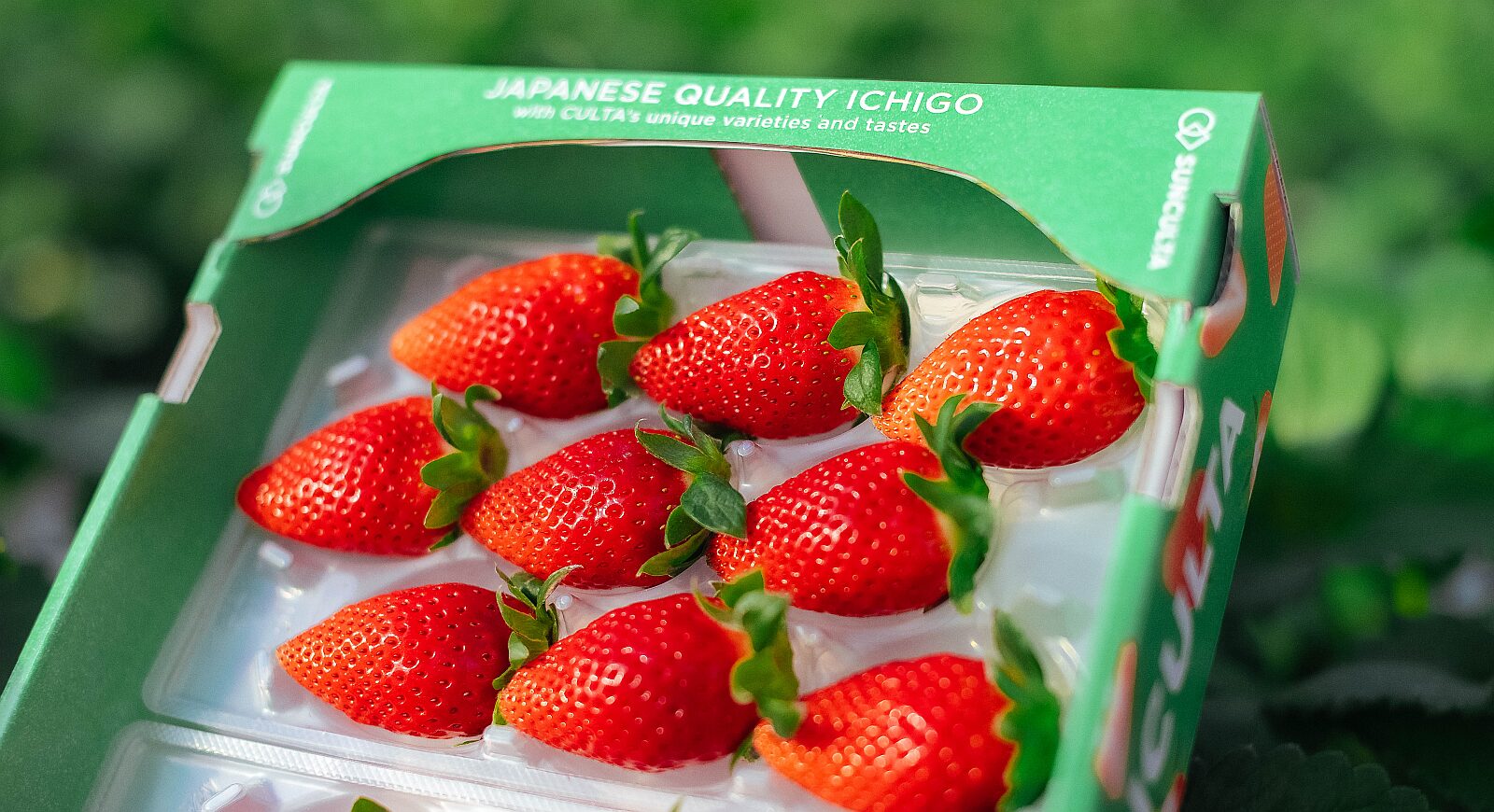
Firmer, sweeter, higher-yielding fruit
Strawberries were an obvious target for its approach, says Noaki, noting that Japanese strawberries are prized for sweetness and eating quality, but have been threatened by climate change in recent years as hotter spring weather has reduced the length of the season.
Japan used to be able to ship strawberries from December to June but now struggles to sell beyond April, he says. Culta’s debut variety SAKURA DROPS can withstand the heat of early spring and can be shipped until June, with yields 1.4 times higher and Brix (sugar content) 1.3x higher than leading Japanese cultivar Benihoppe.
The fruit is also 1.4x firmer, extending shelf-life and allowing fully ripened strawberries to be harvested and transported while maintaining quality for over 10 days. The brand sells in high-end retailers in Singapore and Malaysia for S$20 ($16) per pack.
Additional varieties recently commercialized by Culta include white strawberries with improved sweetness, yield, and disease resistance aimed at China and Southeast Asia. White fruits are popular in the premium gift market there, but have historically lagged red varieties on taste and performance, says Noaki.
“The buyers at supermarkets in Southeast Asian countries say these are the best-tasting white strawberries in the world, so the taste is very distinctive.”

Apples, grapes—and eventually coffee and cacao
Culta began breeding table grapes and apples last year and aims to launch varieties in both crops by 2030, with programs on coffee and cacao also in the pipeline.
In Japanese table grapes, increasingly hot summers are interfering with fruit coloration, while apple production is becoming more challenging even in northern Japan, says Noaki.
“The amount of supply is decreasing because of climate change.”
While fruit trees present challenges for Culta’s speed-breeding approach, the company is experimenting with growing them indoors as part of efforts to compress breeding cycles, he says.
It is also four years into a breeding collaboration with Kirin on heat-tolerant hops, crops that have not traditionally been grown indoors, says Noaki.
“We achieved the flowering in two years. After that we started the crossing.”
Why conventional breeding rather than gene editing?
Although Culta has biotechnology expertise in-house, the traits it is targeting are often poorly suited to gene-editing approaches, says Noaki.
Yield and Brix, for example, are influenced by large numbers of genes rather than a single genetic target, while strawberries are octoploid, adding further complexity.
“This makes them difficult to edit.”
What’s next?
The next test for the firm—which closed a 700 million yen ($4.5 million) pre-series A round in April—will be whether a breeding and branded-produce model developed in Asia can translate into markets in the US and Europe, says Noaki.
“We are planning to start strawberry production in Australia to increase the apply to the Asian market, and also we are looking for the opportunity to start the production in the US and Europe because they have a huge strawberry market, but the taste is totally different compared with [prized, sweet-tasting] Japanese strawberries.”
Further reading:
🎥 Digital twins: Heritable Ag combines AI, genomics and environmental data to slash R&D timelines
Amatera raises $7m to accelerate climate smart crop development by tackling screening bottleneck
🎥 Can editing the ‘dark genome’ make crops more heat tolerant?