[Disclosure: AgFunderNews’ parent company AgFunder is an investor in Plantik Biosciences.]
Can editing the so-called “dark genome” help crops cope with extreme heat?
Rather than altering protein-coding genes, French startup Plantik Biosciences targets the noncoding regulatory elements that determine when, where and how strongly genes are activated in response to environmental stresses.
The idea is to make precise changes to tiny stretches of regulatory DNA so plants can mount a stronger response to heat, drought or disease without permanently activating stress-response pathways that may carry a yield or growth penalty.
Plantik is combining machine learning with multi-omic data to identify these regulatory switches, initially in tomatoes, corn and soybeans. It plans to develop traits in-house and license them to seed companies, while generating near-term revenues through service projects.
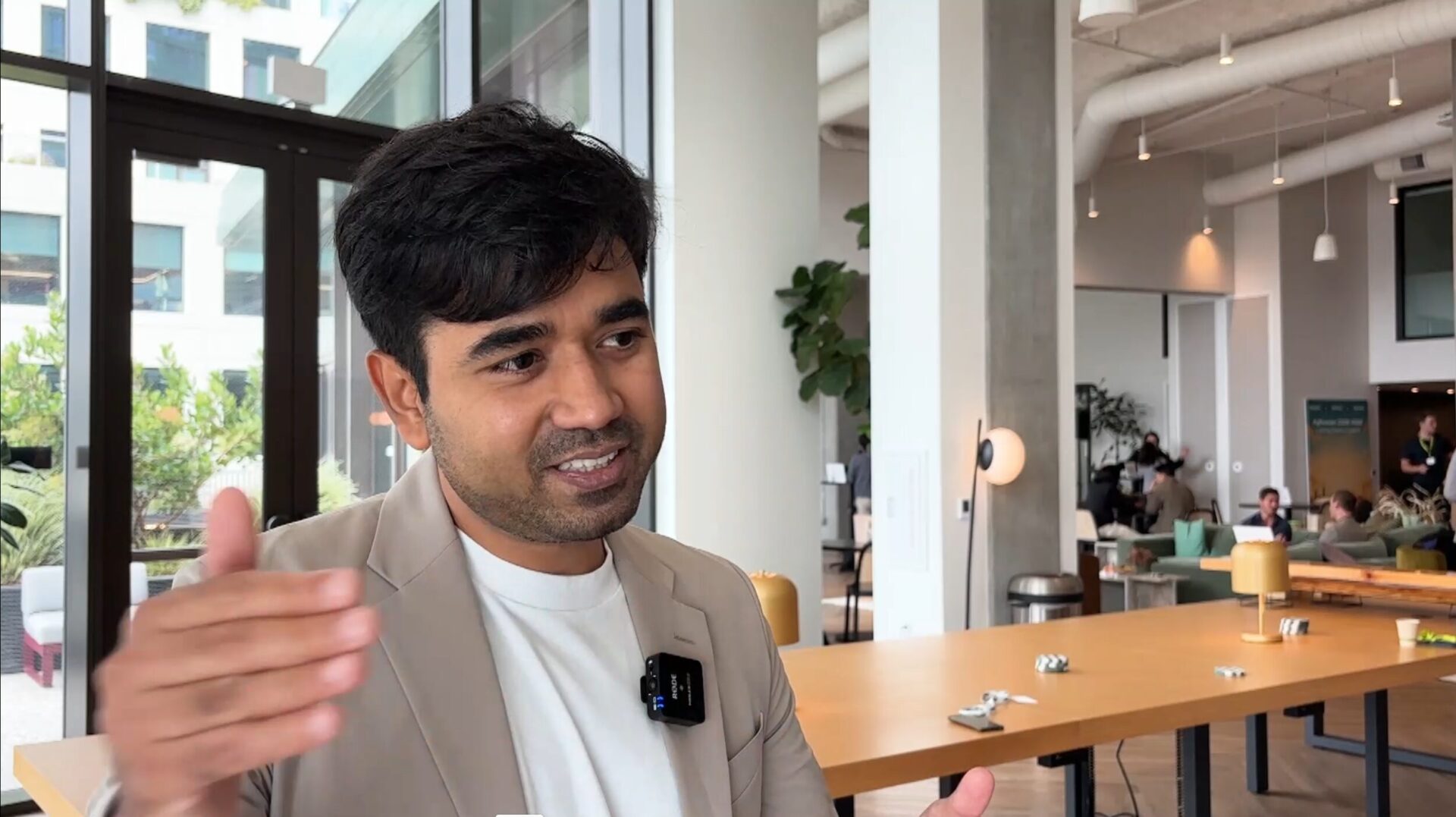
AgFunderNews (AFN) caught up with cofounder Aditya Nayak (AN) at the AgFunder AGM last month to discuss Plantik’s approach to precision gene editing and how shifting regulations could accelerate adoption.
AFN: What is the dark genome and why is it important for traits such as heat tolerance?
AN: Heat tolerance is a very complex trait, and what people have tried doing before is focusing on one gene. There’s this family of heat shock proteins, and people would just put multiple copies of these [heat shock protein genes] inside [the genome of a plant].
But a major issue, which no one has considered till now, is like you put it in, it’s basically switched on forever, right? It doesn’t matter whether the [heat] stress is there or not, and that has been the biggest problem for all these heat resilience genes that were out there [as continuous expression may impose a growth or energy penalty on the plant].
And that’s what we’re trying to solve by looking at the dark genome [to identify the regulatory DNA that controls when, where, and how strongly heat-response genes switch on—potentially improving heat tolerance without keeping those genes permanently active].
So let me give you a fact: only a small percentage of the genome is a coding region. The rest is dark genome regions. At Plantik, we use a little bit of machine learning, where we look into multi-omics datasets, so, for example, genomics, transcriptomics, things that are linked to the opening and closing of chromatin [the structure that organizes DNA and helps control gene activity], using ATAC-seq [a method for mapping accessible regions of the genome].
We also have our own proprietary algorithm that then gives us the precise dark genome elements that can be fine-tuned to create new traits.
For example, for heat-resilient traits, we have come up with some of these switches [regulatory elements], which can be switched off, which gives you a more climate-resilient tomato, for example. But the gene is only switched off when temperature goes up; the rest of the time it’s still functional. It still does whatever it needs to do as long as the temperature doesn’t go up, and that’s the major difference between what we are doing and what was the status quo until now.
AFN: How does your approach compare to what Rainbow Crops is doing?
AN: We do something that is fundamentally different. By that I mean most people are looking at these gene regulatory networks. They’re trying to change some of these main factors, or “hub” factors, as they’re called, which have multiple effects downstream. You can play around with those, make some small changes. We are looking at those gene regulatory networks, but from a very different perspective. We are looking at where do these transcription factors [proteins that bind to DNA and regulate gene activity] go and bind, and just changing those few base pairs.
The changes we make are six to eight base pairs, really small, and that has a much more targeted effect compared to fine-tuning the whole network.
And that’s why we need multimodal data sets. That’s why a lot of data that we use is around ChIP-seq [a technique for mapping where proteins bind to DNA] and protein binding microarrays [tools used to identify the DNA sequences that particular proteins bind to]. And that gives us an idea of, for example, transcription factors that are activated under warm conditions. Where are they going and binding?
And with this kind of knowledge, we are able to discover these exact sequences that then have an effect. And then we use machine learning for understanding all of this and applying it to plants where such kind of datasets do not exist.
And that enables us to massively scale the platform to quickly discover new [traits or targets in plants] for which all the datasets are not yet available.
AFN: What crops are you focusing on?
AN: We have most of our datasets built on tomato, corn, soybean, the major crops. But we have also looked at a dataset in quinoa, and were able to pinpoint mutations that lead to quinoa plants that are more tolerant towards salt stress. The platform was able to pick these small nuances out of [sequences associated with] genes in the non-coding regions or dark genome elements and tell us why some of these changes lead to a better salt-tolerant quinoa plant.
And for that we didn’t have a lot of these multi-omics data sets. We just had the sequencing data set, which today you can create for any new plant at a cost of $100 or $200, and that’s the bare minimum that’s required to get started to use our platform for discovering new traits.
AFN: What is your business model?
AN: Our business model right now is mainly around being a tech platform. So we know what our major focus traits will be for the next 5-10 years. We are working on creating those traits in-house, and then we will license them out to bigger seed companies to put them in the crops.
AFN: So you license the traits?
AN: Yes, so we would license traits out. But in future, we see ourselves becoming more of a product company. So, for example, we have quite some interest from wine growers, chocolate [cocoa] growers, berry growers. The idea would be to work with them to co-create new plants, which then go onto the field, and we can collect revenues on products that end up in the market.
So that’s our long-term vision. To help us reach that vision, initially we are generating small revenues from service projects, but also licensing some of our technology out to bigger seed companies.
AFN: How do regulators view your tech?
AN: In the US and in a bunch of other geographies around the world, these [gene edited] plants are considered as plants that are the same as those that could be created through standard breeding. So that way, it’s not regulated as GMO. And even in the gene editing space, we fall into the category of NGT-1 [New Genomic Techniques -1, the EU’s proposed lower-risk category for certain gene-edited plants].
Currently it takes around one and a half months for every new plant that we create to get a regulatory approval in the US [USDA confirmation that the plant is exempt from its biotechnology regulations] and then those plants can go straight to field testing.
And last week, the European Union said it was going to build the same system as we have here in US [the EU recently adopted a streamlined regulatory framework for certain gene-edited crops, which will apply from July 2028].
In two years’ time, we will have the same regulatory clearance timeline as we have here in the US. So two years from now, the new plants that we create, they would get regulatory approval [in the EU] in a time frame of a month or two, and that’s going to be the case all around the world: India, Japan, and a bunch of other countries.
AFN: What are the biggest challenges that you face as a business?
AN: I think until now it has really been about funding. For this current round, we have been raising for the last 16 months, and that’s quite a long time. Every hour we spend on fundraising, we are not able to focus on building the technology itself.
But I think all of that also had to do with a lot of regulatory red tape back in Europe, where we have our main operations. With that red tape now opening up [now that the European Parliament has adopted new rules on crops developed via New Genomic Techniques], I think funding-wise, it’s going to go faster.
Confidence in firms using these new technologies is also going to go up, and we are already starting to see that in terms of more inbound requests from bigger seed companies to try our platform out.