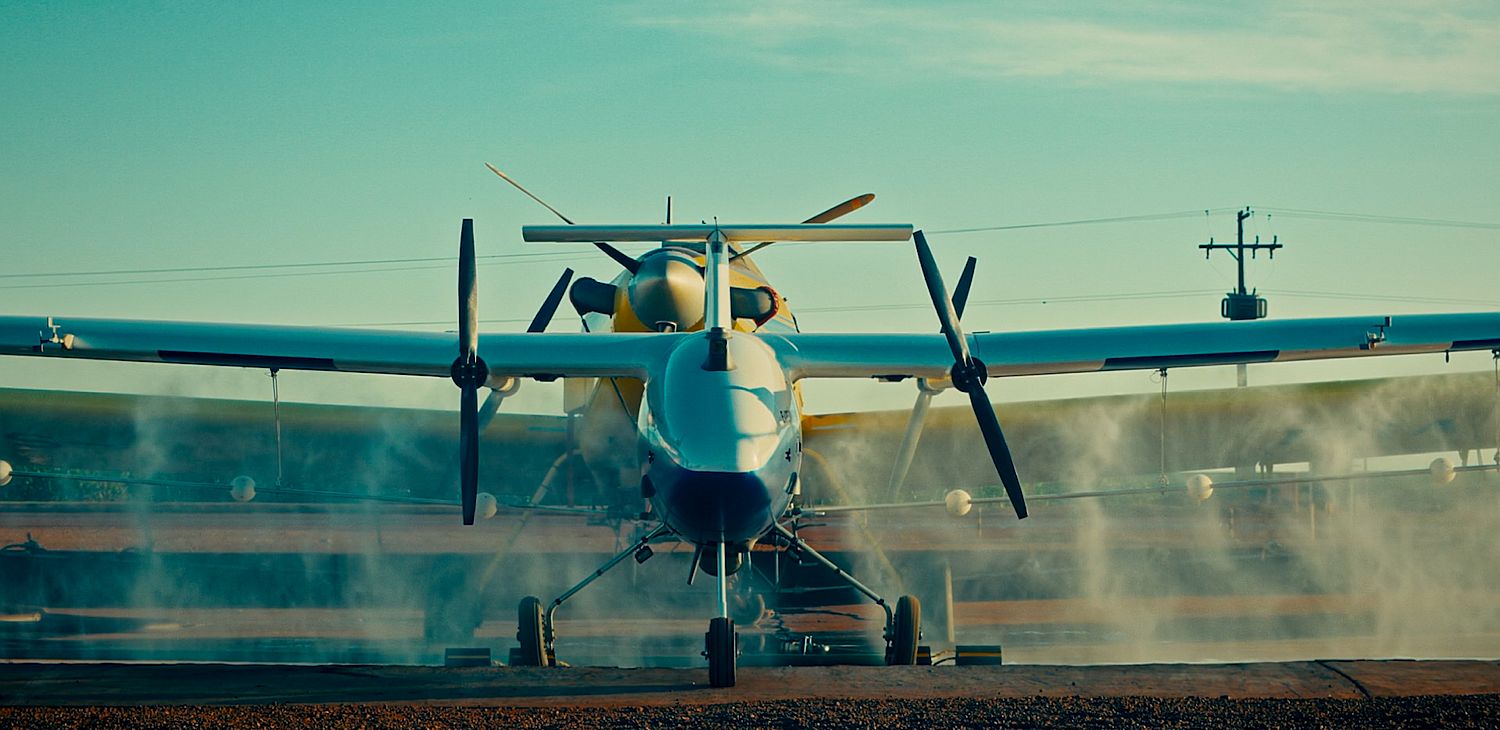
- California-based robotics co Pyka has struck a deal with ag giant SLC Agrícola to supply its Pelican 2 autonomous crop spraying aircraft across multiple farms in Brazil.
- A leading Brazilian agribusiness producing soybeans, corn, cotton, and cattle, SLC Agricola tested the Pelican 2 in the last growing season after Pyka taught two employees how to operate the aircraft.
- SLC is now expanding its fleet to “continue driving innovation and productivity across our operations,” says the firm.
Why it matters
Smaller crop spraying drones are gaining traction in small plots, hilly orchards, difficult-to-reach areas, and soggy ground that makes boom spraying challenging, Pyka cofounder and CEO Michael Norcia told AgFunderNews.
However, growers are looking for alternatives to boom sprayers or manned crop-dusting aircraft that are used in broadacre crops such as soybeans, corn and wheat in large farming operations, he claimed.
“We compete with piloted aircraft and boom sprayers, and we are very competitive with these on price and performance,” said Norcia, who founded Pyka in 2016 and has raised just over $80 million to develop the tech. “But the ability to spray at night is probably the single largest value proposition for customers, at least in Brazil.
“And I think this is true pretty much anywhere, as a significant chunk of pesticides work better at night due to environmental conditions being favorable in terms of lower wind and less chance of evaporation. Plus the bugs you’re trying to kill are often more active at night.”
He added: “Biologic pesticides, which are very popular in Brazil, can also die when it gets too hot out, so they have to be sprayed at night. We have some customers in Brazil whose sole interest is spraying biologics.”
More generally, he said, “Our total cost of application is lower than a piloted aircraft, and quite similar to a boom sprayer, but lower on the whole when you account for the few percent of crop yield loss due to running a boom sprayer through a field over and over again.”
A mid-sized Air Tractor (piloted crop duster) is up to 2.5x more productive than Pelican 2, but costs three times as much ($1.5 million vs $500k) and is 10 times more expensive to operate, he claimed.
“Our partnership with Pyka has exceeded expectations. Pelican 2 proved its ability to deliver reliable crop protection on a nightly basis in demanding field conditions. Based on the results we’ve seen this season, we are expanding our fleet to continue driving innovation and productivity across our operations.” Ronei Sandri Sana.

‘There’s literally no other company doing what we’re doing’
With its 300-liter payload, fully autonomous flight capability, and work rate of up to 100 hectares per hour, Pelican 2 is the largest autonomous agricultural aircraft in the world and the only UAS of its kind authorized for commercial operation at this scale, claimed Norcia.
“There’s literally no other company doing what we’re doing because it’s really, really hard. We’ve had to develop most of the aircraft ourselves, and the entire autonomy stack is ours. Every line of code is ours. We do sophisticated things using LiDAR and radar to map obstacles in real time and avoid them, which are problems that [Chinese drone companies] XAG and DJI have not solved.
“The obstacle avoidance functionality on these drones doesn’t work past 20-ish miles an hour, and we’re flying three to four meters above the crops at 80 miles an hour. That’s a hard problem and one we’ve spent years solving. A huge amount of engineering work has also gone into the spray system.”
Target markets: Brazil, Central America, and the US
In the US, farmers typically buy aerial application as a service, whereas in Latin America, it’s more common for large growers or ag companies to buy airplanes and hire pilots, said Norcia. “The US is a little bit behind Brazil in terms of commercial rollout, but we are going after the same sort of customer type, large growers.”
Pyka currently works with a network of contract manufacturers to source parts and conducts final assembly of its aircraft in Alameda, California, he said.
“We’ll close out this year having delivered seven Pelican 2 aircraft, and our target is to deliver an additional 30 by the end of 2026. We have orders out into 2027 and 2028. If we had 10 more airplanes in our facility right now, we would sell all 10.”
For the next couple of years, the main focus is on Brazil, countries in Central America that grow bananas, and the US, he said.
“As we look to the end of the decade, our targets are about two thirds of the revenue from ag, one third from cargo and adjacent businesses.”
As for the recent FCC restrictions on new foreign-made drone models and critical components, he said, “”With our aircraft production almost entirely based in the US, Pyka is well positioned under the FCC’s new rules. And we’ll be expanding our product lineup in the near term to serve more US farmers across more crops, regions, and operating conditions.”
Further reading:
Made in America: FCC decision sparks scramble to localize ag spray drone production
Ag spray drone leader DJI faces uncertain future in US; sector braces for realignment
Faster, further, longer: Can SiFly upend the ag spray drone market?